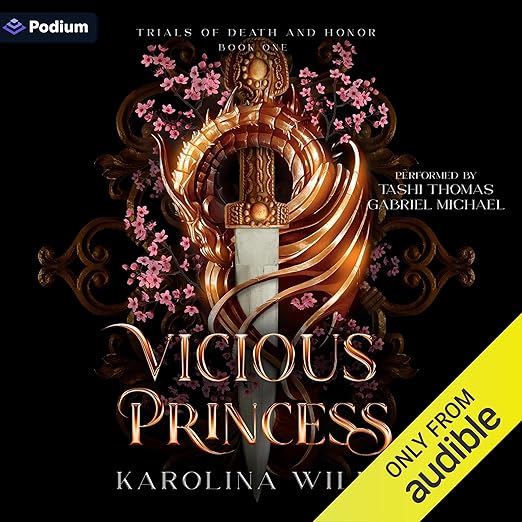
Quick Take
- Narration: Tashi Thomas handles Phoenix’s first-person urgency with energy that suits the academy combat setting, keeping pace with Wilde’s propulsive storytelling.
- Themes: Vengeance as motivation versus belonging as discovery, human in a fae world, forbidden authority
- Mood: Fast, blood-stained, and hungry – the kind of book that pulls listeners through at pace
- Verdict: A solid series opener for readers who want Fourth Wing academy energy with a revenge backstory that gives the protagonist sharper definition.
I finished the first quarter of Vicious Princess on a Thursday evening and immediately wanted to know how Phoenix’s first day of Ezkai Academy training went. That is the correct early response to Karolina Wilde’s series opener, and it is largely what the book sets out to accomplish: establishing Phoenix as a protagonist whose urgency is contagious, placing her in a training environment designed to eliminate her, and giving her a complication in the form of an instructor she already knows in a context that makes their history a problem. Tashi Thomas narrates with an energy that keeps up with Wilde’s pacing.
Phoenix arrives at the fae city with a body full of scars and two clear objectives. Join the Order of ancient soldiers. Gain the power to avenge her family’s murder at the hands of that same army’s predecessors. The dramatic irony Wilde builds into the setup is clean and effective: the institution Phoenix needs to penetrate is connected to the violence she is there to avenge. The hot mysterious soldier she spent one passionate night with before orientation is now her instructor, and he can see her ambition and wants to mentor her. Accepting means risking everything. Refusing means losing the advantage she cannot afford to lose.
Our Take on Vicious Princess
The Fourth Wing comparisons in Wilde’s own marketing are accurate and also the book’s most significant challenge. The academy-combat-romantasy format has become a crowded space since Rebecca Yarros’s series established its dominance, and readers who approach Vicious Princess looking for meaningful differentiation will find some and miss some. The human-among-fae angle is handled with more specificity than the generic ‘sole human in a fae institution’ formula – Phoenix’s body is specifically described as riddled with a thousand scars that serve as a reminder, which gives her physical presence a history rather than a mere attribute. Her revenge motivation is more clearly articulated than many protagonists in similar settings, and her desire for power is unambiguous rather than reluctant. Those distinctions matter.
Why Listen to Vicious Princess
Tashi Thomas’s narration suits the material’s pace. Phoenix is an energetic first-person narrator by nature – she wants things clearly, moves toward them quickly, and observes the world through a lens of tactical assessment developed by someone who has survived worse. Thomas captures that urgency without overselling it as aggression. The slow-burn romance between Phoenix and her instructor benefits from Thomas’s restraint in the early chapters, where the tension is productive precisely because it is not immediately resolved. Several reviewers called out the book as a cure for reading slumps, which is a specific endorsement of pace – this is audiobook listening for moments when you need a story to take you somewhere fast.
What to Watch For in Vicious Princess
The honest critical notes from readers center on two issues. First, the backstory for both Phoenix and her instructor remains vague in this first volume – reviewers who wanted deeper character history found it insufficiently supplied. This is partly a structural choice in a series opener, saving reveals for later volumes, but it does mean the emotional intimacy of the romance rests on present-tense chemistry more than accumulated personal understanding. Second, one reviewer noted that the relationship’s intensity and the degree to which Phoenix adjusts her priorities felt abrupt given how new the connection is. Both are legitimate observations about a book that prioritizes momentum over accumulation. Readers who can accept those trade-offs will find the academy sequences and the political texture of the fae world more than sufficient to sustain twelve hours.
Who Should Listen to Vicious Princess
Listeners who burned through Fourth Wing and Throne of Glass and want something in that territory with a revenge-driven human protagonist at its center will find Vicious Princess a satisfying new series to begin. Readers who have grown fatigued by the academy-combat-romantasy format generally will not find enough deviation here to convert them. Those who specifically want a female protagonist whose scars are history rather than decoration, and whose drive is explicitly vengeance rather than ambiguity, will respond to Phoenix’s particular energy. The series has continuation, so patience for an unresolved arc is required.
Frequently Asked Questions
How does Vicious Princess compare to Fourth Wing – same beats or genuinely different?
Wilde’s own marketing invokes Fourth Wing and Throne of Glass as comparisons, and the academy-combat structure is similar. The main distinguishing elements are Phoenix’s human status among fae, her explicit revenge motivation (her family was murdered by the very army she is joining), and the instructor-student dynamic that begins before orientation. The world’s mythology is distinctly Wilde’s own even if the structural scaffolding is familiar.
Is Tashi Thomas’s narration well-suited to Phoenix as a first-person narrator?
Thomas matches Phoenix’s urgency and tactical energy effectively. Reviewers who cited the book as pulling them out of reading slumps were responding partly to pacing that the narration supports. Character differentiation among the fae is less consistently flagged in reviews, which may be a factor for listeners who struggle to track large secondary casts without strong vocal distinctions.
Does the romance feel earned given Phoenix’s stated revenge goals, or does it overwhelm that arc?
This is the area where reader opinion divided most clearly. Some reviewers found the romantic priority shift abrupt given how new the connection is. Others found Phoenix’s dual motivation – power and attraction – believable. Wilde appears to be building both arcs across the series rather than resolving the tension in this first volume.
Is there a second book in The Trials of Death and Honor series already available?
Based on available metadata, this is book one of the series. Reviewers who finished it expressed eagerness for book two, suggesting the continuation is anticipated but publication details were not confirmed at time of this review.