- Narrator: Vanessa Johansson takes on a dual-register structure that demands real distinction between Lowen's voice and Verity's chilling manuscript.
- Subjects: psychological manipulation, grief, moral compromise
- Tone: Tense and twisted
- Bottom line: A propulsive, genuinely dark thriller for adult listeners who don't need every twist to be unprecedented.
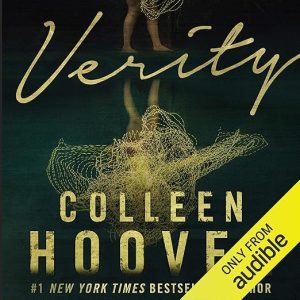
Lowen Ashleigh takes a ghostwriting job that no struggling writer could realistically turn down, finishing the remaining books in a bestselling series for an author who can no longer write them herself, and this audiobook spends eight hours and ten minutes turning that premise into something considerably darker than a rescue job. Colleen Hoover's Verity sends Lowen into the Crawford family home to sort through Verity Crawford's notes, only for her to find an unfinished autobiography Verity never meant anyone to read, full of admissions about the night that changed the family forever. The synopsis is direct about the content warning attached: graphic scenes and mature material recommended for listeners eighteen and older. The premise puts a financially desperate writer inside a grieving family's most private records, and everything that follows turns on how far she is willing to go once she realizes what she has found.
Johansson Splits Lowen's Voice From Verity's Manuscript
Vanessa Johansson narrates a book that lives entirely in the gap between what Lowen tells Jeremy and what Lowen actually knows, and that gap is the whole engine of the novel's tension. The manuscript sections, Verity's own voice on the page, need to read as a different register from Lowen's present-day narration for the structure to land the way Hoover built it, and a narrator who collapses that distinction would flatten one of the book's sharpest formal choices. None of the three attached reviews comment on the narration specifically, all three are focused on plot and pacing instead, so the performance itself has to be judged mostly on how well the format's dual-voice structure comes through.
Fabfamfive's review captures the book's most common reaction: picked up after sitting unread for over a year, finished in about twelve hours because, in her words, she could not put it down, despite not usually enjoying dense books. Rima Ayoub goes further, calling it an easy five-star read and singling out the suspense, the thriller elements, and the chilling mystery that kept her guessing the entire time, while acknowledging upfront that this is a title with famously mixed reviews across the wider reading public. Both reactions point at the same thing: this is a book built to be consumed in as few sittings as possible.
Hoover's broader reputation, built on a huge, devoted readership across contemporary romance and increasingly dark romantic suspense, sets real expectations for Verity specifically: this is the book most often cited as her pivot toward genuinely unsettling material, distinct from the more purely romantic tone of her other bestsellers. Listeners who know Hoover primarily from her lighter contemporary romance titles should be ready for a considerably colder, more menacing register here.
Lowen's Conflict of Interest Inside the Crawford House
A blurb from Mel Reader Reviews calls it 'a stand-alone romantic thriller that is tragic, creepy, and brilliant!' That three-word summary is doing real work: tragic covers the Crawford family's actual grief, creepy covers what Lowen finds in that manuscript, and brilliant is the claim the book has to earn on its own. Karla S's review is titled 'Gripping, but Not Groundbreaking' and offers a useful counterweight, noting the plot twists are good and effective without being phenomenal or shocking to a listener already well versed in the thriller genre.
What makes Verity distinct from a straightforward psychological thriller is the moral position it puts Lowen in: the more her feelings for Jeremy intensify, the more she has to gain from keeping Verity's manuscript hidden rather than exposing it, and the book asks a listener to sit with that conflict of interest rather than resolve it cleanly. Karla S's review also notes the pacing stays strong and holds attention throughout, which for an eight-hour listen matters as much as any individual twist, since a thriller that drags in its middle third loses the exact momentum this kind of premise depends on.
The Crawford family home itself functions almost like a character, all those years of Verity's notes and outlines sitting in a chaotic office Lowen has to physically sort through, and that setting choice keeps the book grounded in domestic space rather than the more exotic locations a typical thriller might reach for. Horror and suspense readers will recognize the pattern: danger hiding inside an ordinary family house is often more unsettling than danger arriving from outside it.
An Eighteen-and-Up Warning That Is Not Decorative
The eighteen-and-up content warning in the synopsis is not decorative. This book earns it through genuinely graphic material connected to Verity's own confessions, and listeners sensitive to content involving child endangerment or explicit sexual content should know that going in rather than discovering it mid-chapter. Fabfamfive's own review notes she does not usually enjoy dense books, which is a useful signal that Verity reads as more accessible than its subject matter might suggest, but accessible is not the same as light.
Karla S's 'Gripping, but Not Groundbreaking' framing is worth taking seriously for any listener who reads a lot of thrillers already: the twists work, but a well-read genre fan may see some of them coming before Lowen does. Rima Ayoub's review acknowledges the book carries a lot of mixed reactions across the wider audience, which tracks with a novel this widely read; strong word of mouth does not mean universal agreement on how well the ending lands, and it is worth going in aware of that split rather than expecting unanimous consensus.
The ghostwriting premise itself deserves a second look before starting: Lowen is hired specifically because Verity cannot finish her own series, and the book quietly asks what it means to inhabit another writer's voice well enough to fool readers, a question that runs underneath the more obvious mystery plot. Listeners who enjoy stories about authorship and creative identity, not just twisty domestic suspense, will find an extra layer of interest here beyond the central mystery.
Graphic Content Is the Real Audience Gatekeeper
Thriller readers who want psychological manipulation over jump scares, and anyone drawn to an unreliable-narrator structure where the person telling the story has an obvious motive to lie, are the clear audience here. Fabfamfive's twelve-hour binge and Rima Ayoub's five-star reaction both suggest this rewards a compressed listen over a stretched-out one, so blocking out a few long sessions rather than a chapter a night may be the better way to experience it.
Graphic content is the real gatekeeper here, not genre preference. Listeners who prefer suspense without it, or who read enough of the category to predict twists early, should moderate expectations against Karla S's less-enthusiastic assessment before starting. Anyone under eighteen, per the synopsis's own recommendation, or uncomfortable with dark material involving a child should skip this one regardless of how the central mystery is marketed.
How explicit is the Verity audiobook?
Explicit enough that the synopsis itself recommends it for listeners eighteen and older, citing graphic scenes and mature content connected to Verity's own confessions.
Is the Verity audiobook a standalone or part of a series?
It's a standalone romantic thriller, per the synopsis's own description, with no other Colleen Hoover book required as background.
Does the Verity audiobook distinguish Lowen's narration from Verity's manuscript voice?
The novel's structure depends on that distinction landing clearly, since Verity's confessional pages need to feel like a genuinely different register from Lowen's present-day story, though none of the attached reviews comment on the narration specifically.
Are the twists in the Verity audiobook predictable for experienced thriller listeners?
One reviewer, in a review titled 'Gripping, but Not Groundbreaking,' found the twists effective but not shocking to someone already well versed in the genre, while other reviewers called it impossible to put down.