Quick Take
- Narration: Leah Horowitz handles the dual perspective of the Townsend sisters with clear vocal differentiation, and her restraint during the fire sequences – not overselling the drama – is the right choice for material that doesn’t need help being intense.
- Themes: faith under crisis, the limits of what women could accomplish within institutional constraints, trauma and its long aftermath
- Mood: Urgent and emotionally weighty, with careful historical texture beneath the personal stakes
- Verdict: A strong opening to the Windy City Saga that earns its emotional resonance through historical specificity and characters whose suffering feels grounded rather than contrived.
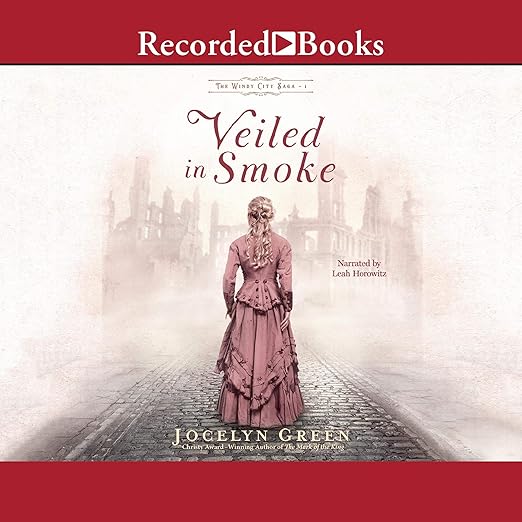
I tend to be skeptical of historical fiction that uses real disasters as backdrop for romance plots – the Great Fire of Chicago is a historical catastrophe that took lives and leveled an entire city’s business district, and it deserves treatment that respects that weight. Jocelyn Green earns that respect consistently throughout Veiled in Smoke. The fire is not a romantic backdrop; it’s an economic and psychological catastrophe that strips the Townsend family of nearly everything they’ve built and sets the conditions for every crisis that follows. The novel is harder than its genre label might suggest, and I mean that as a compliment.
The setup is efficient: Meg and Sylvie Townsend run their father Stephen’s bookshop in Chicago’s business district while also managing Stephen himself – a Civil War veteran whose experience as a prisoner of war left him with what we would now recognize as severe PTSD, though in 1871 it had no name and no treatment. The fire destroys the shop, separates the sisters from their father, and deposits them into the chaotic aftermath with nothing. When they’re reunited with Stephen, he’s soon accused of murdering a family friend in the chaos of the fire’s night. The Cook County Insane Asylum, where he’s committed pending trial, becomes the novel’s most haunting setting – a place where the treatment available was capable of destroying what it claimed to heal.
Our Take on Veiled in Smoke
The historical research is the novel’s most immediately impressive quality. One reviewer specifically calls out the phenomenal level of historical detail woven into the narrative – not just the fire itself but the rebuilding, the refugee crisis, the economic aftermath, the specific nature of PTSD treatment in the Civil War era. Green makes this material feel organic rather than displayed: the history is what’s happening to the characters, not color commentary on events they’re observing from a distance. The murder mystery at the plot’s center is workable if not particularly surprising – experienced mystery readers will likely identify the key information before the characters do – but it functions well as a structural device for keeping Meg in active forward motion through the novel’s second half. The romantic element between Meg and reporter Nate Pierce is handled with appropriate restraint for both the genre and the historical setting, developing through circumstances rather than contrivance.
Why Listen to Veiled in Smoke
Leah Horowitz’s narration is well-matched to the material’s tonal range. Green moves between the urgent physical action of the fire’s night, the grinding emotional labor of rebuilding a life with no resources, and the quieter interior moments where Meg’s faith is interrogated by circumstances that make conventional reassurance feel hollow. Horowitz handles these transitions without jarring shifts in register. Her performance during the scenes at the Cook County Insane Asylum – where Stephen’s deterioration is rendered in painful detail – is measured in a way that allows the material to be disturbing without becoming exploitative. At fourteen-plus hours, this is a substantial listen, and it rewards the investment.
What to Watch For in Veiled in Smoke
The novel’s Christian faith dimension is integral rather than incidental. This is published as Christian historical fiction, and the questions Meg and Sylvie work through – about God’s presence in catastrophe, about whether faith is sustainable under this kind of pressure – are genuine theological explorations rather than pro forma reassurance. Readers who prefer their historical fiction secular may find this element pervasive. It’s handled with more intellectual seriousness than the genre average, but it’s present throughout. The murder mystery itself resolves somewhat neatly, and one reviewer found the overall story slightly disappointing in execution despite the strong premise – a reaction that seems connected to expectations shaped by the fire’s dramatic opening rather than any fundamental weakness in what follows.
Who Should Listen to Veiled in Smoke
Readers of Christian historical fiction will find this among the better-executed entries in the genre – historically rigorous, emotionally authentic, and unwilling to resolve its hardest questions with easy answers. Historical fiction readers more broadly who are interested in the Great Chicago Fire and its aftermath will find the research woven in organically and worth their time. Those drawn to narratives about women navigating institutional constraints in the nineteenth century – the asylum subplot in particular is one of the more thoughtful treatments of its subject in genre fiction – will find this rewarding. Readers who prefer secular historical fiction or who find the faith element intrusive rather than thematically integrated should probably look elsewhere. And anyone considering starting the Windy City Saga should know that this is a strong opener that leaves enough unresolved to make the subsequent volumes feel necessary rather than merely optional.
Frequently Asked Questions
How central is the Christian faith element to Veiled in Smoke – can secular readers engage with it without the religious framing feeling alienating?
The faith dimension is genuinely woven throughout and is central to how Meg processes her circumstances. It’s handled with intellectual seriousness rather than as reassurance, but secular readers should expect it to be a consistent presence rather than a peripheral element. Whether that’s alienating depends on individual tolerance for religious themes in fiction.
Does the novel’s treatment of Stephen’s PTSD from Civil War imprisonment feel historically accurate or anachronistically modern in its framing?
Green is careful to frame Stephen’s condition within its historical context – there’s no name for it, no accepted treatment, and the institutional responses available to him are part of the horror. The depiction draws on research into period treatment of veterans’ mental states rather than projecting contemporary understanding backward.
Is Veiled in Smoke a romance with a historical setting, or historical fiction that includes a romantic subplot?
More the latter. The romantic thread between Meg and Nate develops slowly and is subordinate to the family crisis, the murder investigation, and the historical setting. Readers expecting romance as the primary engine may find the pacing of that element frustrating; those who want their romance earned by circumstance will find the approach satisfying.
Do I need to read the subsequent Windy City Saga novels after Veiled in Smoke, or does this first volume have a complete story?
Veiled in Smoke resolves its central crisis – Stephen’s situation and the murder investigation – but the characters’ larger lives continue in subsequent volumes. It functions as a complete first chapter rather than a cliffhanger, but the series clearly has more to offer the Townsend family than this single installment.