Quick Take
- Narration: Rosa Howard’s narration is accessible and warm, hitting the balance between engaging a young listener and conveying the genuine scale of Harari’s ideas without condescension.
- Themes: Human evolutionary advantage, the storytelling superpower, how shared fictions built civilization
- Mood: Wonder-struck and propulsive, written with the energy of someone who finds everything about humanity surprising
- Verdict: Harari’s Sapiens distilled for younger readers is one of the rare children’s nonfiction releases that genuinely does not talk down to its audience.
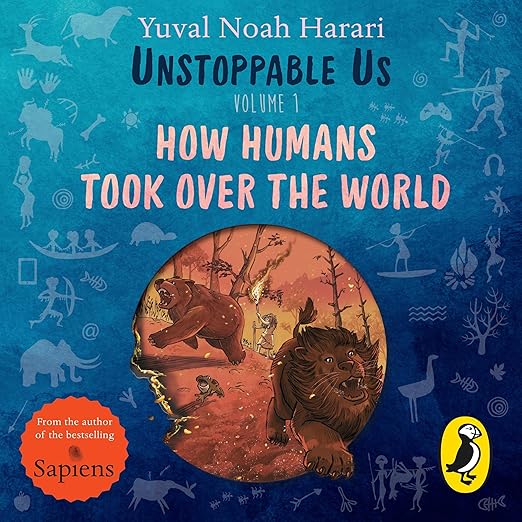
I started this one on a Tuesday evening expecting a light listen, and ended up still going ninety minutes later, genuinely absorbed in what is essentially a children’s version of a book I had read in a completely different register years before. Yuval Noah Harari’s Sapiens is a phenomenon that periodically makes adults feel like they are encountering human history for the first time. Unstoppable Us, Volume 1 takes the same animating question and strips away the academic scaffolding to get at something even more direct: how did creatures with no claws, no wings, and no particular swimming ability end up running a planet?
The answer Harari gives here is the same one he gave in the adult version, but rendered with an urgency and directness that suits its audience better than the denser prose of the original. The storytelling superpower, the idea that humans’ unique ability to believe in shared fictions allowed us to cooperate at scales no other animal can achieve, is presented not as a philosophical concept but as the actual story of how money, religion, and nations got invented. For a young reader encountering this for the first time, the implication that a ten-dollar bill has value only because enough people agree that it does is genuinely mind-expanding.
How the Adaptation Serves Young Readers
Ricard Zaplana Ruiz provides the illustrations in the print edition, and while those obviously do not translate to audio, the text has been written with enough vivid specificity that the abstract concepts remain concrete. Harari explains fire and its effect on human digestion by noting that cooking essentially let our stomachs outsource some of their work, which is the kind of anatomical image that sticks in a ten-year-old’s memory. The Puffin branding and the framing note that this is for younger readers reflects careful editorial calibration rather than simple truncation.
Where Harari Gets Genuinely Uncomfortable
The book does not pretend that human success has been costless. The subtitle’s qualifier, we are unstoppable but also very deadly, is not decorative. Harari introduces the mass extinction of megafauna following human migration, the treatment of animals in industrial farming, and the environmental impact of human expansion in terms that are honest without being despairing. A reviewer with a PhD notes they still learned from this book, which speaks to Harari’s ability to synthesize across disciplines in ways that are genuinely useful even for informed adults.
The Cross-Age Appeal and Its Limits
Multiple reviewers describe reading this alongside children and finding it as engaging as the young audience for which it was written. That is consistent with the Harari brand: he is fundamentally an explainer, and explanation at its best does not have an age floor. Where the adult Sapiens reader may feel occasional impatience with the simpler sentence structures or the broader brush applied to some historical moments, the version in Unstoppable Us compensates with a directness and enthusiasm that can feel like a refresher course in why any of this is interesting. At three hours and fifty-one minutes, the runtime is modest enough that the full volume rewards a single extended listening session.
Who Should Listen and Who Should Skip
This is for curious readers aged eight through fourteen and for adults who want to share a genuine ideas-driven listen with younger family members. Those looking for a narrative-driven story will not find it here. This is nonfiction that moves like adventure writing, but it is still fundamentally an argument about human nature. Listeners who have already read the adult Sapiens will find this a useful companion piece for introducing those ideas to children rather than a substitute. Those who found Sapiens too sweeping or too willing to make large claims from complex evidence will have the same reservations about this version.
Frequently Asked Questions
Is Unstoppable Us Volume 1 a direct children’s adaptation of Sapiens, or an original book?
It is a new book written for younger readers by Harari, covering similar conceptual ground to Sapiens but written originally for this audience rather than abridged from the adult text. The emphasis, examples, and narrative register are all designed for the children’s market rather than condensed from the original.
How much of the original Sapiens material appears here, and what is left out?
Volume 1 covers the cognitive and agricultural revolutions and the origins of human dominance through shared storytelling. Later developments from the adult Sapiens, including the scientific revolution, imperialism, and the future of humanity, are either covered in subsequent volumes or not included in this children’s format.
Does the audiobook version lose anything from the print edition’s illustrations?
The illustrations by Ricard Zaplana Ruiz are print-only. However, the text compensates with concrete, image-generating examples that work well on audio. The conceptual clarity of the writing holds up without the visual elements.
Is this appropriate for an adult who has never read Harari before, or is it too basic?
Several adult reviewers describe it as engaging and informative regardless of prior Harari exposure. The simplicity of presentation is more about directness than omission, and Harari’s core ideas are rendered with enough vividness that readers unfamiliar with the adult Sapiens will get genuine intellectual value from this version.