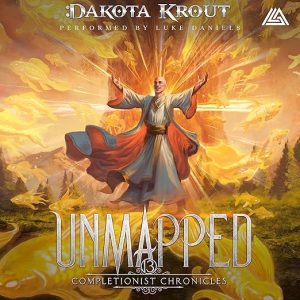
Joe the Ritualist enters book thirteen of The Completionist Chronicles with his Mana Channels destroyed and his skills in ruins, the fallout from trusting a faction leader he shouldn't have. This audiobook picks up mid-catastrophe rather than easing new listeners in, which is exactly what a series this deep into its own run should do: Dakota Krout's LitRPG progression saga has sold more than a million copies at this point, and Unmapped rewards the readers who have already put in the hours rather than pausing to re-explain the system mechanics for newcomers. Narrator Luke Daniels, a genuine veteran of this exact series, returns to carry Joe's recovery arc with the same energy that's kept listeners going for twelve previous installments.
Luke Daniels Grounds Joe's Ritual Recovery
With natural recovery off the table, Joe designs his own solution: crafting entirely new Mana Channels and anchoring them to his body and soul through a custom ritual, a premise that plays directly to the character's core identity as a Ritualist rather than forcing him into a generic power-up montage. The stakes escalate fast from there, since fixing himself is only step one; the book's back half turns toward working ritual magic on a genuinely global scale, aimed at tearing what he needs directly from a World Boss's heart to bring down an enemy faction called the Jotunn.
Luke Daniels has narrated this series long enough that his performance functions almost like a returning cast member rather than a hired reader, and that continuity shows in how naturally he handles Joe's voice under genuine strain, not just triumphant power-fantasy beats but a protagonist working through real damage and real consequences. His energetic delivery keeps fight and ritual sequences clear even when the mechanical detail, skills, channels, Divine Energy, gets dense.
The Ritualist framing is what keeps Joe distinct from the sword-swinging or spell-slinging default protagonist that fills most of this genre. His path to power runs through careful, deliberate construction, designing and anchoring entirely new Mana Channels through custom ritual work, rather than simply grinding fights for experience, which makes this recovery arc a showcase for the character's core identity instead of a generic setback-then-comeback structure. LitRPG readers specifically drawn to crafting- and system-design-heavy builds over pure combat classes will find Joe's problem-solving approach to his own catastrophic injury more satisfying than a straightforward power-up montage.
The genre's core appeal, watching a character acquire and refine measurable systems of power rather than vague, undefined magic, is exactly what Unmapped leans into hardest at this point in the series. Where an early book in a LitRPG series usually spends real time explaining how leveling, skills, and stats work, book thirteen can instead treat all of that as fluent shorthand, moving faster through mechanical detail because both author and listener already share the vocabulary. That efficiency is part of the reward structure long-running progression fantasy offers loyal readers.
Million-Copy Momentum and an Old Norse Villain
Reviewer George337 credits the series with maintaining 'such a solid progression' across thirteen books without the pacing or plot payoffs going stale, calling Joe 'a highly likeable protagonist' worth rooting for this far into his story. That kind of consistency across a long-running progression fantasy series is genuinely hard to sustain, and it's the main reason listeners keep returning book after book rather than drifting to a newer series.
Reviewer Ga Bear, who also follows Krout's separate Full Murderhobo series, calls this entry 'even more intense' than that other favorite and flags Unmapped as 'a must read' for anyone already following the Completionist Chronicles, noting that book fourteen was already on the way at the time of writing. That cross-series comparison is a useful data point for existing Krout readers deciding where to spend their listening time next.
Ga Bear's comparison also points at something worth knowing about Krout as an author: Completionist Chronicles is one of several long-running LitRPG series he maintains simultaneously, and a writer able to keep multiple deep-catalog series moving without either stalling out or diluting quality is a genuinely useful signal for a genre where reader trust often depends on an author's release reliability as much as any single book's individual merits.
Naming the enemy faction the Jotunn is a small worldbuilding choice worth noticing, borrowing the Old Norse term for giants rather than inventing a generic monster name from scratch, which gives this particular antagonist faction a mythological weight the series can lean on without lengthy in-book exposition. Crossing over a million copies sold across the wider series also signals something concrete for a new listener weighing the time investment: this isn't a niche cult favorite, it's a genuinely mainstream entry within LitRPG's own readership, with a large enough existing audience that book fourteen's arrival is treated as a real event rather than a quiet release.
Book Thirteen Ends on a Genuine Cliffhanger
Book thirteen is not a place to start this series, and nothing about this particular audiobook tries to pretend otherwise; the emotional weight of Joe's betrayal by his faction leader and the specifics of his damaged Mana Channels assume a listener who already understands the system Krout has built across twelve previous entries. New listeners curious about the series should start at book one rather than here.
Reviewer GlueFactoryBJJ flags the ending specifically as 'ominous,' which is worth knowing going in: this installment does not wrap up cleanly, and listeners who prefer a satisfying, self-contained conclusion within a single audiobook should brace for a genuine cliffhanger rather than resolution.
Dungeon Crawler Carl Fans Will Feel at Home
Existing Completionist Chronicles listeners current through book twelve will get the most value here, alongside LitRPG and progression fantasy fans generally who enjoy Krout's mix of mechanic-driven character growth and genuine humor, comparable to Dungeon Crawler Carl's snarky tone or Cradle's clearly defined power systems. Luke Daniels' long track record with this specific series is itself a reason to trust the audio format over jumping to text partway through.
Marketing for this entry places it alongside The Primal Hunter, He Who Fights with Monsters, and Unbound, three other major names in the current progression fantasy wave, which usefully signals the specific flavor of LitRPG on offer here: humor-inflected, mechanic-dense, quest-driven adventure rather than the grimmer, more atmospheric end of the genre. Listeners who already enjoy any of those three series have a strong basis for expecting a comfortable fit with Krout's tone and pacing here as well.
Anyone not already invested in Joe's story, or generally allergic to system-and-stats-heavy prose, mana pools, skill trees, ritual mechanics, will find this a rough entry point rather than an inviting one, and should treat book one of the series as the only real starting line worth considering.
Frequently Asked Questions
Can I listen to this audiobook without having heard the earlier Completionist Chronicles books?
Not comfortably. As book thirteen, Unmapped assumes a listener already understands Joe's abilities, allies, and the system mechanics built up across twelve previous installments.
Does Luke Daniels narrate the entire Completionist Chronicles series, including this audiobook?
Yes, and his continuity across the series is a real asset here, giving Joe's voice and the surrounding cast a consistency that a new narrator picking up mid-series couldn't replicate.
Does this audiobook end on a cliffhanger?
Yes. At least one reviewer specifically flags the ending as ominous, and listeners should expect an unresolved setup for book fourteen rather than a self-contained conclusion.
Is this audiobook heavy on game-like mechanics, or more focused on story and character?
Both, but the mechanics are load-bearing. Joe's entire recovery plan centers on rebuilding his Mana Channels through ritual work, so listeners who dislike system-and-stats-driven LitRPG prose should look elsewhere.