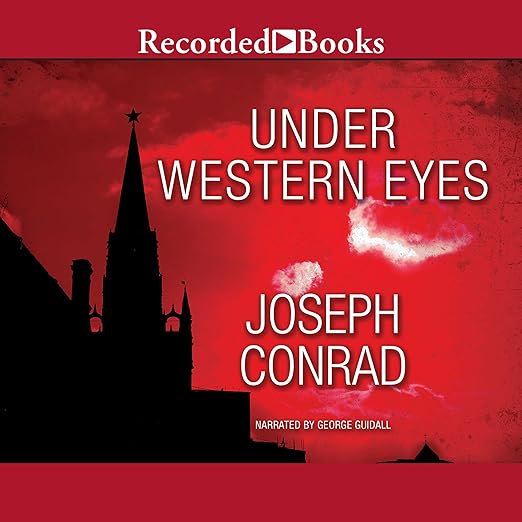
Quick Take
- Narration: George Guidall is one of the finest narrators in classical fiction, and his measured, intelligent reading gives Conrad’s morally dense prose exactly the weight it demands.
- Themes: Betrayal and moral entrapment, Russian political exile, identity under surveillance
- Mood: Oppressive, psychologically intense, and deeply literary
- Verdict: A masterwork of political fiction that Conrad himself considered among his best work, and Guidall’s narration is the version of it you want.
I came back to Under Western Eyes for the first time in about eight years, and I was struck again by how odd and uncomfortable it is. Conrad wrote this novel in the years between 1908 and 1911, drawing on his deep personal hostility toward Russia, the country whose imperial expansion had consumed his Polish homeland, and that hostility is everywhere in the book: in its structure, its narrator’s voice, its portrait of Russian political culture as a closed loop of fanaticism and despair. And yet it is not a simple or comfortable anti-Russian polemic. Conrad was too intelligent and too honest for that. What he produced instead is a novel about moral entrapment that implicates everyone, including its readers, in ways that don’t resolve cleanly.
The setup is efficient and brutal. Razumov, a student at the St. Petersburg university, is minding his own business, trying to excel under the czarist system by keeping his head down and his record clean, when his fellow student Victor Haldin appears at his door. Haldin has just assassinated a Russian minister of police and wants Razumov’s help escaping. Razumov has no political sympathies, no ideological stake in any of this, and everything to lose. He hides Haldin, then betrays him to the authorities. The entire novel flows from that moment.
Our Take on Under Western Eyes
What makes Under Western Eyes so unusual is its narrative architecture. The story is not told by Razumov but by an elderly English language teacher in Geneva who has access to Razumov’s diary and to the circle of Russian exiles among whom Razumov subsequently operates as a spy. The narrator is sympathetic but limited, conscious of his own outsider status, and his inability to fully understand what he is observing is built into the text as a formal and thematic feature rather than a weakness. He is, as he says himself, watching a Russian story through Western eyes, and the gap between what he sees and what is actually happening is the novel’s central irony.
Conrad published this six years before the Russian Revolution, and the novel reads, in retrospect, like a precise and chilling map of the ideological and psychological conditions that made 1917 possible. The reviewer who describes it as “a chillingly accurate prophecy” is not overstating the case. The portrait of Russian exile political culture, its combination of passionate idealism and ruthless internal politics, its tendency toward martyrdom and betrayal in equal measure, is historically astute in ways that become more evident the more you know about what actually followed.
Why Listen to Under Western Eyes
George Guidall is among the handful of narrators who can do real justice to late Conrad. The prose in Under Western Eyes is dense and deliberate, working through layers of irony that require a reader who understands when to emphasize and when to underplay. Guidall’s performance at Recorded Books has the intelligence and patience the text demands. He doesn’t simplify Conrad’s moral ambiguity into clear emotional signals; he reads with the same careful distance that Conrad’s own narrator maintains, and that fidelity to the text’s tone is exactly right.
The reviewer who draws a line from Conrad to Graham Greene, Eric Ambler, and John le Carré is pointing to something important. Under Western Eyes is one of the foundational texts of the spy novel as moral literature, the ancestor of The Spy Who Came in from the Cold’s exploration of what it costs a person to inhabit two identities simultaneously. Listeners who love that tradition will find its origins here, and will likely find Conrad’s version darker and more philosophically unresolved than most of what followed.
What to Watch For in Under Western Eyes
This is not easy listening. Conrad’s prose rewards patience and works against you if you bring distraction to it. The novel moves deliberately in its first third, establishing the moral trap that Razumov has set for himself, and some readers and listeners find that pace frustrating before the Geneva sections pick up. The political contexts, czarist Russia, the expatriate revolutionary community in Switzerland, require some historical orientation to fully appreciate, though the novel provides enough context to follow the action without supplementary reading.
Conrad’s attitude toward his Russian characters is complex and occasionally uncomfortable. He gives them interior lives and genuine moral dignity while also portraying Russian political culture with a kind of dark satire that reflects his own historical grievances. Listeners who are sensitive to that tension should know it’s present, though it is part of what makes the novel so interesting to read rather than a simple flaw.
Who Should Listen to Under Western Eyes
This audiobook is for listeners who take their literary fiction seriously and are willing to work with a text that offers complexity rather than resolution. If you’ve read The Secret Agent and want more Conrad, or if you come to spy fiction through le Carré and want to trace the form back to its roots, Under Western Eyes is the place to go. Guidall’s narration makes the twelve-plus hours feel earned rather than endured.
Skip it if you want plot momentum above all else. Conrad’s interest is in moral psychology and narrative irony, and the novel’s architecture serves that interest rather than the drive of events. For listeners who want their political thrillers kinetic and propulsive, this is the wrong book.
Frequently Asked Questions
How does Under Western Eyes compare to Conrad’s better-known works like Heart of Darkness or Lord Jim?
It’s less frequently taught but considered by many Conrad scholars to be among his finest achievements. Heart of Darkness is more compressed and allegorical; Under Western Eyes is more novelistic and psychologically specific. Readers who find Heart of Darkness abstract may actually prefer this one.
Is George Guidall’s narration suitable for dense literary prose like Conrad’s?
Yes, very much so. Guidall is one of the most experienced narrators in classical and literary fiction and handles Conrad’s layered irony and deliberate pacing with real intelligence. His reading doesn’t simplify the moral ambiguity that the prose requires.
Do I need to know Russian history to follow the novel?
Basic awareness of czarist Russia and revolutionary politics helps, but Conrad provides enough context within the narrative to follow the story without specialist knowledge. Understanding the historical background deepens the irony, particularly knowing what followed in 1917.
Is the novel’s narrative frame, the English teacher reading Razumov’s diary, confusing to follow in audio?
It takes a little orientation in the opening chapters, but Guidall handles the frame clearly. Once you understand that the narrator is an outsider interpreting events through limited access, the structure becomes a source of irony rather than confusion.