Quick Take
- Narration: Ruth Urquhart is well cast, bringing both the fire of Lucy’s English pride and the warmth of Highland life to life with genuine range.
- Themes: Arranged marriage, Highland romance, pride and prejudice (of the non-Austen variety)
- Mood: Spirited and warm with flashes of genuine heat
- Verdict: A confident debut that delivers exactly what Scottish historical romance promises, with enough genuine character chemistry to elevate it above the formula.
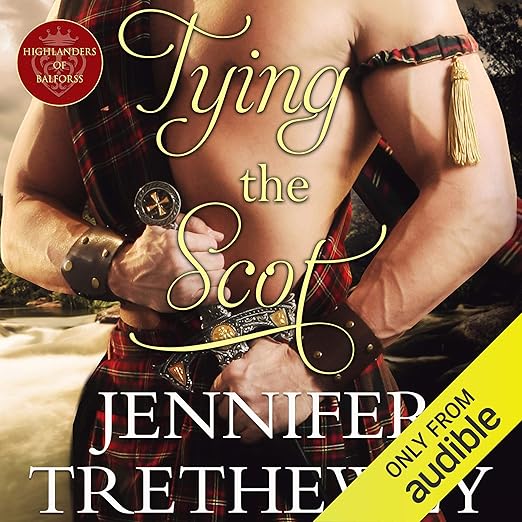
I started Tying the Scot on a Sunday afternoon with a cup of tea and no intention of listening to more than an hour or two. By the time I looked up it was well past dark, and Alex Sinclair had firmly established himself as the kind of fictional Highlander who makes you understand why the subgenre has such devoted readers. Jennifer Trethewey’s debut in The Highlanders of Balforss series is the sort of historical romance that knows precisely what its audience wants and delivers it with real charm.
The setup is pleasingly old-fashioned in the best sense. Alex, at eleven years old, pledges an oath to protect the Duke of Chatham’s illegitimate daughter, Lucy FitzHarris. Nine years later, that boyhood vow turns into a marriage offer, and neither Alex nor Lucy is particularly thrilled about it. Lucy is a proud, London-bred young woman who would, as the synopsis puts it, rather starve than marry a vulgar Scot. Alex, for his part, is hotheaded and not exactly skilled at winning over a reluctant bride. The collision of these two personalities across the Scottish Highlands is the engine that drives the story.
Our Take on Tying the Scot
What works here is the specificity of Trethewey’s world-building. Balforss feels lived-in rather than generically picturesque. The estate, the people on it, and the rhythms of Highland life are rendered with enough detail to make Lucy’s eventual softening feel earned rather than inevitable. When she begins to love the place, readers have already been given enough texture to understand why.
The romance itself follows the expected arc of initial resistance giving way to reluctant attraction and then genuine feeling, but Trethewey has a good ear for the comic friction between her leads. Alex’s temper and Lucy’s pride create conflict that reads as character rather than obstacle-of-the-week plotting. One reviewer described the chemistry as steamy and another called the little dog that appears throughout a heart-winner, which tells you something about the warmth of the supporting details.
Why Listen to Tying the Scot
Ruth Urquhart’s narration is a genuine asset. She handles both the English formality of Lucy’s early chapters and the warmer register of Highland scenes with ease, and her comic timing serves the banter well. At over ten hours, this is a full listening experience, and Urquhart’s range keeps it from feeling padded. For fans of Scottish historical romance, this is exactly the kind of performance that makes the audiobook format preferable to print.
The series opener also does something that not all debut romance novels manage: it sets up the world of Balforss and the extended cast of characters in a way that makes you genuinely curious about subsequent entries, without sacrificing the integrity of Alex and Lucy’s story. This feels like the start of something with real staying power.
What to Watch For in Tying the Scot
A small number of reviewers note that the book contains explicit language and descriptive sexual content, which for some readers is a negative. That is worth flagging for listeners who prefer their historical romance to stay on the warmer side of the line. The conflict that drives the final act, involving Lucy being tricked into running away after an apparent betrayal, resolves in a way that most readers will find satisfying, though the mechanism of the misunderstanding is fairly conventional for the genre.
The historical setting is Highland Scotland in the early nineteenth century, and while Trethewey does not bog the narrative down in period detail, listeners who prefer their historicals rigorously researched may find the atmosphere somewhat impressionistic. For those who read Scottish romance for feeling and character rather than historical precision, this is not a problem.
Who Should Listen to Tying the Scot
This is an ideal listen for readers who enjoy arranged marriage tropes, Scottish Highland settings, and romance leads with genuine personality clashes. If you loved the early Outlander novels or any of Madeline Hunter’s historical romances, Tying the Scot will feel immediately comfortable while offering its own distinctive voice. Listeners who are sensitive to explicit content should be aware it is present. Those looking for rigorous historical fiction rather than romantic historical atmosphere should look elsewhere.
Frequently Asked Questions
Is Tying the Scot the first book in The Highlanders of Balforss series?
Yes, it is book one and functions as a complete standalone story while setting up the world and supporting cast for subsequent entries in the series.
How explicit is the romantic content in this audiobook?
Several reviewers describe it as steamy with descriptive sexual content. One reviewer specifically cited this as a drawback, while others found it a strength. It is not a sweet romance.
Does Ruth Urquhart handle Scottish accents and dialect convincingly?
Most listeners find her performance well-suited to both the Highland characters and Lucy’s English register. Her range across the cast is one of the audiobook’s stronger qualities.
Is the arranged marriage conflict resolved in a satisfying way?
The consensus among reviewers is yes, with the resolution involving both characters needing to overcome their defining flaws, Alex his temper and Lucy her pride, before they can come together.