Brown's Performance Feels Inseparable From Milo
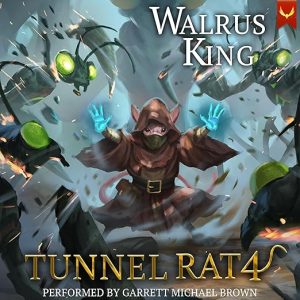
Milo is back in the game world of Genesis, and Walrus King's Tunnel Rat 4 picks up exactly where the series left him: causing the kind of trouble that only someone with his particular combination of skills, suspicions, and reluctant affection for the people around him could cause. This LitRPG audiobook is the fourth entry in a series that has built a devoted following, and narrator Garrett Michael Brown delivers a performance that has become inseparable from the character at this point. At fourteen hours and thirty-one minutes it is the kind of listening you settle into rather than rush through.
The series distinguishes itself within the LitRPG genre through its protagonist rather than its system mechanics. Milo is not the confident power-fantasy hero that anchors most entries in the genre. He is cautious, clever, and only gradually allowing the world, both the game world and the social world, to touch him. Reviewer AdmOrian describes the series' appeal as "the cleverness, the kindness, the cool plays, and the worlds," and that combination is unusual. LitRPG tends to prioritize the cool plays. Tunnel Rat adds the kindness, and that addition is what drives the emotional stakes.
Wally's Uncertain Interest in Milo's Two Families
Book four deepens several threads that have been developing across the series. The central question, whether Genesis is only a game, is given more direct attention here than in previous volumes. Milo has suspicions that the game world is more complicated than it appears, and the investigation those suspicions prompt drives the main plot. That investigation leads him to an underground market of used games, which serves as the introduction point for a new set of companions. Reviewer Lonnie-The-GreatNorthernTroll-Moore captures the experience of finishing the book with the observation that you keep wishing there were more pages, that the ending arrives before you are ready for it, which is a form of praise the author would presumably take gladly.
The corporate and organized crime elements introduced in this volume give the world-building new complexity. Genesis was already a layered setting; the addition of corporations moving into the habitat alongside crime lords raises the stakes in ways that feel consistent with the world rather than imported from a different genre. Milo's response to the invasion of his home by these forces is one of the book's satisfactions: he does not meet power with power but with ingenuity, and the solutions he devises carry the humor and originality that reviewer Matthew Anderson identifies as the series' defining quality, the thing he cannot understand why has not made it more widely known.
The family theme, introduced in earlier volumes with Limburger Hollow, is expanded significantly here. Milo has a new family to protect, a found-family configuration of companions, and an old family that is simultaneously believed dead and looking for him. The AI Wally's interest in both threads adds an observer-figure whose motivations are genuinely uncertain, and Brown's narration gives Wally a distinctly different register from Milo's first-person voice, which helps the reader track perspective shifts without confusion. The question of what Wally actually wants, and whether wanting is even the right word for whatever process the world's largest AI is running, is one of the more interesting threads in the broader series arc.
The humor throughout is worth flagging separately for listeners who may come primarily for the action or system mechanics. Walrus King writes comedy into the structure of Milo's problem-solving rather than inserting jokes around it, and the result is a series that is funny in an organic rather than performative way. Brown has clearly internalized this: his timing for the comedic beats is as reliable as his handling of the dramatic ones, and the balance between wit and genuine danger is one of the audio production's defining qualities.
Milo's Shell Cracks Just a Small Bit
New listeners should not start here. Tunnel Rat is a series with significant world-building and character development carried forward across its volumes, and Book 4 does not pause to re-establish context. The payoff for characters like Wally and the Alphabet requires knowledge of their history. Start with Book 1 and listen through; the series is consistent enough in quality that this is not an imposition.
Brown's handling of Milo's gradual social opening is worth particular attention across this volume. The synopsis describes it precisely: he's "slowly coming out of his shell. Just a small crack, nothing big." That incremental quality is deliberately paced, and Brown understands that the restraint is the point. Milo's warmth is more moving for being hard-won, and Brown communicates that without overplaying the moments when it surfaces. The scene at the underground market, where the new friendships begin to form, is one of the audiobook's quieter successes for exactly this reason.
The system mechanics in Tunnel Rat 4 are detailed and internally consistent, but Walrus King does not allow them to overwhelm the human story. Listeners who come to LitRPG primarily for the stat progression and item invention will find both here; listeners who are more interested in character and world will not be made to wade through pages of system notation. The balance is one of the genre craft decisions that distinguishes Tunnel Rat from LitRPG titles that mistake the scaffolding for the building.
Devoted Fans Back a 4.8 Rating Here
Series listeners who are current on the first three books should start this audiobook without hesitation. The rating of 4.8 across 195 reviews reflects a genuinely devoted audience, and the attached reviews read as close to unanimous on the quality of this particular entry, with no real dissent to weigh against the praise.
For listeners new to LitRPG who are wondering whether this is a good genre entry point, the answer is yes, if they begin with Book 1. Tunnel Rat is among the more character-driven and emotionally textured series in the genre, and it rewards listeners who want something beyond pure game-system optimization. The fourteen-hour runtime is well-earned, and Brown's performance is one of the consistent pleasures across the series.