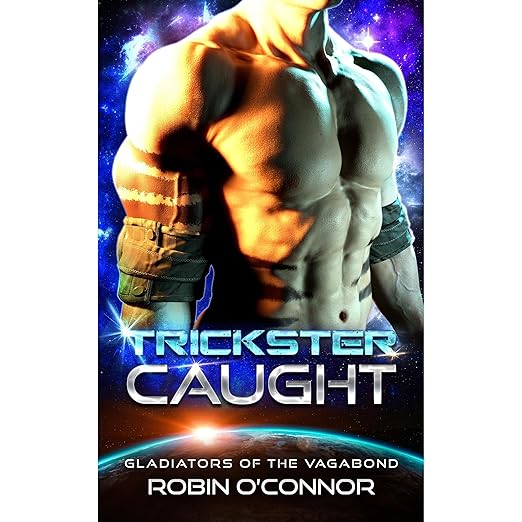
Quick Take
- Narration: Virtual Voice AI narration handles the dual-POV structure mechanically; the emotional beats of Chloe and Kitan’s developing trust suffer from the absence of a human performer.
- Themes: hidden identities and forced vulnerability, freedom versus servitude, the cost of choosing protection over self-preservation
- Mood: Tense and tender in turns, with a sci-fi adventure frame around an intimate emotional core
- Verdict: A well-constructed sci-fi romance premise that earns its emotional stakes, though AI narration puts the ceiling lower than the writing deserves.
I was halfway through my Tuesday morning run when I started Trickster Caught, and the opening setup hooked me faster than I expected. A woman who has hidden herself inside voluminous clothing for years to appear younger than she is, surviving among space pirates by making herself invisible. An alien shapeshifter, badly injured from a gladiator revolt, who stumbles on her hiding place in the cargo hold. Two people who have both made survival into an art form, suddenly required to trust each other. That is a strong premise for a romance, and Robin O’Connor works it seriously. The catch, as it is with a growing number of independently published audiobooks, is the Virtual Voice AI narration, and I want to be direct about what that means for the listening experience.
What the Dual-POV Structure Asks of the Narration
Trickster Caught alternates between Chloe’s first-person perspective and Kitan’s, and that structure is where the story’s real engine lives. We need to feel the difference between a woman who has learned to make herself small and an alien who has learned to hide his most essential nature. The emotional architecture of their developing trust depends on hearing those two voices as distinct people with distinct weights of experience behind them.
AI narration smooths that distinction flat. The Virtual Voice delivers the text competently and does not stumble, and the pacing is adequate. But the shifts between Chloe’s guarded interiority and Kitan’s protective drive register as textual rather than felt. In a book where the central emotional question is whether two damaged people will let themselves be fully known by another, the absence of a human interpreter is a real loss. Readers who come to the story through the print edition will likely experience it more fully than listeners do here.
The Stowaway and the Shapeshifter
O’Connor’s plotting holds up under scrutiny. Chloe’s backstory, taken from Earth as a child, kept by pirates, surviving by disguise, is rendered with enough specificity that it feels genuinely consequential rather than generic alien-romance backstory. Her nav-augment, a piece of technology that is slowly killing her because it is degrading without replacement parts, gives the story a medical urgency that keeps the middle sections moving even when the romance is doing the slower work of building trust.
Kitan’s shapeshifting ability is the book’s most interesting element. He has hidden it his entire life because revealing it carries enormous personal risk. When he shows Chloe, the gesture is irreversible, and O’Connor understands the weight of that moment. The parallels between Chloe hiding her body and Kitan hiding his nature are not subtle, but they are handled with genuine care rather than merely pointed at. Reviewers note that the book deals with more serious and in-depth issues than earlier entries in the Gladiators of the Vagabond series, and that assessment feels accurate based on the material O’Connor is working with here. The story earns its heavier emotional register.
The medical stakes introduced by Chloe’s degrading nav-augment also deserve more attention than a capsule summary can give them. O’Connor uses this element to force Kitan into a set of choices that test his stated values directly: he claims he wants to protect her, and then the book arranges circumstances where protecting her genuinely costs him something. That is the correct structural move for a romance built on trust rather than convenience. The reader can evaluate whether Kitan is who he says he is because the plot creates situations where the answer is not automatic. This is better plotting than the genre generally requires of itself, and it pays off in the final third.
Chloe’s own arc is equally careful. She begins the story in the specific posture of someone who has survived by minimizing her own presence, and the question of whether she can learn to take up space, not just physically but emotionally, runs through every chapter. The parallel with Kitan’s hidden shapeshifting identity is obvious but not manipulative. O’Connor earns the structural rhyme by grounding both characters’ concealment in specific historical experience rather than convenience.
Series Context and Standalone Readability
This is the second book in the Gladiators of the Vagabond series. O’Connor notes that while each story is complete, reading in order provides the maximum experience. New listeners can follow the narrative without that context, but certain background tensions, the political situation of the Krektar, the gladiator revolt’s immediate aftermath, the ship’s social dynamics, will feel slightly underpowered without the foundation established in Book 1. The series reads as one continuous world with rotating primary couples rather than a tightly serialized plot, which means the entry cost is low but the depth of investment rewards the established reader.
The happily-ever-after is guaranteed, as O’Connor states plainly in the synopsis, and the path to it is built on character work rather than manufactured conflict. That is worth more than it might sound in a genre where contrived misunderstandings often do the heavy lifting.
Who This Is For and Who Should Wait
Fans of sci-fi romance with alien shapeshifter heroes and a focus on emotional trust rather than action-first plotting will find Trickster Caught delivers what the genre promises. Readers of the print or ebook edition will likely find this one of the stronger entries in the alien-romance subgenre, with a heroine whose backstory carries genuine weight.
For audiobook-first listeners, the AI narration is a real limitation. If you are sensitive to the particular affectlessness of current Virtual Voice technology, this is a book worth waiting for in the event a human narrator records it, or one to enjoy in its text form instead. The story itself is better than the audio delivery suggests.
Frequently Asked Questions
Does Trickster Caught work as a standalone, or is knowledge of Book 1 essential?
It functions as a standalone with its own complete romance arc and resolved plot. However, the world-building and the gladiator context will feel more grounded for listeners who have read or heard the first book in the series. O’Connor is transparent about this in the series notes.
How significant is the Virtual Voice AI narration limitation for this particular story?
More significant than for a straightforward action-forward novel. Trickster Caught is built on an intimate dual-POV structure where the emotional distinction between Chloe and Kitan is central. AI narration flattens that distinction in ways that reduce the impact of the trust-building at the story’s core.
What makes Kitan different from typical alien-hero archetypes in the genre?
His shapeshifting is treated as a secret he has carried in isolation rather than a superpower. Revealing it to Chloe is an act of genuine vulnerability rather than demonstration of strength, which gives the romance a more psychologically grounded foundation than the gladiator setup initially suggests.
Is there content in this book that is significantly heavier than typical alien romance fare?
Yes. One reviewer noted it deals with more serious issues than earlier books in the series. Chloe’s backstory involves childhood abduction and years of deliberate self-concealment for survival. These elements are handled with care rather than graphically, but they give the romance more emotional weight than a lighter genre entry.