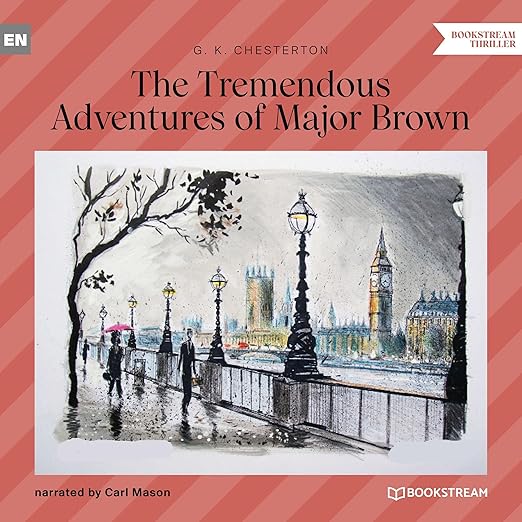
Quick Take
- Narration: Carl Mason brings a measured British register to Chesterton’s prose that suits the newspaper column origins of these essays, though at just over an hour there is little time to build a sustained listening relationship.
- Themes: Wonder in everyday life, paradox and observation, the philosophy of small things
- Mood: Whimsical, sharp, and quietly subversive, like a brilliant friend who notices things you have walked past a hundred times
- Verdict: A brief but genuinely delightful introduction to Chesterton’s essay voice, proof that century-old columns about lying in bed and lamp-posts can still be the most interesting thing you heard all week.
I found myself listening to Tremendous Trifles on a lunch break, an hour stolen from an otherwise busy Tuesday, and I stayed with it past the point where I should have gone back to my desk. G.K. Chesterton is one of those writers who gets recommended in oblique ways: you find his name in the footnotes of other essayists, or, as one reviewer noted, Neil Gaiman mentions him in a video and you take the hint. The collection in question here is drawn from Chesterton’s columns for the London Daily Mail around 1909, and the question any contemporary listener reasonably asks is what a set of Edwardian newspaper pieces could possibly offer a reader today. The answer, it turns out, is quite a lot.
The synopsis attached to this listing refers specifically to The Tremendous Adventures of Major Brown, a story rather than a collection of essays. The audiobook itself, titled Tremendous Trifles after the 1909 collection, covers the essays, observations on lying in bed, on chalk, on the proper attitude toward a lamp-post, on the difference between adventure and danger. Chesterton’s Daily Mail columns were short, usually not more than four pages, and they were written to be read in minutes. That structure translates unexpectedly well to audio: each essay is its own complete experience, with a setup, a turn, and a final paragraph that lands like the punchline of a perfectly constructed joke that is also, somehow, a piece of genuine philosophy.
Our Take on Tremendous Trifles
What Chesterton does in these essays is take something apparently trivial, a piece of chalk, a garden, an eccentric neighbor, and use it to expose a larger truth about perception, wonder, and the habits of mind that make us blind to what is in front of us. He was writing against a strain of late Victorian rationalism that he felt had drained wonder from ordinary life, and his method was to demonstrate, essay by essay, that wonder was hiding in plain sight. A century later, that instinct feels as urgent as it did then, which is the best argument for why Chesterton keeps getting recommended across generations.
The collection is uneven, as reviewers candidly note. Some essays are clearly stronger than others. This is the nature of newspaper column collections, they were written on deadlines to fill space, and not every one achieves the heights of the best. On Lying in Bed is consistently identified as among Chesterton’s finest short pieces. Others in the collection are slighter. At just over an hour, the audiobook does not have room for the weaker pieces to drag; the listening experience flows quickly enough that the unevenness is less of a problem than it would be in a longer collection.
Why Listen to Tremendous Trifles
Carl Mason’s narration suits the material. He brings a composed, measured British voice to Chesterton’s prose that respects the newspaper column origins without making the essays feel dusty or museum-adjacent. Chesterton’s sentences are syntactically complex, he builds arguments through layered clauses and unexpected inversions, and Mason handles that complexity without losing the listener. The prose rewards a second pass on some essays, and the audio format actually facilitates that: it is easy to replay a paragraph where the meaning arrived just a moment too late on first hearing.
For readers new to Chesterton, this is a genuinely low-commitment entry point. An hour is what it costs to discover whether his particular mode of wonder-soaked argumentation resonates with you. If it does, the Collected Works are substantial. If it does not, you have spent an hour with prose that is at least elegantly assembled, which is more than can be said for most things that last an hour.
What to Watch For in Tremendous Trifles
Listeners expecting a unified argument or narrative thread will need to adjust their expectations. These are discrete essays that share a sensibility but not a through-line. The listening experience is closer to spending time with a remarkable mind than following a sustained case. Some of the cultural references and targets of Chesterton’s argument, the specific intellectual fashions he was pushing against in 1909, require a moment’s historical orientation to fully appreciate. Context helps but is not essential; his points tend to outlast their original targets.
The collection also includes The Tremendous Adventures of Major Brown, the story mentioned in the synopsis, a whimsical detective tale that sits somewhat differently from the essays and provides a useful illustration of Chesterton’s fiction alongside his nonfiction instincts.
Who Should Listen to Tremendous Trifles
Readers encountering Chesterton for the first time will find this an ideal sampler. Essay lovers with an appetite for writers who find philosophical depth in apparently trivial observations will feel immediately at home. Those who want sustained argument rather than discrete observations will be better served by Chesterton’s full-length works. And anyone who needs to fill a lunch break with something that leaves them feeling genuinely more alert to the world around them should start here.
Frequently Asked Questions
Is Tremendous Trifles a collection of essays or a single story?
Primarily a collection of essays drawn from Chesterton’s Daily Mail columns circa 1909, the audiobook also includes The Tremendous Adventures of Major Brown, a short story. The synopsis in this listing describes only the story, which does not fully represent the collection.
Does Carl Mason’s narration capture Chesterton’s wit and irony effectively?
Reasonably well. Mason’s composed British delivery suits Chesterton’s measured prose, and he handles the syntactic complexity without losing the listener. He does not perform the humor, which is the correct approach, Chesterton’s comedy comes from the ideas, not the delivery.
At just over an hour, is this a worthwhile listening investment for someone unfamiliar with Chesterton?
Absolutely. An hour is a very low-cost way to find out whether Chesterton’s particular mode of philosophical observation resonates with you. If it does, there is an enormous body of work to explore. If it does not, you have spent an hour with excellent prose either way.
How does this compare to Chesterton’s longer works like Orthodoxy or Heretics as an introduction?
This is a lighter, more immediately accessible entry point. The essays are playful and observational where Orthodoxy is sustained argument. Listeners who find the essays engaging and want more structural depth should move to Orthodoxy or The Everlasting Man next.