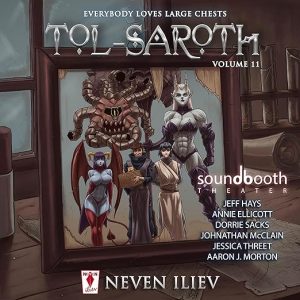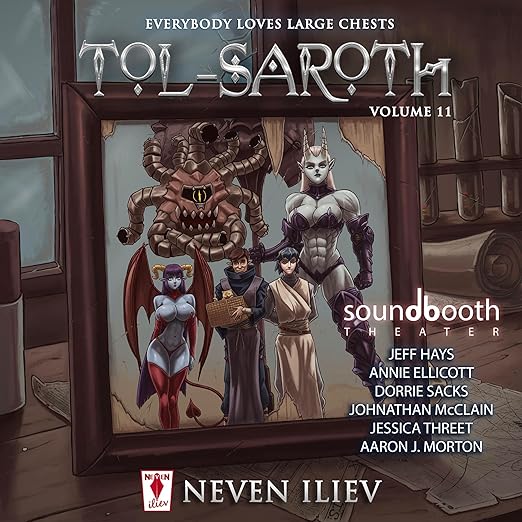
I was on a flight when I finally caught up to Tol-Saroth, the eleventh entry in Neven Iliev's Everybody Loves Large Chests series. I had deliberately saved it for a long haul, knowing from experience that the ELLC books demand a kind of sustained, gleefully unhinged attention that does not fit easily into a commute. I was three chapters in somewhere over the Atlantic when I started laughing at something Boxxy did to a demon and the passenger in the seat next to me gave me a look I will not easily forget.
That is the ELLC experience. Iliev has been writing fantasy from a monster's point of view for eleven volumes now, and what is remarkable is that the series has continued to evolve rather than settling into formula. The premise sounds like a joke: Boxxy T. Morningwood, a shapeshifting mimic who views all of reality through the lens of caloric acquisition and survival optimization, has become one of the more consequential beings in its world. The comedy comes from the gap between how monstrously self-interested Boxxy is and how consistently its selfish schemes produce outcomes that accidentally benefit others.
What We Made of It
This installment delivers something long-term fans have been waiting for: background on Tol-Saroth himself and an explanation of why he has been shifting inside Boxxy's consciousness. One reviewer described it as finally getting background information on some of the stuff that made Boxxy into the Mover it has become, and that tracks. Iliev has been laying groundwork for several volumes and this entry begins paying off those debts in ways that feel earned rather than convenient. The introduction of another Mover whose relationship to the current Hero of Death carries genuine ominous weight, and the final sequence, which reviewers have called a Death Star-sized teaser for future books, closes the volume in a way that makes the wait for book twelve feel unreasonably long.
The current arc also involves the troublesome triplets, Boxxy's demonic affliction, and the ongoing problem of a one-time divine favor the mimic is reluctant to spend. These narrative threads are handled with Iliev's characteristic ability to keep a vast number of moving pieces organized and interesting simultaneously. One reviewer specifically praised the author's capacity to wargame combat with a vast number of spells, characters, and abilities. That remains one of the series' genuine technical achievements: the fights are choreographically coherent, which matters more than it might seem when you are dealing with a protagonist who has accumulated an absurd number of skills.
Why Listen to Tol-Saroth
There is no honest way to review an ELLC audiobook without spending time on Jeff Hays and the Soundbooth Theater production. The series has been a flagship for the full-cast audiobook format, and Tol-Saroth maintains that standard. Hays's own performance as Boxxy and its various facades is technically impressive, requiring him to voice a shapeshifter who impersonates a rotating gallery of species and character types. The demon companions, particularly Xera and Fizzy, remain sonically distinct even as their personalities have evolved across eleven books. For new listeners, the production quality alone is a reason to start from the beginning rather than dropping in here.
The sixteen-plus-hour runtime is appropriate for the series. Iliev writes dense, busy fantasy and the audio adaptation does not compress it. Listeners who are not already invested in the ELLC world should approach this entry as what it is: the eleventh chapter of an ongoing story with extensive lore and relationships. The payoffs in Tol-Saroth are proportional to the investment that precedes them.
What Might Not Land
One reviewer drew a comparison to Flowers for Algernon in describing Boxxy's arc, and I want to engage with that seriously for a moment because it is a more accurate observation than it might initially appear. Iliev has been developing Boxxy's intelligence and awareness across the series in a way that mirrors certain questions that serious fiction has asked about what it means to become smarter, and whether increased capacity for understanding necessarily produces increased moral responsibility. Boxxy's answer to that question is a consistent and resounding no. That consistency is funny, but it also has an internal logic that gives the series a coherence that distinguishes it from ordinary progression fantasy. The character has genuine integrity to its monstrousness, which is a strange thing to admire in a protagonist but is legitimately worth admiring here.
The rating of 4.8 across more than six hundred reviews after release in September 2025 reflects a deeply loyal and genuinely enthusiastic readership that has been with this series through a substantial commitment of time and attention. That loyalty is justified. Iliev is doing something in this series that is difficult to replicate, and Tol-Saroth is among the stronger entries in the run.
Who Should Pick Up Tol-Saroth
This is not a book to start with. As one reviewer noted, go back to the first book and if you love how that story goes, your interest will not die even after eleven books. That advice is sound. The ELLC series builds on itself extensively, and Tol-Saroth specifically pays off threads from multiple previous entries. For existing fans, it is exactly what the series does best. For curious newcomers, the beginning is the right place to start.
- Voice: Jeff Hays delivers Soundbooth Theater's signature full-cast treatment, which is the only sensible way to handle Boxxy's sprawling cast of demons, gods, and morally questionable companions.
- Big ideas: Monstrous intelligence, power accumulation, chaos as a lifestyle
- Atmosphere: Darkly comedic, relentlessly energetic, occasionally alarming
- Worth it?: Eleven books in and the series still has more ideas than most fantasy manages in half the runtime.
Questions Listeners Ask
Can someone new to the ELLC series start with Tol-Saroth?
No. This is book eleven of a series with dense ongoing lore, character development, and plot threads that extend back several volumes. Begin with Everybody Loves Large Chests book one for the full experience.
What is the Soundbooth Theater production format, and how does it differ from a standard single-narrator audiobook?
Soundbooth Theater uses a full-cast approach with multiple voice actors, sound design, and music, closer to an audio drama than a traditional audiobook narration. Jeff Hays leads the production, and the format has become a defining part of the ELLC series identity.
Does the Tol-Saroth entry resolve any major long-standing plot threads?
Yes. It provides significant backstory on Tol-Saroth's role in Boxxy's development and begins answering questions about the demonic affliction arc. It also introduces a new Mover character and closes with what reviewers have called a major setup for the next installment.
How does the combat system hold up at book eleven given how many abilities Boxxy has accumulated?
Reviewers continue to single out Iliev's capacity to design and execute complex fights with a large number of spells and abilities. The choreography remains coherent and the power scaling, while extensive, is tracked consistently within the series' internal logic.