Quick Take
- Narration: Anais Inara Chase handles the Regency register with confidence and gives Jane’s sharp tongue and Penvale’s reserve enough tonal distinction to make the slow thaw of their relationship audible.
- Themes: The haunted-house as romantic device, marriage of convenience as negotiated independence, the slow disclosure of compatible personalities
- Mood: Witty and cozy, with gothic staging that is light enough to feel playful rather than atmospheric
- Verdict: A charming Regency romance that rewards readers drawn to banter and slow-burn emotional development over plot momentum, know that very little happens, and come for that specifically.
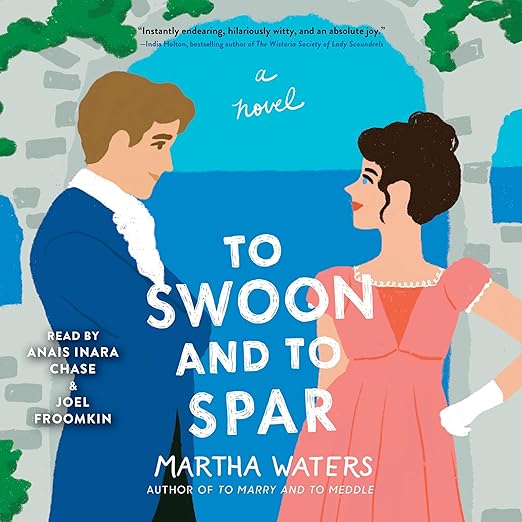
I listened to To Swoon and to Spar over two evenings, the kind of reading context this book specifically seems designed for: something comfortable and unhurried, with a glass of something warm and no particular pressure to be anywhere. Martha Waters has been building the Regency Vows series across multiple volumes, and this fourth installment has the confidence of an author who knows exactly what she is doing and for whom she is doing it. It is not a book for readers who need narrative propulsion. It is a book for readers who want to spend time with two people who are, despite themselves, genuinely well-suited to each other.
The setup is the kind of marriage-of-convenience premise that Regency romance has refined to a high art over the past decade. Viscount Penvale has spent years working to reclaim Trethwick Abbey, his ancestral home. His estranged uncle will sell it, but with a condition attached: Penvale must marry his ward, Jane Spencer. Neither is charmed by the arrangement or by each other. Penvale finds Jane headstrong. Jane finds him cold. They agree to a nominal marriage and retreat to the estate, where Jane immediately begins plotting to drive her new husband back to London through an increasingly absurd campaign of staged hauntings.
The Ghost Plot and Its Comic Register
The haunting scheme is the book’s most original element, and it is handled with the light touch the premise demands. Jane, working with the housekeeper, engineers ghostly sounds, moving objects, and atmospheric disturbances designed to convince Penvale that Trethwick Abbey is occupied by something supernatural. His failure to take the bait, his steady refusal to be driven away by the spectral theater Jane is producing, is both the book’s central comic engine and the gradual revelation of his character. A man who will not abandon his childhood home to theatrically arranged misfortune is also a man who will not easily abandon anything he has committed to, and Waters uses the hauntings to disclose this without stating it directly.
Reviewers have noted that the hauntings are funny to read, and that assessment holds in audio. Chase’s delivery of Jane’s increasingly elaborate scheming, and Penvale’s increasingly puzzled but unfrightened response, has enough comic rhythm to generate genuine laughter in the quieter passages where Waters’s prose is most precise.
Jane as a Protagonist: The Likability Question
Jane is the most discussed element of this book’s reception, and the conversation reveals a genuine fault line in contemporary romance reading tastes. She is, multiple reviewers acknowledge, not easy to like in the opening chapters. Her scheme to drive Penvale from his ancestral home because she has decided it is hers to inhabit alone reads as selfish, and the novel’s justification, that women of the era had limited agency and Jane is working within those constraints, is offered but not developed with the depth it would need to fully explain her behavior rather than simply excuse it.
One reviewer with considerable sympathy for Jane’s introversion and homebody tendencies still found her plan cruel. I think that is the honest response. Waters seems to be aware of this, because the arc she gives Jane involves recognizing the limitations of her own perspective, learning to see what she was unwilling to see before. Whether that arc arrives convincingly will depend on how much patience you extend to the early chapters. For readers who share Jane’s preference for solitude and can understand the fantasy of having a large country house entirely to oneself, the sympathy arrives faster. For readers who find the scheme simply unkind, the recovery arc has more work to do.
Penvale and the Slow Revelation
If Jane is the character who requires patience, Penvale is the character who rewards it. His reserve, which Jane reads initially as coldness, is more gradually revealed as a kind of careful attention, the quality of someone who does not speak until he has something specific to say. The pleasure of watching Penvale and Jane’s relationship develop is largely the pleasure of watching him become legible to her, and her surprise at what she finds when she actually looks. Waters is more skilled at writing male leads in this series than many of her contemporaries in the genre, and Penvale earns his reputation as the series’s most sympathetic hero.
The romance’s resolution is not earth-shattering, which is entirely the point. One reviewer called it exactly the romance novel they were looking for: nothing much happens, two people fall in love, and it is delightful. That response captures what Waters has built, and the listener who walks in expecting that specific experience will not be disappointed. The listener who wants plot surprises and high romantic stakes will find the book’s emotional landscape too flat.
Anais Inara Chase and the Nine-Hour Listen
Chase narrates with the light, clear diction that Regency prose rewards. Her handling of the period’s particular comedy of manners, the understatement, the precise language of social performance, is assured. She differentiates the supporting cast clearly enough that the housekeeper-accomplice and the various London society figures remain distinct across nine-plus hours. The gothic atmosphere of Trethwick Abbey, when Waters gestures toward it in the setting descriptions, is given appropriate weight without tipping into the melodrama the novel is deliberately avoiding. The runtime is comfortable for the story’s ambitions: long enough to develop the characters properly, not so long that the limited plot feels stretched.
For listeners who have enjoyed the previous Regency Vows installments, this is a natural and satisfying continuation. For newcomers, it stands independently while being most resonant for readers who have encountered Waters’s voice before. The comparison to Bridgerton that appears in multiple promotional contexts is useful insofar as it signals tonal register, though Waters’s wit is rather more economical than Julia Quinn’s more elaborate constructions.
Frequently Asked Questions
Do I need to read the previous Regency Vows books before starting To Swoon and to Spar?
The book works as a standalone romance. The characters from previous volumes appear but are not central to this plot, and newcomers will not feel lost without that context. That said, readers who have followed the series will have an added layer of enjoyment from recognizing recurring characters and seeing the world Waters has built continue to develop.
The synopsis positions this as similar to Bridgerton, is that comparison accurate in terms of tone and content?
The tonal comparison is useful. Both operate in the Regency romance register with wit, drawing-room comedy, and marriage-of-convenience plotting. Waters’s prose is more economical and less operatic than Quinn’s, so readers who love Bridgerton’s maximalist emotional style may find this version somewhat cooler. The explicit content level is considerably lower than the Bridgerton novels.
Several reviewers found Jane unlikeable, is this a significant problem for the romance’s emotional payoff?
It is worth knowing about in advance. Jane’s opening characterization is deliberately difficult, and the book asks for patience before it delivers her arc. Readers who can engage with a protagonist who is wrong about things she needs to learn will find the development satisfying. Readers who require a sympathetic heroine from chapter one will struggle with the first third of the book.
How committed is the gothic haunting element, is this genuinely atmospheric or is it primarily played for comedy?
Primarily comedy. The hauntings are Jane’s scheme, deliberately staged and executed with increasing elaboration. The novel is not attempting gothic atmosphere in the tradition of the Brontes or Northanger Abbey; it is playing with those conventions affectionately and for laughs. Readers expecting genuine supernatural or atmospheric dread should adjust expectations accordingly.