Quick Take
- Narration: Abby Craden leads with Gregory Salinas providing the alternate POV bonus content, the casting works for the material, though Craden carries the weight of the primary narrative.
- Themes: chosen vs. assigned identity, loyalty under coercion, the tension between survival and moral integrity in service to power
- Mood: Fae romantasy with political intrigue, slower-building than the average ACOTAR-adjacent novel but rewarding for patient listeners
- Verdict: A competent and atmospheric opener to the Tales of Forgotten Fae series, stronger on world-building and character than on the romantic payoff it promises up front.
I started To No End on a Tuesday evening fully prepared for the kind of romantasy that moves fast and prioritizes chemistry over depth. What I found instead was a book that is taking its time, deliberately, sometimes frustratingly, but ultimately for reasons that seem coherent. Lexy Night is constructing something with this series, and the first installment is more interested in the architecture of that construction than in the immediate satisfactions the romantasy genre typically delivers in Book One. That’s either going to work for you or it isn’t, and being clear about that upfront feels more useful than pretending the pace is something other than what it is.
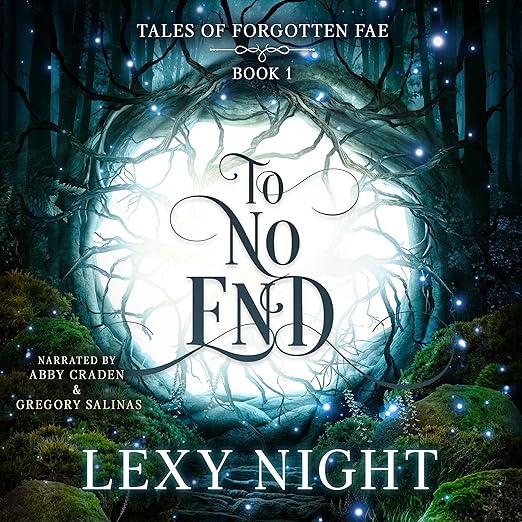
To No End, published in March 2026 for the Tales of Forgotten Fae series, opens with a premise that sits in well-established romantasy territory: Cress Blackthorn has thirty days before she must answer the Offering, one Fae son or daughter from each High Court family, delivered to the king for purposes that aren’t immediately clear. What distinguishes the setup is that the Offering turns out to be an entry point to a covert training program rather than whatever more sinister fate it initially suggests. Cress and her highborn companions are to become, essentially, spies and assassins for the realm, and the Order they enter is the setting for most of the novel’s significant action.
Our Take on To No End
The book is at its strongest in the Order sequences. The training environment, the relationships that form under pressure among people who have reason to distrust each other, and Cress’s attempts to disentangle her “heartstrings from those who came before and those yet to come”, this material has real texture. Night has thought about how power operates within institutions of coercion, and Cress’s negotiation of the Order’s demands against her own survival instincts is more psychologically complex than the average romantasy protagonist’s equivalent struggle.
The romantic elements are present and building, but reviewer carleigh seibert’s observation about “insta love” and difficulty engaging at the start identifies a real tension. The pre-Order section, the thirty days of freedom the synopsis describes, is slow. There’s character establishment happening, and there’s foreshadowing for the cryptic Seer and the dangerous rogue who will complicate Cress’s destiny, but the narrative momentum doesn’t find its feet until Cress is actually inside the Order and the stakes become concrete rather than anticipated. Listeners who commit past that opening third will find a more propulsive story waiting for them.
Why Listen to To No End
Abby Craden is a reliable narrator for this genre and she brings consistency to Cress’s first-person voice that serves the longer atmospheric stretches well. The bonus alternate POV content featuring Gregory Salinas, included within the audiobook, adds dimension to the romantic interest’s perspective that clarifies motivations without spoiling the central dramatic tension. That inclusion is a smart use of the audio format’s capacity for bonus material, and Craden and Salinas have enough tonal differentiation to make the transitions between narrators clearly purposeful.
Reviewer amber’s detailed breakdown of tropes, morally grey MMC, forced/close proximity, fated mates, touch her and die, one bed, suggests the book delivers competently on its genre promises for listeners who are specifically looking for those elements. Reviewer Claire Mariah Pesek places it “between Fourth Wing and ACOTAR on your shelves,” which is a strong positioning claim but indicates the tonal register accurately: this is closer to those comparisons in its romantic fantasy approach than to anything more literary. Within that space, the magic system is noted as genuinely unique, which is meaningful in a genre where magic systems often feel interchangeable.
What to Watch For in To No End
The pacing in the first act is the primary friction point, and it’s worth naming clearly: if you go in expecting the immediate momentum of Fourth Wing or the sexual tension of ACOTAR from page one, the thirty-day opening section will test your patience. Night is doing necessary world-building and character work, but it arrives more slowly than listeners conditioned by the genre’s most successful recent entries may expect.
There are also some conventions here that are genuinely conventional. The secret identity element, the fated mates underpinning, the morally grey love interest, these are familiar structures, and whether they feel fresh or formulaic will depend on your depth of experience with romantasy as a genre. Night executes them competently, but she isn’t substantially reinventing them. The series’ distinctiveness is more in its setting and its political machinery than in its romantic architecture.
Who Should Listen to To No End
Romantasy readers who have worked through the big titles, Fourth Wing, ACOTAR, From Blood and Ash, and are looking for new series with comparable atmosphere will find this worth the trial period required to get past the slow opening. The unique magic system and the Order’s covert training structure give the world genuine distinctiveness. Listeners who prefer immediate romantic momentum should be aware that Book One is building a foundation that likely pays off more fully in Book Two. Those who bounced hard off slow-build pacing in other romantasy series should approach cautiously, but those who value atmospheric world-building alongside their romance will find Night’s approach ultimately rewarding.
Frequently Asked Questions
How slow is the first act of To No End, and when does the story find its pace?
The pre-Order section, roughly the first third of the book, is the slowest part. Listener carleigh seibert specifically names this as a difficulty: it’s heavy on day-to-day life and lighter on momentum. The story accelerates significantly once Cress enters the Order and the training dynamic and covert-operations framing take over. Most reviewers who engaged past that point found the rest of the book considerably more propulsive.
How does the forbidden romance develop, is it primarily told in Cress’s first-person POV, or do we get the love interest’s perspective?
The primary narrative is Cress’s first-person POV. However, the audiobook includes bonus content from an alternate POV, narrated by Gregory Salinas rather than Abby Craden, which gives the listener access to the love interest’s perspective. This is framed as special bonus content within the audiobook rather than as the book’s primary structure.
Is this suitable for fans of Fourth Wing and ACOTAR, as some reviewers suggest?
The tonal register is similar, adult romantasy with Fae mythology, morally grey love interest, forbidden romance, and training sequences under pressure. The pacing is slower than Fourth Wing and the spice level appears to be lower, estimated at around medium for the genre. Reviewer Claire Mariah Pesek places it between Fourth Wing and ACOTAR on the shelf, which is a reasonable characterization of where it sits in the current romantasy landscape.
What makes the magic system in To No End distinct from other Fae romantasy?
Multiple reviewers flag the magic system as genuinely unique without detailing the specifics. The setup involves unlocking abilities that Cress and her companions have never been permitted to develop, which the Order facilitates. The design is tied to the particular mythology of the High Court Fae families and the kingdom of Cambria in ways that feel internally consistent rather than generic. This appears to be one of the series’ clearest points of differentiation from more template-driven Fae fantasy.