Quick Take
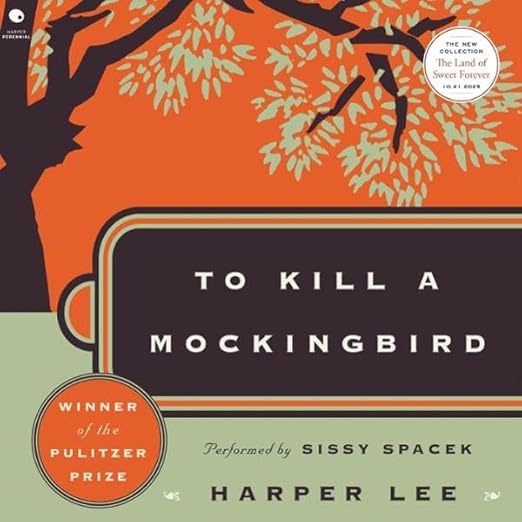
- Narration: Sissy Spacek is a revelation in this role, bringing Scout’s perspective to life with Southern authenticity and emotional intelligence that transforms a familiar text into something new.
- Themes: Racial injustice and moral courage, childhood and the loss of innocence, the gap between law and justice
- Mood: Warm and heartbreaking in near equal measure, with a moral weight that accumulates slowly
- Verdict: Sissy Spacek’s performance makes this the definitive audio version of Harper Lee’s novel, essential listening even for those who know the book well.
I had read To Kill a Mockingbird in print twice before listening to this audiobook edition, which meant I came to it with what I thought was a settled relationship to the text. I was wrong about that. Sissy Spacek’s narration, which I started on a Friday evening and did not put down until the early hours of Saturday morning, does something to the novel that reading it silently cannot quite replicate. Scout’s voice, when it is someone else’s actual voice, carries the confusion and moral awakening of childhood in a way that interior reading can approximate but never fully land.
The Caedmon recording, released in 2014 and running to over twelve hours, is the audiobook edition most listeners will encounter. It is, straightforwardly, the right way to hear this novel for the first time or the fifth.
Our Take on To Kill a Mockingbird
Harper Lee’s 1960 novel has accumulated a weight of cultural significance that can actually get in the way of reading it. It won the Pulitzer Prize, was voted America’s most beloved novel on PBS’s The Great American Read, and has been required school reading for generations of American students. All of that apparatus can make it feel like an obligation rather than an experience. What the Spacek narration does is strip some of that weight back. Scout’s voice, filtered through Spacek’s specifically Southern, specifically feminine sensibility, brings us back inside the story rather than back inside its reputation. The coming-of-age narrative, Scout and Jem watching their father Atticus defend Tom Robinson, a Black man unjustly accused of a crime, plays differently when you hear it rather than read it. The moments of humor, which Lee deploys with considerable skill and which often get flattened in serious-minded discussions of the book’s racial themes, land properly when spoken aloud.
Why Listen to To Kill a Mockingbird
Multiple reviewers who know the novel well describe this audiobook as an experience that justified revisiting familiar material. One reviewer who came to it for the first time in their late forties described something close to a revelation. Another called the writing way better than the movie, which is a specific claim worth sitting with, given that Gregory Peck’s Atticus in the 1962 film is one of American cinema’s most iconic performances. Lee’s prose does things Peck’s embodiment cannot: the irony, the indirection, the way Scout’s child-level perspective produces adult insight without the adult awareness that usually generates it. Spacek understands this, and her reading gives the novel’s humor and its grief equal weight, which is the correct balance Lee actually wrote. A reviewer who described the novel as a must-read for anyone able to read is selling the book’s significance correctly even if the phrasing is conventional. This is a novel that earns that kind of unqualified recommendation, and the Spacek recording earns the same for the audiobook format.
What to Watch For in To Kill a Mockingbird
At twelve hours and seventeen minutes, this is a substantial listen, but the pacing earns the length. The early sections of the novel, Scout’s childhood summers and the Boo Radley mystery, can feel slow to readers who are waiting for the trial narrative to begin. In audio, these sections work better because Spacek carries them with observation and warmth rather than allowing them to feel like setup for the main event. One younger reviewer noted that some of the language in the book is now uncomfortable in its racial vocabulary, which is a real consideration for contemporary listeners, particularly in classroom contexts. The novel does not protect modern ears from the period language, and that is a choice worth acknowledging rather than resolving in advance. Lee’s inclusion of that language is part of the documentary accuracy of the work, and Spacek reads it without inflection that would either soften or amplify the discomfort.
Who Should Listen to To Kill a Mockingbird
This audiobook is for everyone who has read the novel in print and wants to experience it freshly, and for everyone who has been meaning to read it and kept deferring. Spacek’s narration is genuinely the best argument for the audiobook format’s unique power: she does something with this text that no print reader can do for themselves. Listeners who encountered the novel as required reading in school and found it dutiful rather than moving should give this edition a chance before setting the book aside permanently. And listeners who love it already should listen again. It holds up in a way that very few novels do.
Frequently Asked Questions
Is Sissy Spacek an appropriate narrator for Scout, given that Scout is a child and Spacek’s voice is an adult woman’s?
This is the right question to ask. Spacek does not attempt to perform a child’s voice in a way that sounds artificial. She reads as an adult woman remembering childhood, which is exactly what Scout is doing narratively. The retrospective frame makes the casting work beautifully.
How does this audiobook edition compare to other available audio recordings of To Kill a Mockingbird?
The Caedmon recording with Sissy Spacek is the most widely available and most praised audio version. It is the standard recommendation for this title, and listener reviews consistently describe it as the version that finally made the novel click for them.
How does the audio version handle the novel’s period-accurate racial language?
Spacek reads the text as written, which includes language that reflects the novel’s 1930s Alabama setting. Harper Lee includes this language deliberately to document the moral environment Scout is growing up in. Listeners who are sensitive to that language should be aware it is present throughout.
Is this audiobook suitable for younger listeners, given that To Kill a Mockingbird is often taught in middle school?
The novel is commonly assigned from around age 13 upward. The audiobook content is identical to the print text. Younger listeners may benefit from discussing some of the themes and period language with an adult, particularly around the trial narrative and its racial dynamics.