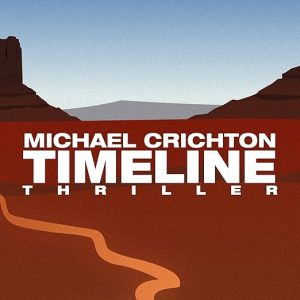
Crichton at his most kinetic: Timeline remains one of the most propulsive science-fiction thrillers Michael Crichton ever produced, and this audiobook narrated by Henning Palner delivers the full 20-hour-and-21-minute experience of quantum physics meeting medieval France in a plot that refuses to slow down. A word of caution before purchase: the synopsis associated with this listing is written in Danish, which suggests this edition may be targeted at a Danish-language market. Verify that the audio itself is in English before buying if you require an English-language version, the 4.3 rating across more than 7,300 reviews reflects the English-language novel, and Crichton's text is otherwise exactly what the title promises.
A Closer Look at Timeline
Crichton published Timeline in 1999, deep in the run of his most commercially dominant decade, and the novel carries the signature architecture he had refined through Jurassic Park and The Lost World: a scientific premise explained with enough rigor to feel plausible, a team of specialists dropped into a situation their expertise alone cannot handle, and a plot that treats the environment itself, prehistoric jungle, medieval battlefield, as an antagonist with its own rules and dangers. Here the environment is fourteenth-century France during the Hundred Years' War, and the scientific frame is quantum multiverse theory applied to time travel via a process that ITC, a secretive technology company, has been developing under the radar of public scrutiny.
A group of history graduate students discovers that their thesis supervisor, Edward Johnston, has become stranded in 1357 Perigord. The company that sent him there has run out of options, and the students, specialists in medieval history who know the period's landscape, language, and warfare intimately, are recruited to go back and retrieve him. What follows is a race against a hard physiological deadline: each transcription through the quantum mechanism degrades the traveler's biochemical integrity, meaning the clock is not just narrative but written into their bodies. Crichton uses the students' academic expertise as both character motivation and plot necessity in a way that makes the historical research feel earned rather than decorative. You understand precisely why a medievalist is valuable in 1357 in a way that matters to the plot's outcome, which is a more elegant structural move than it sounds.
What Makes Timeline Worth Hearing
Palner's narration is the unknown variable in this edition. He is not among the well-documented English-language audiobook narrators, and the Danish synopsis raises the question of whether this is a Danish-produced recording. If it is an English recording by a Danish narrator, the accent may add texture or present occasional challenges depending on the listener's tolerance for non-American English narration in a US-published novel. What is not in question is the quality of the source material. Crichton's dialogue is lean and functional, his action sequences are spatially precise, and his historical detail, the mechanics of trebuchets, the geography of Dordogne castles, the economics of medieval siege warfare, is delivered with the same confident authority he brought to dinosaur genetics in Jurassic Park.
The 4.3 rating across more than 7,300 reviews reflects a book with genuine range of response. Some listeners find the scientific preamble overly dense before the action begins. Others, particularly those who came for the historical setting, find the fourteenth-century sequences the strongest sections by a considerable distance. Both assessments are defensible. The quantum mechanics framing is Crichton working at the outer edge of where his scientific explanations remain convincing, and the novel's climax requires a degree of suspension of disbelief that the rigorously grounded middle section slightly undercuts. These are not fatal problems for a novel of this ambition, but they are the places where the seams show.
Things to Know Before Starting Timeline
The pacing shifts significantly once the characters arrive in 1357. The novel's first third, which establishes ITC, the quantum multiverse theory, and the disappearance of Professor Johnston, moves with the measured buildup of a thriller that knows it has a long game to play. Once the graduate students make the transcription and land in medieval France, Crichton switches to a different gear entirely, urgent, physical, and operating with the spatial precision of someone who has studied the actual fortifications. The sequences in and around Castelgard castle are among the most tactile historical fiction passages in his entire catalog. The jousting, the siege mechanics, the smell and noise of fourteenth-century military operations, these are described with the same attention to physical detail that characterizes the best sequences of Jurassic Park, just in a different register entirely. Listeners who find the opening section slow should know that the audiobook pays off the patience substantially in the second half.
One element Crichton handles with particular skill is the gap between historical knowledge and historical competence. His graduate students know everything about medieval France in an academic sense but quickly discover that knowing about siege warfare and being caught in siege warfare are categorically different experiences. That gap between theoretical expertise and physical survival is the engine of the novel's tension, and it generates some of Crichton's best character work: people whose identities are built around knowledge having to discover whether that knowledge is actually useful when the stakes are immediate and mortal.
Who Michael Crichton Is Writing For
Crichton readers who have worked through Jurassic Park, The Andromeda Strain, or Congo will find Timeline familiar in form and rewarding in execution, it is a confident example of his mature commercial thriller mode. Listeners with a specific interest in the Hundred Years' War period will find the medieval sequences particularly satisfying; Crichton did serious historical research, and the detail shows. Those who need their science fiction to maintain strict internal consistency with established physics may find the quantum framing frustrating. And again: confirm the language of the recording before purchasing, given the Danish synopsis attached to this listing.
- Read by: Henning Palner brings a distinct cadence to this production; listeners should verify the audio is in English before purchasing, as the associated synopsis is written in Danish.
- At its heart: Quantum multiverse time travel, medieval siege warfare, the ethics of corporate technology secrecy
- Vibe: Propulsive and spatially precise, with a gear-shift into urgent physicality once the characters land in 1357 France
- Short version: Crichton's fourteenth-century sequences are among the most tactile historical fiction passages in his catalog, and the novel rewards listeners who stay patient through the quantum physics setup.
Good to Know
Is the Timeline audiobook narrated in English?
The synopsis on this listing is written in Danish, which raises a question about the edition. Verify that the audio is in English before purchasing if you need an English-language version.
Do you need to know quantum physics to follow the Timeline audiobook?
No, but some familiarity with the concept of parallel universes helps. Crichton explains his version of the time travel mechanism in the early chapters, it is accessible if not entirely scientifically rigorous.
How does Timeline compare to other Michael Crichton audiobooks in terms of pacing?
The opening third is methodical by Crichton's standards as he establishes ITC and the scientific setup. Once the graduate students arrive in medieval France, the audiobook shifts to the urgent pace readers associate with Jurassic Park's action sequences.
Is Timeline a standalone audiobook or part of a series?
Standalone. No prior knowledge of Crichton's other works is required, and it does not connect to any of his other novels.