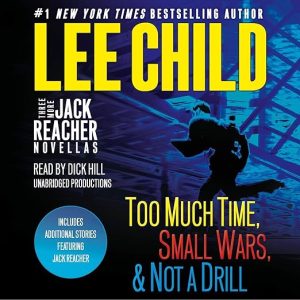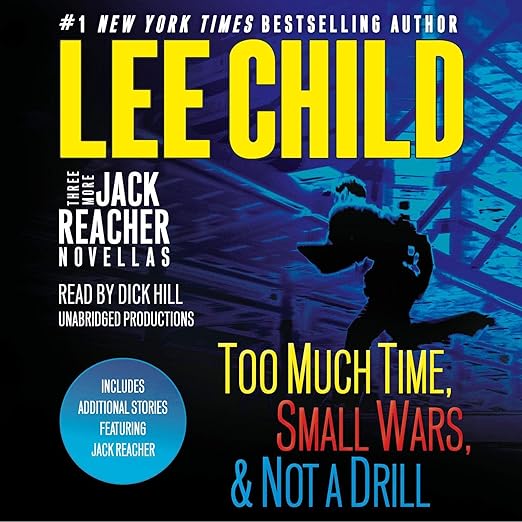
Jack Reacher works in the novella form with a logic that is not obvious until you hear Dick Hill read one aloud. The character's defining quality, a near-mechanical threat assessment that runs continuously beneath whatever social interaction is happening on the surface, is better suited to the compressed form than the longer novel sometimes allows. Three More Jack Reacher Novellas collects Lee Child's three novellas alongside six short stories in a single audiobook running 8 hours and 8 minutes, and the collection demonstrates exactly why Hill has been the voice of Reacher in audio for decades: the laconic precision of his delivery matches Child's prose style so completely that the two feel inseparable.
Where This One Lands
The anchor piece is Too Much Time, a novella set in a hollowed-out Maine town that connects directly to the novel The Midnight Line. A bag-snatching that Reacher witnesses contains more information than it appears to, and the expansion from that single observed moment into a full understanding of what is actually happening is classic Reacher narrative mechanics: the apparent simplicity of the crime concealing a more complex situation underneath. Child's skill at this particular structure, the event that turns out to be the visible surface of something deeper, is on full display.
Small Wars is the collection's most unusual piece chronologically, returning to 1989 and a younger Reacher as an MP assigned to the murder of a fellow officer. The military context here is different from the civilian-world Reacher most listeners know, and the presence of Frances Neagley and Reacher's older brother Joe adds relational texture that the road-wandering Reacher rarely accumulates. Hill's narration handles the shift in period and setting cleanly, and the younger Reacher's voice does not feel like a different character, just an earlier version of the same calculating precision.
Not a Drill returns to the familiar wandering mode, with Reacher in Maine again, this time hiking with young Canadians through forest that is suddenly and menacingly closed. The military police presence that arrives suggests a drill, but the collection's title should be enough to tell you it is not. The compression of this piece is particularly effective: the threat reveals itself in stages, and Child controls the pacing so that each stage lands with appropriate weight.
The Best Parts of Three More Jack Reacher Novellas
The six additional short stories listed in the collection, James Penney's New Identity, Everyone Talks, Maybe They Have a Tradition, Guy Walks into a Bar, No Room at the Motel, and The Picture of the Lonely Diner, are noted as appearing for the first time on audio in this edition, which makes the audiobook the primary access point for completists. Hill's reading of these shorter pieces, some of which veer into near-comic territory, maintains the character's gravity without turning Reacher into a parody of himself.
The reviewer who observed that the Reacher short stories are very entertaining and come to a conclusion that leaves you feeling satisfied is identifying something precise about Child's construction of these pieces. Short story anthologies often end unsatisfyingly because the story form requires a different contract with the reader than the novel. Child's Reacher stories tend toward complete resolution within a single contained premise, which suits the audio listening mode well: each story is a unit with a shape, and the transitions between them feel natural rather than abrupt.
What Gives Us Pause
Listeners new to Reacher should note that the collection assumes baseline familiarity with the character. The novellas are not stand-alone introduction points, and while they contain enough exposition to follow the plots, the emotional weight of the Frances Neagley scenes in Small Wars or the connection of Too Much Time to The Midnight Line will register differently for listeners with series knowledge. This is a collection for the committed, not the curious newcomer.
The 8-hour and 8-minute runtime is also worth flagging as a per-unit consideration: spread across nine entries, this is a listening experience that rewards multiple shorter sessions rather than a single sustained run. Each novella or story functions as its own episode, and the format suits the podcast-episode listening habits that many audio consumers now have.
Hill's long association with the Reacher character in audio means that his delivery has absorbed the character's particular interpretive register to the point where they are inseparable in the listener's imagination. Child's prose style relies on Reacher's internal assessment narration, the counting of exits and evaluation of opponents that runs continuously beneath social interaction, and Hill reads this material with the flat efficiency it requires. The short story format, which compresses that assessment into fewer scenes, actually makes the character's cognitive mode more visible rather than less, and the collection benefits from that compression.
Who Should Listen to Three More Jack Reacher Novellas
This audiobook is the natural next purchase for any listener who has followed the series and wants Dick Hill's definitive narration of material they may have encountered only in print. The inclusion of six stories appearing for the first time on audio is a genuine reason to choose this edition specifically. Skip this collection if you have no prior Reacher context; the character's appeal is built on accumulated knowledge of who he is and how he moves through the world, and the compressed novella form does not provide enough space to establish that from scratch. Start with one of the full novels first and return to this collection when the Dick Hill voice has already become synonymous with Reacher in your imagination.
Do I need to have read the Reacher novels before listening to Three More Jack Reacher Novellas as an audiobook?
Series familiarity helps significantly. The novellas assume you know who Reacher is, and the Too Much Time entry connects directly to The Midnight Line, which enriches the piece for listeners who have read that novel.
Are the six short stories in this audiobook available anywhere else?
The collection notes that these stories appear for the first time on audio in this edition, making it the only audiobook source for those specific entries.
Is Three More Jack Reacher Novellas a good audiobook for listeners who typically prefer full-length novels over short fiction?
Potentially. Child's novella form provides enough room for complete narrative arcs, and the reviewer consensus confirms the stories reach satisfying conclusions. But listeners who need extended character immersion may find the format less rewarding than a full Reacher novel.