Quick Take
- Narration: Krys Janae brings energy and emotional range to Elara’s first-person sections; the performance does most of the work the prose requires
- Themes: hidden identity and suppressed power, enemies-to-lovers under political pressure, belonging versus destiny
- Mood: Propulsive and romantic, with a dark streak that surfaces in waves
- Verdict: A confident series opener with a protagonist whose trauma-shaped arc gives real stakes to what could have been a generic portal fantasy setup.
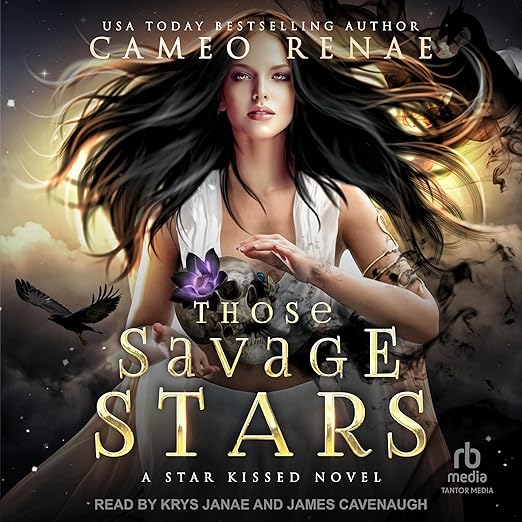
I started Those Savage Stars during a stretch of evenings when I needed something to occupy my hands and my ears simultaneously. Cameo Renae’s name had come up in two separate conversations about romantasy over the past year, and I was curious what the fuss was about. By chapter three, I understood the fuss. Renae builds her world quickly and populates it with a protagonist who earns attention rather than demanding it, and that distinction matters more than it might sound.
Elara’s backstory is compressed into the book’s opening pages with an efficiency that less confident authors struggle with: abandoned as an infant, raised in an abusive foster home, homeless as a young adult, and then, at nineteen, killing someone in a situation the synopsis deliberately leaves vague. Before she can process any of this, three men in black cloaks pull her through a magical portal into a realm called Celestria, which is conveniently in turmoil and conveniently in need of someone exactly like her. The setup is not original. What Renae does with it is.
Elara’s Suppressed Power and the Question of Who Erased Her
The most interesting structural choice in Those Savage Stars is the revelation that someone deliberately suppressed Elara’s magic before she was transported to the mortal world as an infant. That detail transforms the standard portal fantasy premise into a mystery: not just what can Elara do, but who feared what she could do enough to hide her from it. The question of her identity gets complicated by the fact that her assessment in Celestria reveals magic of a scale that should not be possible for a Changeling who has lived her whole life without access to it. Elara’s journey is less about learning her powers than about excavating the conspiracy around her origins, which is a more interesting narrative engine than a simple training arc would have provided.
Reviewers consistently praise Renae’s ability to make readers root for Elara from the opening pages, and I found this accurate. Elara’s resilience reads as the product of a specific kind of damage rather than as a generic heroine quality. She fights back against her kidnappers before she understands the situation; she catches on to the dynamics of Celestria faster than the people around her expect; she processes the revelation of her Changeling identity with wariness rather than instant acceptance. These behavioral details give the character interior consistency that the broader fantasy premise does not always earn on its own terms.
Prince Kage and the Weight of an Arranged Betrothal
Kage’s chapters are written in third-person and present a prince who has been dreaming of Elara since childhood without knowing why. That device could easily become cloying, but Renae earns it by giving Kage a reason to keep his distance that is structural rather than merely temperamental. His arranged marriage is a political obligation with real consequences for breaking it, and his awareness that his attraction to Elara is both real and dangerous produces a tension that sustains the slow-burn romance without artificially prolonging it. One reviewer praised the book for not dragging out its love triangle, and that restraint is real and appreciated by anyone who has read romantasy that strings out manufactured misunderstanding across three volumes.
The dual POV structure works because the two perspectives genuinely do not know the same things. Elara’s confusion about Celestria and Kage’s knowledge of it are productively asymmetrical, and the reader gets to hold information that neither character has fully assembled. That asymmetry keeps the mystery functional through a story that is also asking you to invest in a romance, which is a harder balance to maintain than most series openers achieve.
Krys Janae and the Sound of Dark Fantasy
Narrating a dual-POV novel with a single voice is a challenge that Krys Janae handles with real skill. Elara’s voice is sharper and more guarded; Kage’s passages get a slightly different register, slower and more formal. The distinction is not exaggerated to the point of parody but it is consistently maintained, which matters over ten hours. The action sequences, and there are several, are delivered with urgency rather than theatrics. Janae also manages the book’s tonal swings, from Elara’s darkly funny internal commentary to the genuinely menacing political intrigue around the throne of Celestria, without letting either register undermine the other.
This is the first book in the Star Kissed series, and the ending does what series openers are supposed to do: answer enough questions to feel complete while leaving the larger mystery open. The major character dynamics resolve in ways that satisfy without deflating the reader’s interest in what comes next. That is a harder balance to strike than it sounds, and Renae manages it cleanly here.
Romantasy Listeners Who Will Find This and Those Who Will Not
Those Savage Stars is for listeners who enjoy portal fantasy with genuine stakes and a female protagonist shaped by real trauma rather than convenient backstory. If you found yourself frustrated by romantasy protagonists whose suffering exists mainly for the hero to rescue them from, Elara is a corrective worth finding. Readers who prefer their fantasy free of romance elements should look elsewhere; this is firmly a romantasy from its setup forward. Fans of Chloe Gong or Jennifer L. Armentrout will feel at home here. The mature content warning in the synopsis is accurate; there is darkness in this book that earns the label, and the spice content reviewers mention is present though not dominant in this first volume.
Frequently Asked Questions
Does Those Savage Stars end on a cliffhanger, or does it resolve enough to stand on its own?
It resolves the major questions around Elara and Kage’s immediate situation while leaving the broader conspiracy about her origins open for the series. Most readers describe the ending as satisfying rather than frustrating, a functional series opener rather than a hard stop.
The synopsis mentions that Elara killed someone at nineteen. Is that backstory central to the plot or mainly character context?
It is backstory that shapes Elara’s psychology and her reasons for being homeless at the story’s opening, but the killing itself is not the mystery the plot turns on. Her suppressed magic and the conspiracy around her Changeling identity are the central puzzles.
Is the romance in Those Savage Stars slow-burn throughout, or does it resolve during this first installment?
The romance follows a slow-burn trajectory through most of the book before moving toward resolution in the final act. Reviewers note that Renae avoids dragging out the tension artificially; the emotional arc feels earned rather than manufactured.
The book is tagged as both fantasy and horror. Is there genuine horror content, or is that a loose categorization?
The horror tag reflects the dark elements of Elara’s origin story and certain aspects of the antagonist’s methods rather than sustained horror atmosphere. This reads primarily as dark romantasy; listeners expecting the dread of actual horror fiction will not find it here.