Quick Take
- Narration: Arthur Morey brings a warmth and precision to Angell’s prose that honors its rhythms without overselling them, and his delivery of the light verse and haiku sections is particularly well-judged.
- Themes: The texture of old age, literary friendship, baseball as a thread through American time
- Mood: Warm and rueful, wise without being solemn
- Verdict: One of the most pleasurable essay collections you are likely to spend ten hours with, and Morey’s narration makes a re-read feel like a first encounter.
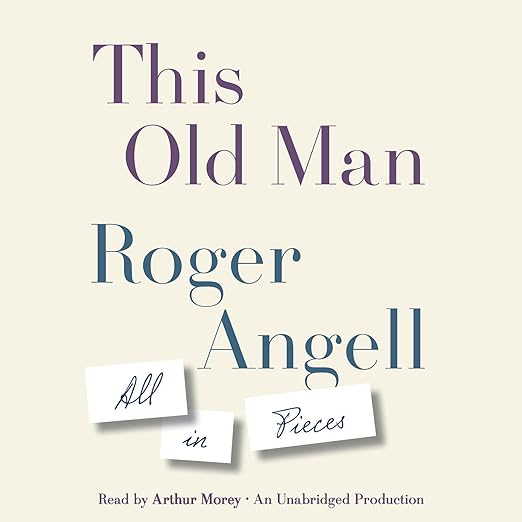
I came to Roger Angell late, as many people do who find him through his baseball writing and then discover that the baseball was almost incidental to something much larger: a sensibility shaped by decades at The New Yorker, by proximity to some of the most interesting writers and artists of the twentieth century, and by an unusual capacity for noticing things precisely without becoming precious about them. This Old Man collects writings from across Angell’s career, centered on the ASME Best Essay winner of the same name, which he published at ninety-three and which became, as he writes himself, something he did not entirely expect: widely shared, widely read, passed between generations as people recognized in it something true about how it feels to be old and still alive.
The centerpiece essay is about loss as much as it is about age. Angell catalogs the people who have died around him with a directness that is neither sentimental nor clinical, and he writes about his own failing body with a humor that does not deny the cost but refuses to be consumed by it. The famous line about the elderly being a pack of people who don’t talk much about the dead because they’d have to keep going back and adding to the roster has the quality of something you want to write down and keep. Angell has that quality throughout this collection: the quotable line that is also genuinely earned by the thinking around it.
Our Take on This Old Man
The collection moves between genres with the ease of someone who has spent a long career refusing to be categorized. There are full essays, Talk of the Town pieces from decades past, light verse, haiku, book reviews, letters to a son, Christmas greetings, and farewells to departed friends including editors, ballplayers, and writers of the caliber of John Updike. What holds all of it together is what one reviewer identifies as the complete absence of self-pity, which is not the same as stoicism. Angell feels things fully; he simply does not perform his feelings for the reader’s benefit.
The baseball writing is, as ever, superb. The farewell to Derek Jeter, the account of the final game of the 2014 World Series, the pieces on minor league and spring training baseball: these are by a writer who loves the game enough to let it mean more than the game. But this collection makes clear how much Angell’s range exceeded any single subject, and listeners who come primarily for the baseball will find themselves equally engaged by the pieces about John Updike or a Fourth of July in rural Maine.
Why Listen to This Old Man
Arthur Morey’s narration is everything the material requires. Angell’s prose has a specific cadence, clear, unhurried, precise without being cold, and Morey finds it without apparent effort. The light verse sections, which could easily become precious in the wrong hands, are read with an amiable simplicity that lets the wit land without emphasizing it. The haiku fare similarly well. Morey understands that Angell trusts his reader, which means a narrator must trust the listener in the same way and not reach for emotion the prose is already providing.
At just over ten hours, this is a long collection by essay standards, but it does not feel long in the way that a padded argument book can. The variety of forms keeps the listening experience alive across the runtime. A reviewer who picks up the book frequently to re-read individual pieces describes it as a book worth keeping next to your nightstand, and the audio version has that same quality of something you can enter at any point and find what you need.
What to Watch For in This Old Man
One reviewer notes a mild narrowness of interest: Angell writes extensively about writers he knew, and if you are not already invested in the literary world of the mid-to-late twentieth century, some of those pieces will feel more like insider conversation than open address. This is the honest limitation of an essay collection by a writer who was also an editor and who spent his career surrounded by other literary figures. The baseball pieces and the personal essays are the most universally accessible; the literary tributes reward some prior knowledge of who is being mourned.
The collection is also not organized with any particular editorial logic beyond theme, so listeners should feel free to move between pieces without worrying about sequence. Morey’s narration makes each piece feel complete on its own terms.
Who Should Listen to This Old Man
Listen if you care about American literary nonfiction, baseball writing, or essays about time and age that do not reach for comfort. Angell is among the finest prose stylists the American century produced, and this collection is a generous survey of what that means across sixty years of writing. Skip only if the subject matter of age and literary friendship is not where you are at the moment; the rewards are real, but they require some personal readiness to receive them.
Frequently Asked Questions
Is this collection mostly baseball writing, or does it range more broadly?
It ranges broadly. The centerpiece essay about old age is not about baseball at all, and the collection includes light verse, haiku, book reviews, literary tributes, personal letters, and pieces about art, war, and rural Maine. Baseball is a significant presence throughout but shares space with everything else Angell cared about across a long career.
Who is the title essay primarily addressed to, and what makes it widely shared?
The title essay was published in The New Yorker when Angell was ninety-three, and it addresses the experience of extreme old age: the physical diminishment, the losses that accumulate, and the persistence of love and humor and engagement despite all of that. It found readers across generations because it describes something true about what it means to still be here, and Angell writes it without sentimentality or performance.
Does Roger Angell discuss his relationship with John Updike in this collection?
Yes. Angell’s relationship with Updike, whom he edited at The New Yorker for decades, surfaces in several pieces, including editorial exchanges that illuminate both the friendship and the professional dynamic. The letters and correspondence sections of the collection give a texture to those literary relationships that pure memoir rarely achieves.
Is Arthur Morey’s narration consistent in quality across the different formats in the collection?
Morey handles the tonal shifts between essays, light verse, haiku, and personal correspondence with genuine range. The formal variety of the collection is what makes narration challenging, and Morey navigates it by reading each piece in its own register rather than imposing a uniform approach across all the forms.