Quick Take
- Narration: Suzanne Toren delivers a reading the Guardian called ‘careful and sensitive’; she embodies Li’s analytical calm without flattening the grief underneath it, and the result is essential.
- Themes: Surviving the unsurvivable, language’s failure in the face of loss, continuing to live as an act of will
- Mood: Still, lucid, and devastating; not in waves but in the way that cold water is cold throughout
- Verdict: A work unlike anything else you will listen to this year; not for every moment, but for listeners willing to sit with Yiyun Li inside the hardest possible subject, it is extraordinary.
I don’t know how to set up a listening context for this book the way I usually would, because the truth is that Things in Nature Merely Grow resists the usual framing. It’s not a book you pick up on a commute or queue for a long drive. I listened to it in fragments, over several days, in quiet rooms, with the kind of attention you give to something that asks you to be present rather than merely engaged. I want to be honest about that because it matters for how you approach it and what you bring to it.
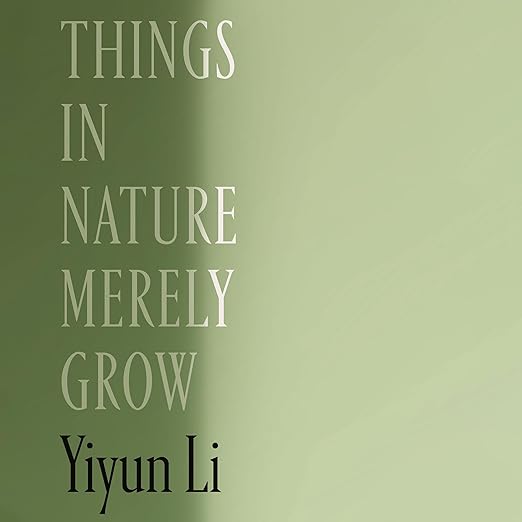
Yiyun Li lost both of her sons to suicide. Vincent died in 2017 at sixteen; James in 2024 at nineteen. This audiobook, produced by Macmillan Audio for Farrar, Straus and Giroux, was made for James. That distinction Li draws explicitly: it is not about grief or mourning, as those words frame too comfortably what refuses comfort. It is an attempt to hold a place for James through thinking, through gardening, through reading Camus and Wittgenstein, through learning the piano, and through words, which fail, and through trying anyway.
What Language Can and Cannot Do Here
Li begins with the statement that there is no good way to say what must be said. She says it anyway, and this tension, between the inadequacy of language and the necessity of attempting it, is the book’s structural core. She is a writer trained in English as her second language, and her relationship to English is part of what she examines: how a language adopted in adulthood, one that doesn’t carry the weight of childhood, might handle grief differently than a native tongue. She returns repeatedly to grammar, to tense and verb and the particular work of conjugation in the face of death.
Several readers noted that Li’s prose is unusually lucid for material this heavy, and that lucidity is not avoidance. One reviewer, describing themselves as having some background overlap with Li’s immigrant intellectual experience, wrote about the book with the care you give to something that met you where you actually were. Another described it as a book “where language feels insufficient,” and then tried anyway to write about it at length, which is what Li models. The book generates this response in its readers. It teaches, by demonstration, how to approach the impossible subject.
Suzanne Toren and the Calibration of a Voice
The Guardian’s description of Toren’s narration as “a careful and sensitive reading, embodying the author’s calmly analytical mind” is precise and I won’t improve on it. What Toren achieves is the most difficult thing in literary narration: she reads grief that has been transmuted into prose without turning either the grief or the prose into performance. Li’s writing is analytical in a way that could, in less capable hands, feel like emotional suppression. Toren reads it as what it is: a particular form of courage, the courage of someone who has decided that reason is what she still has and she will use it to hold the place where James was.
The audiobook runs under five hours, which is right. This is a short book because it couldn’t have been longer; Li says what can be said and stops. Toren’s pacing respects this economy completely, and the silences within the reading carry as much weight as the words.
The References Li Reaches For
Li moves through the book accompanied by a range of writers and thinkers she has loved or is learning: Camus’s relationship to absurdity, Wittgenstein’s limits of language, Shakespeare, various garden writers whose relationship to growth and patience she finds useful. One reviewer noted these references are filled with “interesting” touch points, and they are, but they’re not decoration. Li uses each reference the way you use a familiar object when everything else is unfamiliar: to have something to hold while you think. The reader doesn’t need to know these sources to follow her thinking, but knowing some of them deepens the texture considerably.
The gardening sections are among the book’s most affecting, precisely because they are the most concrete. Li describes what actually grows, what she tends, what returns each season without being asked to. The verb that does not die is to be, she writes. She finds in the garden a grammar for what she needs to say.
Who Should Listen, and When
This audiobook is available as a free listen on Audible, and it runs four hours and fifty-six minutes. The length alone shouldn’t determine whether you listen to it. What should determine it is whether you are willing to be altered by what you hear: not comforted, not instructed, but altered. Things in Nature Merely Grow is for readers who have suffered loss and found language inadequate for it. It is for readers interested in what serious literary intelligence does when confronted with the worst thing. It is for anyone who has wondered whether it is possible to remain a thinker after something unthinkable happens. Li’s answer, enacted across every page, is that it is not only possible but necessary, and she shows you how. There are books that are important and books that are true, and the rarest books are both simultaneously. This is one of those. It will not make you feel better. It will make you feel more honestly whatever you actually feel, which is a harder and more lasting gift.
Frequently Asked Questions
Is this audiobook appropriate to listen to while grieving a loss yourself?
That depends entirely on where you are in your grief and what you need from a book right now. Li does not offer consolation in any traditional sense, and some readers in acute grief may find that difficult. Others have found it exactly what they needed because it refuses false comfort. Know yourself before you begin.
How does Yiyun Li’s background as a fiction writer shape this nonfiction work?
Significantly. Li brings a novelist’s attention to sentence-level detail and a short story writer’s economy to the book’s structure. The prose is precise in ways that literary nonfiction rarely is, and the analysis of language itself reflects a writer’s professional relationship to words as instruments of meaning.
Does the book address the cultural context of suicide in Li’s family in any depth?
Li touches on the cultural pressures and expectations that shaped her own upbringing, and one reviewer noted she treats her sons with deliberate care that contrasts with how she was treated by her own mother. However, the book doesn’t seek to explain the deaths so much as to sit with the fact of them and build a space where James continues to exist.
Is Suzanne Toren’s narration available alongside a written version, and does format matter here?
The book originated as an Audible production from Macmillan Audio, making it particularly suited to the audio format. Toren’s reading adds a dimension that silent reading cannot replicate, and the Guardian specifically cited her performance as essential to the work. The audio format is not incidental here; it is the intended experience.