Quick Take
- Narration: Elizabeth Sastre handles the wartime English setting and the three-sibling ensemble with period-appropriate restraint and genuine warmth.
- Themes: Finding your gift under duress, the legitimacy of artistic education, family loyalty under wartime strain
- Mood: Cozy and wartime-tinged, with the gentle pace of a mid-century English children’s classic
- Verdict: A worthy addition to the Streatfeild canon for fans of Ballet Shoes, with Sastre’s narration making the Academy scenes come alive particularly well in audio.
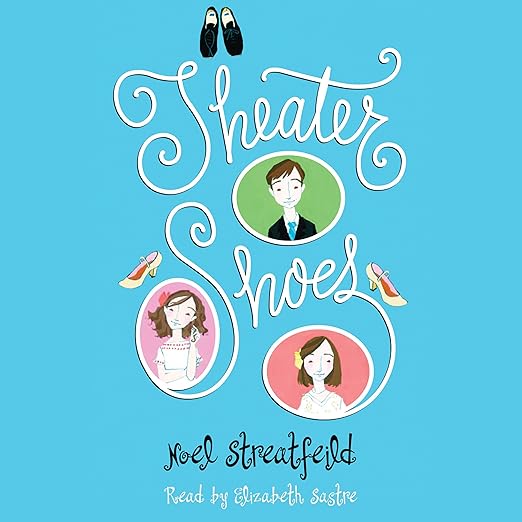
I came to Theater Shoes already carrying affection for Ballet Shoes, which is the better-known Streatfeild novel and the one most adults who grew up with this tradition will have encountered first. Theater Shoes operates in the same world, references the same Academy, and maintains the same structural premise: children with natural abilities are placed in an environment that develops them under conditions that require adult skills they have not yet fully acquired. What distinguishes Theater Shoes from Ballet Shoes is the wartime context and the fact that the three Fossil children who made the Academy famous are now historical figures within the book’s world, which gives Sorrel, Mark, and Holly’s enrollment a layer of inheritance and expectation that Ballet Shoes never had to navigate.
Sorrel, the eldest and most dramatically gifted of the three orphaned siblings, arrives at the Academy already carrying her actress grandmother’s expectations and her military father’s more practical values. Mark can sing. Holly charms everyone, apparently without effort. Their grandmother, who has arranged the enrollment and is herself a famous actress, represents a tradition the children have to accept before they can transcend it. Noel Streatfeild understands that talent operates within context, and that what children need is not just instruction but the experience of finding out what kind of instruction matches what kind of gift. This is the quiet subject of the Shoe Books, and Theater Shoes makes it explicit in a way that Ballet Shoes handles more obliquely.
Elizabeth Sastre and the English Class Register
Wartime English children’s fiction carries a very specific class and social register that is easy to flatten and difficult to render authentically. Elizabeth Sastre navigates this with more care than many narrators of period material manage. Her differentiation between the Academy’s various teachers and the three siblings preserves the novel’s social comedy without making it a cultural relic. The wartime setting adds what one reviewer accurately called a gentle depth: the adults in the story are absent or preoccupied for reasons that are never dramatized but always present. Sastre’s pacing accommodates Streatfeild’s longer, more discursive sentences without losing the narrative thread, which matters for younger listeners encountering mid-century prose rhythms for the first time.
The Academy as Argument About Education
The Children’s Academy of Dancing and Stage Training is not simply a setting. It is an argument about what constitutes a proper education. The tension Streatfeild establishes between the Academy’s training and the conventional schooling the children’s parents would have wanted is handled with a complexity unusual for children’s fiction of any era. The Academy teaches children to inhabit other people, which is also what the novel does with its readers. Sorrel’s dramatic flair, Mark’s singing, and Holly’s ineffable charm are presented as forms of intelligence that the Academy exists to develop, not performance tricks. That framing gives the book its staying power across generations of readers.
Who Will Love This and Who Should Start Elsewhere
Readers who have already spent time with Ballet Shoes will find Theater Shoes a natural and rewarding companion. The cross-reference to the earlier novel’s characters adds resonance for those who know the source material, though Streatfeild provides enough context that new readers will not be lost. The pacing and tone are firmly mid-century English children’s fiction, which means readers expecting contemporary-style plotting may find the story slower and more episodic than they prefer. For the right listener, particularly those drawn to performing arts fiction and to the particular warmth of the British children’s classic tradition, Theater Shoes at seven hours and six minutes is a deeply comfortable listen.
Frequently Asked Questions
Do you need to have read Ballet Shoes before listening to Theater Shoes?
Theater Shoes stands on its own narrative legs. Streatfeild provides sufficient context for readers new to the world. However, listeners who have already read Ballet Shoes will get additional pleasure from the way Theater Shoes acknowledges and builds on its predecessor’s legacy.
How does Elizabeth Sastre handle the three sibling characters differently in her narration?
Sastre gives each sibling a distinct vocal quality without exaggerating the differences. Sorrel’s dramatic seriousness, Mark’s quieter confidence, and Holly’s natural ease are each communicated through subtle shifts in tone and pace rather than performer-style character voices, which suits the period register of the material.
Is the wartime setting central to the plot, or is it background detail?
The wartime setting is structural rather than plot-driving. The children are orphaned in the context of the war, their father is away at sea, and the absence of normal adult oversight shapes what happens to them. But Theater Shoes is not a war story. It is a story about finding your gift while the world around you is in suspension.
How does Theater Shoes compare to Dancing Shoes and Skating Shoes within the Shoe Books series?
Each Shoe Books installment focuses on different children and different performing arts disciplines. Theater Shoes is generally considered the most emotionally substantial after Ballet Shoes, in part because the three siblings are drawn with more interiority than some other entries. Listeners who enjoy this one typically find Skating Shoes a natural next step.