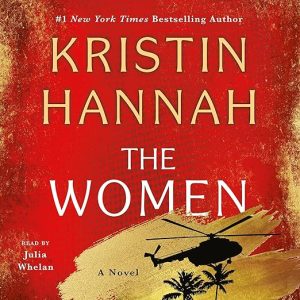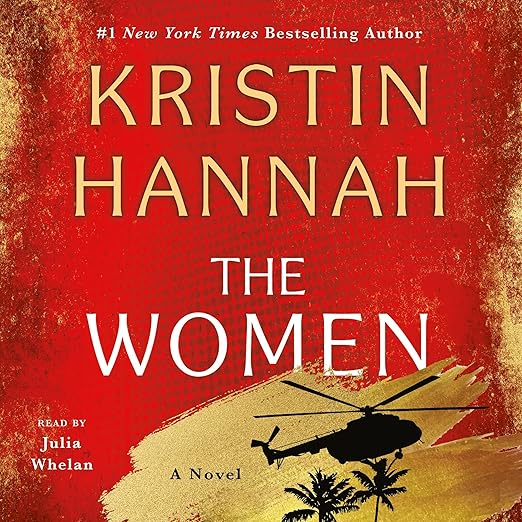
I started The Women on a Saturday morning with the intention of listening for an hour or two, and I was still in my chair when it got dark outside. Kristin Hannah has a particular skill for making the historical personal, for finding the single specific life inside the large event, and in Frankie McGrath she has built one of her most fully realized characters. The setup is not subtle in its moral stakes: nursing student from a sheltered Southern California family joins the Army Nurse Corps in 1965 and follows her brother to Vietnam. What happens in the fifteen hours that follow is neither simple nor comfortable, and Julia Whelan's narration ensures that you feel every moment of it.
Hannah's Vietnam is not primarily a battlefield. It is an operating room, a recovery ward, a series of spaces where young women are asked to manage the consequences of violence while being told they are not really there, not really veterans, not really part of the story that will be told later. The Women is, at its core, about that erasure: the gap between what Frankie and her fellow nurses did and what their country chose to acknowledge.
Reviewer Joel Burcat describes Hannah as giving a deep dive into what Frankie encounters in Vietnam, which is accurate as far as it goes but undersells the structural achievement. The Vietnam sections are harrowing and meticulously researched, but the second act, the homecoming, is where the book finds its real subject. Coming back to an America divided over a war it would rather forget, to protesters who see veterans as symbols of something they despise, to a family that does not know how to receive what Frankie has become: this is the part of the Vietnam narrative that popular culture has most consistently gotten wrong, and Hannah gets it right.
Reviewer C, who identifies as a historian focusing on women's military history, specifically cites the book's historical accuracy, and that endorsement carries weight. Hannah did her research. The portrayal of women's experiences in Vietnam and of what happened to many of them after they returned is grounded in testimony and documentation, not in the sentimentalized version that made female veterans invisible by refusing to acknowledge that they had been warriors in all but the official designation.
Whelan Inhabits Frankie From the Inside
Julia Whelan. The Washington Post's description of her as having an empathy that is palpable is the most precise critical observation about her performance, and it is exactly right. Whelan does something that the best literary narrators do: she inhabits the character's interiority rather than performing it from the outside. Frankie's transitions from naive idealism to competence to trauma to the complicated aftermath of survival are carried in Whelan's voice with a nuance that would be difficult to achieve in print and becomes overwhelming in audio.
Reviewer diana jaycox, who is a Vietnam-era Army nurse herself, writes about her own hesitation before reading the book and her eventual feeling of being seen. That response from someone who lived a version of the experience is the best evidence for what Hannah and Whelan achieve together. The book is not exploiting its subject. It is honoring it with enough care to hold up under scrutiny from the people who were actually there.
Fifteen Hours of Love, Addiction, and Loss
Reviewer Carole Macdonald notes the many facets that make this a rich book club choice: love, infidelity, mortality, morality, addiction, parental disappointment. That list is accurate and also serves as a content advisory. This is not a book that treats war as primarily exciting. The trauma that Frankie carries home is depicted with enough specificity to be difficult listening for anyone who has experienced or is close to someone who has experienced PTSD, addiction, or the particular kind of alienation that combat survivors sometimes describe.
The length is also substantial at nearly fifteen hours. Hannah's novels tend to earn their length, and this one does, but listeners should know that the pacing in the middle section is deliberate rather than fast. The compression of years of post-Vietnam struggle requires the space Hannah gives it.
Whelan's Narration Is Not Just Supplemental
Readers who loved The Nightingale will find this thematically and emotionally continuous with that novel's project of recovering women's experiences from historical erasure. Listeners interested in Vietnam-era American history, particularly the experiences of women who served, will find this one of the most carefully researched fictional treatments available. Julia Whelan's performance alone justifies the audio format for anyone who might otherwise consider the print edition. This is one of those audiobooks where the narration is not supplemental to the experience but integral to it.
The Short Version
- Voice: Julia Whelan won a 2025 Audie Award for Best Fiction Narrator for this performance, and the recognition is earned, her range across Frankie's emotional arc is extraordinary, and the Washington Post's description of her empathy as palpable is not an overstatement.
- Big ideas: Women's invisible service and sacrifice, the trauma of homecoming, friendship under impossible conditions
- Atmosphere: Emotionally intense and deeply immersive, with the weight of historical injustice running underneath every scene
- Worth it?: Kristin Hannah's most ambitious historical novel in years, and Julia Whelan's narration elevates it to something close to essential.
Questions Listeners Ask
Is The Women appropriate for listeners who are sensitive to depictions of trauma, medical gore, or PTSD?
The book is explicit about both the physical realities of combat nursing and the psychological aftermath of Vietnam for its characters. Listeners who are sensitive to these subjects should approach with awareness rather than avoidance, the depictions serve the narrative rather than being gratuitous, but they are present throughout.
How does Julia Whelan's narration compare to her work on other audiobooks?
Whelan is a widely admired narrator across multiple genres, and The Women is considered among her strongest performances. She won a 2025 Audie Award for Best Fiction Narrator for this recording. The Washington Post specifically praised her limber, empathetic delivery.
Does The Women require prior knowledge of Vietnam War history to follow and appreciate?
No. Hannah provides enough historical context within the narrative itself. Listeners who do have Vietnam-era knowledge will recognize the accuracy of the period detail, but the book is fully accessible to listeners coming to the subject without background.