Quick Take
- Narration: Simon Vance is one of the gold-standard voices for epic fantasy, and he handles Hamilton’s Norse-inflected world with the authority and pace the story demands.
- Themes: Forging identity through adversity, the cost of revenge, fate versus choice
- Mood: Propulsive and immersive, darkening steadily across all three books
- Verdict: A complete, emotionally committed Viking-inspired fantasy trilogy that delivers genuine character investment across thirty-two hours.
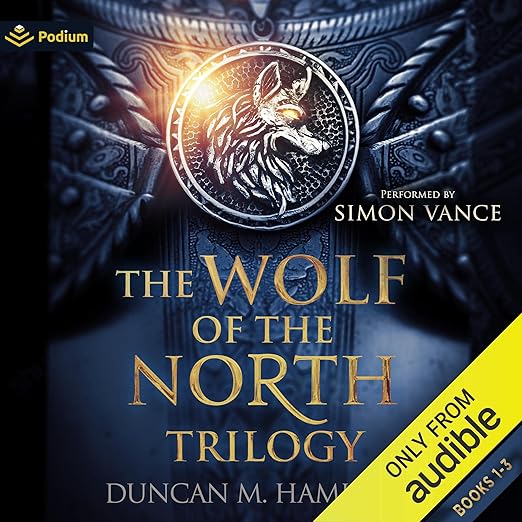
There is a particular satisfaction in starting a boxed set on a Friday evening with no plans for the weekend. That was how I came to Duncan M. Hamilton’s Wolf of the North Trilogy – three books collected into a single thirty-two-hour Audible production narrated by Simon Vance. By Sunday night I was somewhere in the third volume, and the reviewer in me was trying to stay analytical while the reader in me had long since stopped taking notes.
Hamilton writes Viking-adjacent epic fantasy, set in the fictional Northlands and rooted in Norse mythology without being a direct retelling of it. The trilogy follows Wulfric from boyhood through the full arc of his life – from a bullied, timid child to the warrior-hero the Northlands calls the Wolf of the North. It is a traditional hero’s journey structure, but Hamilton executes it with enough psychological specificity to keep it from feeling formulaic. Wulfric’s transformation is earned, and more importantly, it costs him something real.
Our Take on The Wolf of the North Trilogy
What distinguishes Hamilton’s writing from the considerable mass of self-published epic fantasy is his sense of consequence. Characters die when the story logic demands it, relationships fracture under realistic pressure, and the victories are rarely clean. One reviewer called the ending “depressing” because all three major lovers wind up dead; another praised the same ending as “very well done.” That division of opinion is actually a mark in the trilogy’s favor – it is making choices rather than hedging them.
The magic system is restrained, which suits the Norse register. Hamilton is more interested in the human machinery of war, loyalty, and grief than in elaborate metaphysics. The second book, Jorundyr’s Path, broadens the world significantly, taking Wulfric from the highlands he knows into the dry plains of Darvaros and the urban streets of Elzburg. That expansion could have diffused the story’s intimacy, but Hamilton manages it by keeping Wulfric’s interiority consistent even as the world around him changes.
Why Listen to The Wolf of the North Trilogy
Simon Vance is one of those narrators who has been so consistently good for so long that listeners can forget how much work goes into that consistency. His voice carries the weight of the Northlands convincingly, distinguishing between the terse northern warriors and the more polished southern characters without resorting to exaggerated accents. For a boxed set of this length – just over thirty-two hours – a narrator of Vance’s reliability matters enormously. The listening experience stays smooth across all three books, which is not guaranteed even with capable performers.
The audio format suits this kind of sweeping saga. Hamilton’s prose is clean and purposeful rather than ornate, which means nothing is lost in the translation to audio. The pacing across all three volumes is well-handled, with enough variation in scene tempo that thirty-two hours never becomes monotonous.
What to Watch For in The Wolf of the North Trilogy
Readers expecting a tidy heroic resolution should understand that Hamilton is more interested in the shape of a life than in triumphant endings. The trilogy’s emotional register darkens considerably from book one to book three, and the final pages are elegiac rather than celebratory. If you come into this expecting the satisfaction of a traditional fantasy climax, you may feel wrongfooted. If you come in understanding that this is closer in spirit to the Norse sagas that inspired it – where greatness and tragedy are inseparable – you will find the ending entirely coherent.
The first book spends considerable time on Wulfric’s childhood and the circumstances that shape him, which some listeners find slow before the action momentum builds. Stick with it through the first five or six hours; the investment pays off substantially.
Who Should Listen to The Wolf of the North Trilogy
This collection is ideal for listeners who want a complete epic fantasy narrative without waiting for future installments – all three books are here, and the story is genuinely finished. Fans of Joe Abercrombie’s First Law trilogy, Bernard Cornwell’s Saxon Stories, or David Gemmell’s Legend will find Hamilton’s sensibility recognizable: morally serious, action-driven, and unsparing about the human cost of violence. Listeners who prefer lighter fantasy or who need a happily-ever-after will want to look elsewhere. For the right reader, though, this is exactly the kind of absorbed, immersive weekend listen that makes the format worth its subscription.
Frequently Asked Questions
Do all three books in The Wolf of the North Trilogy need to be read in order?
Yes, absolutely. This is a single continuous narrative arc following Wulfric’s life from childhood to its conclusion. The three books are not standalone stories; the second and third volumes build directly on the events and relationships established in the first.
How dark does the trilogy get by the end?
Quite dark. Hamilton does not shy away from loss, and the final volume carries a distinctly elegiac tone. Several major characters die, including romantic leads, and the ending is more in the spirit of Norse saga tragedy than conventional fantasy triumph. Readers who found the first book’s tone manageable should be prepared for the register to shift.
Is Simon Vance’s narration consistent across all three books in the boxed set?
Yes. The production treats all three books as one continuous audio experience, and Vance maintains vocal consistency across the full thirty-two hours. Character voices and tonal register remain stable, which matters significantly for a collection of this length.
How does The Wolf of the North compare to Duncan Hamilton’s other series?
Reviewers who have read multiple Hamilton series describe this trilogy as among his best work, with particularly strong character development and a well-realized world. The series shares his characteristic blend of restrained magic and psychologically grounded action with his other work, but the Norse-inflected setting gives it a distinctive atmosphere.