Quick Take
- Narration: Victoria Aston handles both the dark mythological weight and the slow-burn romantic tension with authority, giving Bryony and Evander distinct emotional registers that make their chemistry audible.
- Themes: Sacrifice and resurrection as political currency, immortality as burden, forbidden desire across the divine-mortal divide
- Mood: Dark and atmospheric, with addictive romantic tension and genuine mythological menace
- Verdict: A standalone romantasy that earns its length, best for readers who want their gods and assassins laced with genuine emotional consequence rather than spectacle alone.
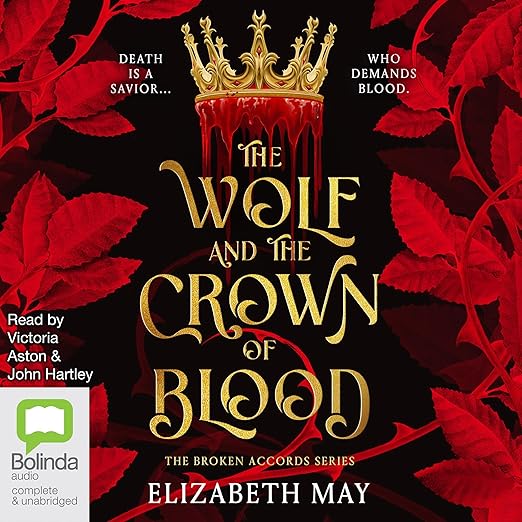
I started this one on a Thursday night and did not surface fully until Saturday morning. There is a specific kind of romantasy that works in audio, the kind where the prose has enough density to reward slow listening and enough momentum to make you stay for one more chapter, and The Wolf and the Crown of Blood sits firmly in that category. Elizabeth May has built a world where death is institutional, royal blood is political currency, and an immortal assassin has spent centuries perfecting a skill he is no longer certain he wants to use.
Bryony Devaliant, the princess at the center of this story, dies every year. It is written into the treaty between her kingdom and the gods, and she has been resurrected enough times that she has developed a particular relationship with her own mortality, not fearless exactly, but fluent with it. When the god-king’s enforcer, Evander, is sent to kill her under circumstances that don’t require the annual treaty, the setup is doing something more interesting than a standard assassin-falls-for-target plot. Both characters are already trapped by systems older than either of them, and that shared captivity is where the chemistry begins.
Our Take on The Wolf and the Crown of Blood
May is writing in the higher-spice romantasy space, and she is doing it with more structural sophistication than the genre often delivers. The book is a standalone, which is relatively unusual for this category, and the discipline that entails shows in how the plot and the romance are paced against each other. The first half is doing worldbuilding work that requires patience. Evander’s centuries of accumulated trauma, the theological and political machinery that governs Vartena, the specific conditions under which the treaty can be broken, all of this needs to be established before the stakes can operate. Listeners who stay with the slower opening will find themselves invested in a way that makes the second half pay off considerably.
Victoria Aston’s narration is a strong contributor to that payoff. She differentiates Bryony and Evander through vocal register rather than accent, which is the right approach for a story this invested in the emotional interior of both characters. Bryony’s fluency with death reads as a kind of practiced quiet. Evander’s centuries of violence read as control that is wearing down. When those two registers start leaking into each other, Aston captures the texture of it without overselling the moment.
Why Listen to The Wolf and the Crown of Blood
The mythology here is original rather than borrowed. May has constructed a theology in which gods and mortals have a treaty relationship that is simultaneously sacred and deeply exploitative, and the framing that when gods fall in love with mortals, mortals are always the ones to break is earned rather than decorative. The romantic tension doesn’t exist in spite of the mythological architecture but because of it. Every gesture Evander makes toward Bryony is a gesture against the entire order he has enforced for centuries. That weight is felt.
The spice level, which multiple reviewers flag, is real. This is not a clean romance with implied heat. Readers who want that should be directed elsewhere. For those who want the spice to feel consequential rather than perfunctory, to emerge from character and circumstance rather than just opportunity, this delivers. The relationship earns its physical intensity through the slow accumulation of everything that precedes it.
What to Watch For in The Wolf and the Crown of Blood
The critical review in the data raises a fair point about the first thirty percent: the mutual hatred between Evander and Bryony doesn’t always feel motivated by internal logic in those early chapters. There is a lot of telling rather than showing in the monologue sections, where both characters describe feelings of soul-crushing pain and hatred without those feelings being made viscerally legible. For some listeners this will be a genuine obstacle. The reviewer who almost abandoned the book at that point is not being uncharitable.
The second half of the book is where May’s control fully asserts itself, and by most accounts the resolution more than compensates for the earlier friction. The 18-plus-hour runtime is long for a standalone romantasy, but the story uses most of that space productively. Listeners who invest in the worldbuilding will not feel the length the same way those who came primarily for the romance might.
Who Should Listen to The Wolf and the Crown of Blood
This is for readers who want their romantasy with actual theological stakes and a morally serious treatment of what it means to be immortal. The spice is higher than clean romance, the darkness is real rather than atmospheric, and the mythology is original enough to feel like a world rather than a backdrop. Those who need fast romantic payoff and minimal worldbuilding should look for something shorter. Those willing to let the mythology breathe will find a romance that lands with considerably more force for the patience it required.
Frequently Asked Questions
Is The Wolf and the Crown of Blood a standalone audiobook or the first in a series?
It is marketed as a standalone, and the Broken Accords series listing at number one suggests more entries in that world may follow. Based on available information, this book resolves its central narrative arc internally without requiring a sequel to feel complete.
How dark does this romantasy get, is it more dark fantasy or dark romance?
It sits closer to dark romance with a substantial fantasy framework. The violence is real, the mythological stakes involve literal annual death and resurrection, and the emotional content deals with centuries of trauma. Reviewers describe the tone as genuinely dark rather than aesthetically dark.
Does the first thirty percent of this audiobook’s slow pacing affect the overall experience significantly?
Some listeners do report needing to push through the opening sections, where the internal monologues can feel more told than shown. The consensus from reviewers is that the second half compensates substantially. If you can commit to an hour before judging momentum, you’ll be better positioned to evaluate whether it’s for you.
How does Victoria Aston differentiate between Bryony and Evander in the narration?
Aston works through emotional register rather than heavy accent work. Bryony’s voice carries a kind of practiced equanimity about death; Evander’s carries centuries of controlled violence that is beginning to erode. The distinction becomes more audible as both characters are drawn out of their established patterns.