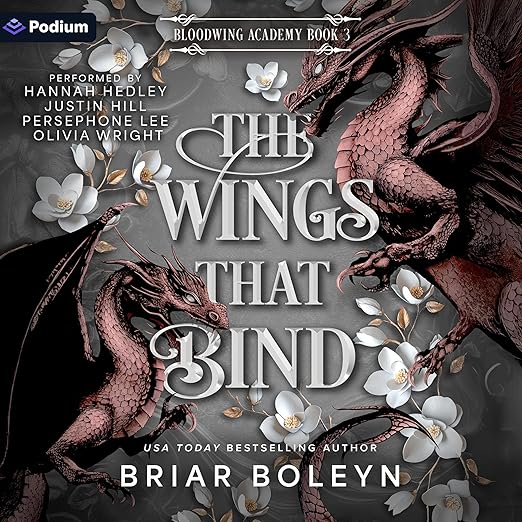
Quick Take
- Narration: Hannah Hedley handles the expanded five-POV structure with skill, giving each character a distinct emotional signature without losing the dark academic atmosphere.
- Themes: Loyalty under pressure, morally gray power dynamics, dragon bonds and their costs
- Mood: Dark, emotionally relentless, and propulsive, a series accelerating rather than coasting
- Verdict: A third installment that expands its world significantly and delivers the emotional payoff readers have been waiting for, provided you’ve done your homework with Books One and Two.
I started The Wings That Bind late on a Friday night, fully intending to listen to just a chapter or two. I turned it off somewhere around two in the morning, not because I wanted to but because I had run out of ways to justify staying awake. This is the kind of dark fantasy that does something specific to your sense of time. Bloodwing Academy is not a comfortable place, and Briar Boleyn does not make it comfortable, but there’s a pull to it that’s hard to explain and harder to resist once you’re inside it.
This is the third book in the Bloodwing Academy series, and I want to be transparent about that structural reality upfront: The Wings That Bind is not an entry point. The synopsis makes this clear with its shorthand, a second dragon awakened, Nyxaris on the brink of death, Blake’s betrayal still fresh, and the novel proceeds immediately from where Book Two left off. If you haven’t spent time with Medra, Blake, and the politics of Sangratha already, this is not the place to start.
Our Take on The Wings That Bind
What Boleyn does in Book Three that feels new and necessary is the expansion of the POV structure. Where earlier books in the series were more narrowly focused, this installment adds perspectives for Nevell, Medra, Blake, Regan, and Florence, five viewpoints that open the world considerably. Some readers find this multiplicity initially disorienting, but the payoff is substantial: by giving us access to characters who have been opaque or secondary, Boleyn makes the moral landscape of Sangratha genuinely complex rather than simply dark.
Blake’s arc is the element that reviewers consistently highlight, and with reason. The trajectory from relentless tormentor to something much more complicated is earned in ways that slow-burn character development usually isn’t. The fact that Medra and Blake are finally on the same page at the start of Book Three, rather than still locked in the earlier dynamic, gives the novel room to explore what comes after the initial tension resolves, which is often where dark fantasy series lose their footing. Boleyn doesn’t lose hers.
Why Listen to The Wings That Bind
Hannah Hedley’s narration is one of the production’s genuine assets. The five-POV structure could have become an audiobook liability, a reason for confusion about who is speaking and what register we’re supposed to be in, but Hedley differentiates her characters clearly without turning the performance into a one-woman show. Her handling of the emotional climaxes, and there are several significant ones, is particularly strong. One reviewer described going through an entire range of emotions across the final chapters, from fury to heartbreak to joy, and the narration is a meaningful part of why those emotional shifts land with the force they do.
The world-building in Book Three is denser than earlier installments, introducing new factions, a new headmaster, and the implications of a second awakened dragon with corrupted power. Hedley navigates this material without losing momentum, which is a real technical achievement across nearly seventeen hours of listening.
What to Watch For in The Wings That Bind
The trigger warnings mentioned in the synopsis are not decorative. Boleyn’s note that this series tackles mature themes and advises consulting trigger warnings before beginning should be taken seriously. The content is morally gray in the way that phrase is often used casually but here means genuinely: characters make choices that cause real harm, and the narrative doesn’t rush to comfort the reader afterward.
The ending, while emotionally satisfying in some dimensions, does what third installments in ongoing dark fantasy series frequently do: it resolves some threads and opens others, with at least one revelation that multiple reviewers describe as requiring the next book immediately. If you’re someone who waits for complete series before starting, this may not be the moment to invest.
Who Should Listen to The Wings That Bind
Listen if you’ve already read the first two Bloodwing Academy books and are ready for the series to expand its scope, deepen its character work, and actually deliver on the relationship dynamics it has been building. This is a book for committed series readers who want the payoff that slow-burn setup earns.
Skip it entirely as a starting point and go back to Book One. The Wings That Bind requires the full context of what came before, the specific betrayals, bonds, and history that Boleyn has established, and it rewards readers who have that context with the kind of emotionally devastating third-act delivery that fantasy series should aspire to.
Frequently Asked Questions
Can The Wings That Bind be read as a standalone, or is series order mandatory?
Series order is mandatory. The novel begins immediately where Book Two ends, references prior events and relationships throughout, and assumes complete familiarity with the world of Bloodwing Academy and the characters established in the earlier books. Starting here without that context would be genuinely disorienting.
How does the five-POV structure in Book Three compare to the earlier books in the series?
The Wings That Bind significantly expands the number of perspectives compared to the earlier installments, which were more narrowly focused. Reviewers note this initially feels like a bigger shift but ultimately serves the expanded scope of the series’ third act, giving access to characters who had been more opaque previously and opening up the world’s political and emotional complexity.
Are the trigger warnings for this series significant, and what kind of content do they cover?
The author explicitly advises consulting trigger warnings before beginning the series, and based on reviewer descriptions of the content, that advice is genuine rather than precautionary boilerplate. The series involves morally gray and black characterization, power dynamics, violence, and situations with real emotional weight. Specific trigger warning details are available on the author’s website and in the series’ front matter.
How does Hannah Hedley’s narration handle the jump between five different character perspectives?
Hedley differentiates the five POV characters through consistent vocal and emotional signatures rather than dramatically distinct voices, which keeps the performance coherent over nearly seventeen hours. Reviewers who noted the multi-POV structure as a potential concern before listening consistently find the audiobook version easier to navigate than they expected.