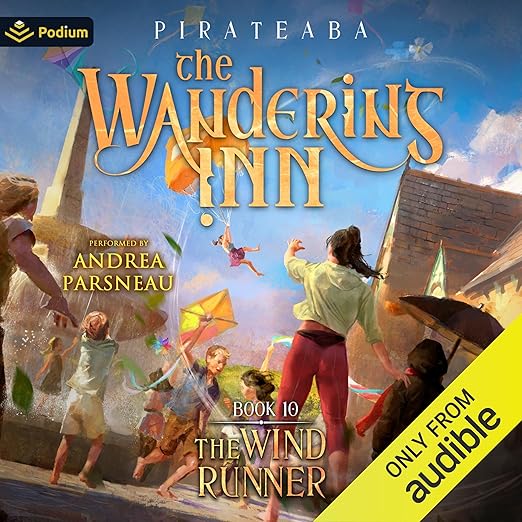
Quick Take
- Narration: Andrea Parsneau handles the vast ensemble of The Wandering Inn with practiced authority, differentiating voices across dozens of characters over 36 hours.
- Themes: Recovery and grief after war, the weight of interconnected fates, the slow renewal that follows catastrophic loss
- Mood: Epic and unhurried, emotionally generous, occasionally demanding in its scope
- Verdict: The tenth volume of The Wandering Inn rewards the series’ most committed listeners with some of its most emotionally resonant material, but this is not the entry point anyone should use.
There is something almost ritualistic about returning to The Wandering Inn. I started The Wind Runner on a quiet Tuesday evening, knowing I was looking at more than thirty-six hours of audio and knowing I would not regret a single one of them. By the time pirateaba had brought Ryoka Griffin back into focus after her long absence from the narrative, a return that has readers genuinely celebrating, I had already lost track of which part of my week I was supposed to be living in. That’s the particular gravity of this series at its best.
The Wind Runner is the tenth volume in a web serial that has grown into something genuinely difficult to categorize. It began as a LitRPG isekai in the familiar mold and gradually became something far stranger and more ambitious. By book ten, the system mechanics are almost incidental. What pirateaba is writing now is closer to sprawling literary fantasy, a chronicle of a world dealing with the aftermath of war, grief, and the slow process of figuring out what comes next. The volume’s framing, floodwaters receding, a ruler fallen, the renewal of summer after the horrors of the conflict, announces its emotional register clearly. This is a book about what happens after the fighting stops.
The Scale That Either Holds You or Loses You
The honest thing to say about The Wandering Inn as a series is that its scale is both its greatest strength and the thing most likely to frustrate listeners who want a tighter narrative. The Wind Runner juggles multiple major storylines simultaneously: Ryoka in Izril’s north, Geneva and her companions falling under the shadow of the Titan of Baleros in the jungles of the continent, Erin Solstice grieving and pulling her found family close. One reviewer puts the challenge plainly, chapters that run to 20,000 words each, side characters who sometimes dominate long stretches before their relevance to the main thread becomes clear.
But that same reviewer, after noting the difficulty, calls the series “wonderfully written” and praises how pirateaba ties those tangents back in. That’s the contract this series asks you to sign: patience for a scope that occasionally sprawls beyond what feels manageable, in exchange for a world that feels genuinely alive and a cast of characters whose development across ten volumes is remarkable. The Wind Runner honors that contract. The emotional payoffs here, particularly around Erin’s grief and the quieter scenes of recovery, are among the series’ most affecting.
What Ryoka’s Return Means at This Stage
One of the small pleasures of reading the reviews for this volume is seeing how many readers simply wrote “Yay! More Ryoka action! After her being missing for pretty long”, which captures something real about how pirateaba manages reader investment across a narrative this size. The Wind Runner gives Ryoka substantial page time after her relative absence in earlier volumes, and the renewed focus on her story is one of the book’s genuine pleasures. Her relationship to Izril’s north, to the ongoing consequences of earlier events, and to her own evolving sense of purpose makes this one of her stronger volumes in the series.
The Quarass being dead, the King of Destruction’s war continuing in the background, the Titan of Baleros emerging as a new force in the Balerian jungle, all of this is handled with the kind of confident world-building that has made this series remarkable. pirateaba does not over-explain. The world has been built slowly enough that returning readers feel the weight of these events without needing everything spelled out.
Andrea Parsneau and the Long Haul
Thirty-six hours of audio is a serious commitment, and Andrea Parsneau has been the voice of this series long enough that her performance here carries its own accumulated history. She differentiates the enormous cast with consistency, handles the shifts between action, comedy, grief, and cosmic strangeness without losing the thread, and brings a warmth to the ensemble scenes that makes the quieter moments feel earned. One review mentions the series’ depiction of depression and the slow road to recovery as something that landed with unusual honesty, and Parsneau’s handling of those sections is measured and real rather than performative.
For new listeners, thirty-six hours for a tenth volume means you have somewhere in the vicinity of three hundred combined hours of prior material to absorb first. That is simply the reality of this series, and it is not a criticism of The Wind Runner specifically. It is the nature of what pirateaba has built. But for those who have been there from book one, The Wind Runner is the series doing exactly what its best volumes do: taking a vast, complicated world and finding the human, and inhuman, hearts beating at its center.
For the Committed and the Curious
If you are already a Wandering Inn listener, The Wind Runner is essential. The emotional threads from earlier volumes pay off here in ways that will stay with you, and the renewed emphasis on Ryoka alongside Erin’s recovery arc makes this a volume that functions as both continuation and emotional pivot. If you are new to the series, this is not where you begin, start with the first volume and prepare to give a significant portion of your listening year to something that will change your sense of what a long-form fantasy series can do. The Wind Runner is pirateaba operating at full capacity, and that remains a genuinely impressive thing to witness.
Frequently Asked Questions
Is The Wind Runner accessible to someone new to The Wandering Inn series?
No. This is the tenth volume of a series that spans hundreds of hours of audio. Character histories, world politics, and emotional stakes all depend on what came before. Starting here would be like reading a novel’s final act without the preceding chapters.
How does The Wind Runner handle the shift away from LitRPG mechanics that defined the early series?
By volume ten the system elements are largely background rather than foreground. The Wind Runner functions primarily as literary epic fantasy concerned with grief, recovery, and geopolitical aftermath rather than skill progression and status screens.
Does the Erin Solstice storyline progress significantly in this volume?
Yes. Erin’s grief and her process of pulling her found family close after the losses of the previous volumes are among the most emotionally central threads in The Wind Runner. pirateaba handles her recovery arc with notable care.
How does Andrea Parsneau manage the voice differentiation across such a large cast over 36 hours?
Parsneau has narrated the series long enough that her character voices have become consistent across volumes. She manages the tonal range from high action to quiet grief to occasional absurdist comedy without losing coherence across the extended runtime.