At a Glance
- Voice: Pierre-Henri Prunel narrates the French-language edition, which is the only available version in this listing.
- Big ideas: Political resistance, identity concealment, hierarchical power
- Atmosphere: Taut and cerebral, with the sustained pressure of living under constant surveillance
- Worth it?: This listing is the French-language edition of James Islington's fantasy novel; English-language listeners should verify they are purchasing the correct edition before completing any transaction.
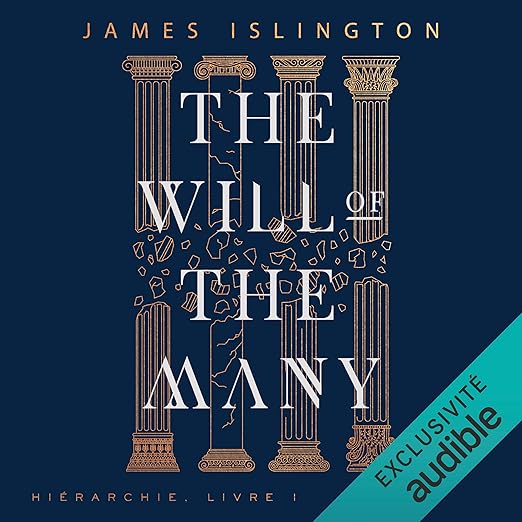
James Islington's The Will of the Many arrived to significant reader enthusiasm, accumulating nearly thirteen thousand ratings at 4.8, which places it among the most warmly received fantasy debuts of recent years. Pierre-Henri Prunel narrates this audiobook, which is the French-language edition of the novel. The synopsis provided for this listing is in French and the listing explicitly notes: this audiobook is in French. English-language listeners who encounter this listing should confirm they are purchasing the French edition rather than the English-language production before completing the transaction, as the two are separate products with different production teams and narrator performances.
Prunel Narrates the French-Language Edition
For listeners reading in French, Islington's novel offers a Roman-empire-inflected fantasy built around a social hierarchy that literally extracts mental energy from lower castes. The Hierarchy has conquered the world by exploiting this transferred Volonte, the French edition renders the core concept clearly, and the protagonist, who gives his name as Vis Telimus, has been placed inside the system under false pretenses. He is there to solve a murder, locate a legendary weapon, and expose secrets that could destroy the Republic, all while concealing his true identity from the factions competing to control and direct him.
The setup is a recognizable infiltration narrative, but Islington executes it with more structural care than the genre average. The power hierarchy here is not just atmospheric dressing for a coming-of-age academy story; it is the central engine of the plot. Vis must navigate a system he finds morally intolerable while appearing to embrace and ascend within it, and Islington uses that sustained tension to examine how institutions maintain themselves through extracted complicity rather than simply through force or violence. The Academy setting where much of the novel unfolds gives the story a contained social pressure that escalates with each new discovery Vis makes about the people around him.
Prunel's narration serves the material's intellectual register. The novel rewards attention to political and institutional detail rather than to pure action sequences, and a narrator who can make dialogue-heavy scenes about power, information, and loyalty carry real dramatic weight is essential to a story constructed this way. Prunel brings a controlled intensity to Vis's first-person perspective that fits the character's constant vigilance, the awareness that any slip in performance or any misread of another person's intentions could be immediately fatal. The French-language performance gives the novel a formal register that suits its Roman-inflected setting.
PDF Companion Tracks the Voluntas System
The twenty-seven-hour duration reflects Islington's commitment to building his world before accelerating the plot, which is a choice that pays off substantially for patient listeners. The first third of the audiobook is deliberately methodical, establishing the mechanics of the Voluntas system, the specific social layers Vis must navigate, and the cast of Academy students whose loyalties will prove crucial in the later volumes. Listeners who stay with the pacing are rewarded with a second half that moves considerably faster and pays off the structural foundation with genuine narrative force. This is a novel that earns its length rather than padding it, which is a meaningful distinction in contemporary fantasy publishing.
A PDF accompaniment is noted as available in the listener's Audible library alongside the audio file. This supplementary material is worth using for readers who want to track names, terminology, and the layered hierarchy of the Voluntas system, which can be difficult to keep organized across an extended listen without visual reference. The system Islington has built is logically consistent but complex enough that some listeners will want the reference material on hand during the first third of the audiobook.
The twenty-seven-hour audio experience also rewards listeners who appreciate worldbuilding that accumulates meaning over time rather than delivering immediate gratification. Islington layers in detail about the Voluntas system, the Academy's internal hierarchies, and the political factions operating outside the institution with the patience of a writer who trusts that the groundwork being laid will pay off. That patience is not a weakness of the book; it is the condition for the kind of payoff the second half delivers. A reader who skips or skims the first third would find the later sequences far less affecting than they should be.
French Terms Replace the English Forum Names
The novel functions as the opening volume of a series, and Islington does not resolve all his central questions by the final chapter. Listeners who prefer complete, self-contained narratives should be aware that the ending sets up rather than closes out. Those who have read Islington's The Licanius Trilogy will recognize his instinct for sustained dramatic irony, for structuring narratives around information asymmetry between protagonist and reader, and for placing characters in situations where the cost of knowledge accumulates across volumes rather than resolving within one.
The French-language edition also assumes a reader already comfortable with French fantasy conventions and vocabulary. The translation carries Islington's prose into a register that should feel natural to francophone genre readers, but listeners who have encountered the English-language community discussion of the novel should be aware that certain proper nouns and world-building terms will appear in their French rendering rather than the English versions they may have seen in reviews or forums.
Correct Choice Only for Francophone Listeners
This listing is the French-language production, and it is the correct choice for francophone listeners who want an intelligent, politically textured fantasy novel in audio form. English-language listeners should locate the English-language edition rather than this one. For either audience, Islington's novel rewards readers who respond to fantasy that takes its institutional mechanics seriously, that builds tension from concealment and surveillance rather than from combat or spectacle, and that trusts its audience to track complex loyalty networks across a long narrative.
Is The Will of the Many audiobook available in English in this listing?
No. This listing is the French-language edition narrated by Pierre-Henri Prunel. The synopsis and all content in this production are in French. English-language listeners should seek the separately listed English-language edition of the novel.
How long is The Will of the Many audiobook and does the pacing feel justified?
The production runs twenty-seven hours and twenty minutes. The first third is deliberately measured as Islington builds the Voluntas power system and Academy setting, but the pacing accelerates significantly in the second half. Most listeners who finish the novel find the length justified by the structural payoff.
Does this audiobook include any supplementary material alongside the audio?
Yes, the listing notes that a PDF accompaniment will be available in the listener's Audible library alongside the audio file, which can help track the novel's complex hierarchy of castes and factions across the extended runtime.