Quick Take
- Narration: Edoardo Ballerini brings a hushed, ceremonial quality to Eliot’s verse, his voice carries the poems without theatrical excess, letting the language do the work it was always capable of doing.
- Themes: Spiritual fragmentation, the ruins of Western civilization, the search for meaning in a disenchanted world
- Mood: Austere and quietly devastating, with passages of startling beauty
- Verdict: The centenary recording with Ballerini is the version to own, a rare instance where a narrator’s considerable reputation is fully justified by the performance.
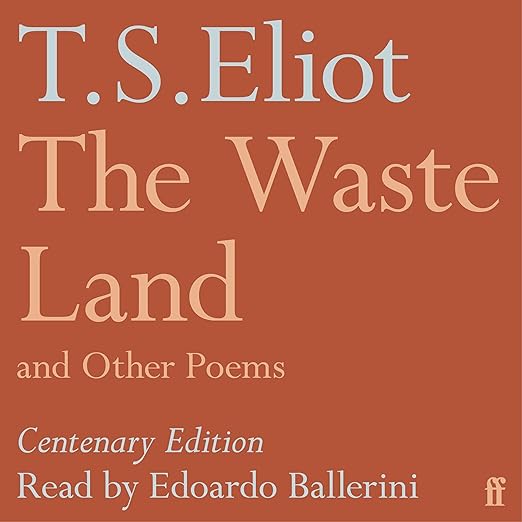
There is a specific kind of attention that poetry demands from a listener, different from what prose requires. You cannot half-listen to The Waste Land the way you might half-listen to a thriller on the treadmill. I made the mistake of trying that once, years ago with a different recording, and arrived at “April is the cruellest month” with my mind still on something else entirely. The Faber centenary recording with Edoardo Ballerini is the version that finally taught me to stop moving when Eliot is speaking.
This recording was commissioned to mark the hundredth year of The Waste Land’s publication, 1922 to 2022, and Faber brought in Ballerini, whose credentials are as close to impeccable as the audiobook world offers. The New York Times called him the Vladimir Horowitz of audiobooks; he has won the Audie Award for Best Male Narrator twice and is the only narrator profiled by the New York Times Magazine as “a master in his field.” On paper, this is either exactly the right match for Eliot or an occasion for a very expensive disappointment. It is the former.
What Forty-Seven Minutes of Eliot Actually Contains
The runtime, under an hour, surprises many listeners. But the seven works collected here are not light reading: “The Love Song of J. Alfred Prufrock,” “Portrait of a Lady,” “The Boston Evening Transcript,” the title poem, “The Hollow Men,” “Journey of the Magi,” and “Animula.” What you are getting is the essential Eliot, the poems that defined literary modernism and still carry an undiminished charge. “The Hollow Men” alone, “We are the hollow men / We are the stuffed men”, is worth an entire listening session in itself. “Prufrock” is among the most performed poems in the English language and one of the most difficult to perform badly in an interesting way. Ballerini manages it, which is a non-trivial achievement.
The Particular Achievement of Ballerini’s Reading
What makes Ballerini exceptional with this material is what he does not do. He does not try to explain the poems through his reading. He does not editorialize with pauses that signal “this is a significant line” or emote in ways that impose a single interpretive layer on language that has sustained hundreds of different readings over a century. He reads with an almost devotional restraint, and that restraint opens the poems up rather than closing them down. One reviewer noted the recording is “bleak but hopeful”, that combination is almost exactly right, and it is partly a function of Ballerini’s refusal to push either quality at the expense of the other. The voice is clear, unhurried, and genuinely beautiful, though never in a way that sentimentalizes verse that is deliberately resistant to sentiment.
What This Recording Asks of the Listener
A reviewer offered a candid admission that despite “amazing command of the language painting incredible images,” the full meaning was lost on them. That is not a failure of the recording, it is an honest report on what Eliot does. The Waste Land is encyclopedic in its references, drawing on Sanskrit, Dante, Webster, Shakespeare, and Wagnerian opera, among much else, and a single listening without annotation is going to yield a partial experience for most people. That is fine. Poetry at its best works on registers beyond the purely comprehensible, and Eliot understood this. The recording rewards both the casual listener catching atmosphere and sound, and the committed reader following along with a text edition simultaneously. These are not mutually exclusive experiences, and the recording is well-suited to both approaches.
Who This Centenary Edition Is For
For anyone approaching Eliot for the first time, a class assignment, a long-delayed literary obligation, or simple curiosity about why this poem still appears on syllabi a century after it was written, Ballerini’s voice is the least alienating possible entry point. For devotees who have read these poems many times on the page, the recording offers something rarer: a reading that illuminates rather than merely illustrates, that adds a dimension to texts you thought you already understood. The 47-minute runtime is not a limitation but a feature of the material’s intensity. Very few audiobooks this short repay this much repeated listening.
Who should listen: Students approaching Eliot in an academic context; readers who have encountered the text but never heard it performed with this quality of restraint; anyone interested in the sound of literary modernism as it was meant to be heard rather than silently parsed. Who should skip: Listeners who need narrative momentum or plot to stay engaged, these poems are dense, allusive, and non-linear, and there is no accommodating that difficulty away, only entering it with a good guide.
Frequently Asked Questions
Do I need to know Eliot’s work already to get something out of this recording?
No. The poems work on a sonic and emotional level before they work on an intellectual one, and Ballerini’s reading is accessible even to first-time listeners. That said, having access to an annotated text alongside the audio will significantly deepen the experience.
Is this the Centenary Edition with new narration, or the standard collection?
This is the Centenary Edition commissioned by Faber and Faber in association with the T. S. Eliot Foundation specifically for the hundredth anniversary of The Waste Land’s 1922 publication. The narration by Edoardo Ballerini was recorded fresh for this occasion.
How does Ballerini’s reading compare to recordings of Eliot reading his own work?
Eliot’s own recordings are historically significant but stylistically dated, flat and somewhat mechanical to modern ears. Ballerini brings contemporary vocal technique while maintaining fidelity to the poems’ gravity. Most listeners with access to both find Ballerini more accessible and emotionally present.
At under an hour, is this recording worth purchasing as a standalone audiobook?
Yes, if you take poetry seriously. The density of Eliot’s language means this 47 minutes will repay multiple listens more than many 12-hour prose audiobooks reward a single pass. The Centenary Edition also makes it an artifact of the poem’s own publishing history.