Quick Take
- Narration: Justin Hill brings warmth and gentle humor to a cast of distinct voices, handling Hattie’s dry wit and Mateo’s formal cadences with equal care.
- Themes: mismatched social standing, the Cyrano-style deception, self-determination in Regency England
- Mood: Witty and warm, with just enough tension to keep things interesting
- Verdict: Julia London delivers a charming third installment that earns its humor through well-drawn characters rather than easy farce.
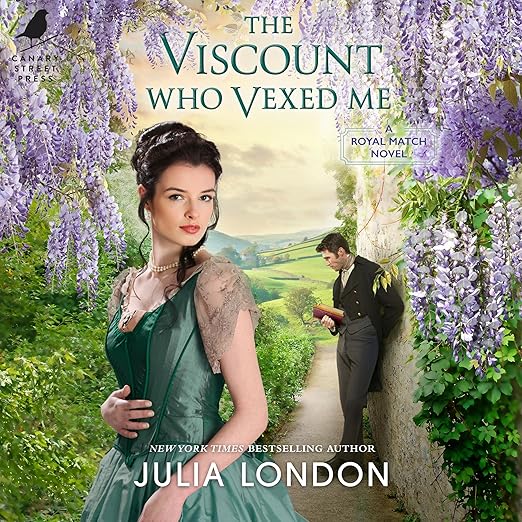
I picked up The Viscount Who Vexed Me on a Friday evening when I needed something light but not shallow. After two earlier entries in Julia London’s A Royal Match series, I had a reasonable sense of her rhythm, but I was unprepared for how much I would genuinely root for Harriet Woodchurch. By the time I reached the halfway point, my tea had gone cold and I hadn’t noticed.
Hattie is that rare Regency heroine who has a plan that has nothing to do with a husband. She works as a bookkeeper, acts as companion to her friend Flora, and is quietly saving her way toward a life of independence far from her embarrassing family. The setup London has engineered is essentially a gender-swapped Cyrano de Bergerac: Hattie feeds information about Mateo to Flora so that her tongue-tied friend can impress the handsome duke-turned-viscount, while Mateo finds himself increasingly drawn to the very woman helping his future duchess court him. It is a premise with real comic and emotional potential, and London largely delivers on both.
Our Take on The Viscount Who Vexed Me
What elevates this above the average Regency farce is that London takes Hattie’s ambitions seriously. Hattie’s desire to earn her own living is not treated as an eccentric quirk to be corrected by marriage; it is a genuine character motivation that runs through the entire story. Mateo, for his part, is not simply a handsome cipher waiting to be won. His status as a foreigner navigating a society whose unspoken rules baffle him makes him unexpectedly vulnerable, and the bond he forms with Hattie over books and quiet observation feels earned rather than convenient. One reviewer described Hattie as a heroine who deserved a HEA more than any she had encountered, and that assessment tracks. She carries most of the emotional weight here, and London does not let her down. The supporting cast, particularly Hattie’s chaotic family and the scheming matrons of the ton, are drawn with a lightness of touch that keeps the comedy grounded in character rather than caricature.
Why Listen to The Viscount Who Vexed Me
Justin Hill’s narration is precisely calibrated for this kind of material. He gives Hattie a voice that feels capable and a little wry without tipping into self-parody, and his Mateo carries genuine dignity, the slight formality of a man choosing his English words with care. The comedy of the ton’s supporting cast lands better in audio than it might on the page because Hill commits to the absurdity of the secondary characters without letting them overrun the story. At just under twelve hours, the pacing never drags. The romantic resolution is satisfying without feeling rushed, which is harder to pull off than it sounds. London structures her chapters to keep the central misunderstanding alive without making it feel contrived, and Hill’s performance honors that structure.
What to Watch For in The Viscount Who Vexed Me
Readers coming in at book three without the earlier volumes will pick up the threads without difficulty, though some of the warmth that comes from knowing London’s broader world will be missing. The deception plot, while charming, does not generate quite the friction it could; Flora exits the triangle a little too cleanly, and a few of the supporting character turns feel telegraphed. One reviewer noted that the story has a somewhat Cinderella quality, which is fair. London does not subvert the genre so much as execute it with more care than usual. Those looking for narrative surprises may find the arc predictable, but the journey itself is consistently enjoyable, and Hattie’s voice is distinctive enough to carry the familiar structure.
Who Should Listen to The Viscount Who Vexed Me
This is a strong choice for listeners who enjoy historical romance with a heroine who has her own agenda, and for anyone who appreciated the earlier A Royal Match novels and wants more of London’s sharp social observation. It also works well for new listeners to the series. Skip it if you need high narrative tension or a complex villain; the conflict here is gentle by design, and that is both its strength and its limitation.
Frequently Asked Questions
Do I need to listen to the first two A Royal Match books before The Viscount Who Vexed Me?
No. London provides enough context that newcomers will follow the story without confusion, though returning listeners will enjoy the wider world she has built across the series.
Is Justin Hill’s narration a good match for Julia London’s comedic style?
Yes. Hill has a light touch that serves the wit well, and his ability to differentiate Hattie’s dry practicality from Mateo’s more formal speech patterns adds real texture to their scenes together.
How does the Cyrano de Bergerac premise play out? Does Hattie’s deception create genuine conflict?
The deception is more comic than dark, and London resolves it more gently than you might expect. Those hoping for a high-stakes confrontation will find the resolution a little soft, but the emotional payoff is still genuine.
Is Hattie’s goal of financial independence treated as a real character arc or just a setup device?
It is treated seriously throughout. London does not frame Hattie’s ambitions as something to be surrendered; the ending honors both her independence and her romantic choices, which is one of the stronger elements of the book.