Quick Take
- Narration: Robin Miles is the Vanderbeekers series’ great constant, her ability to differentiate the family’s overlapping voices across six books without losing warmth or clarity is a genuine feat of sustained performance.
- Themes: Family resistance to change, sibling dynamics and growing up, road trip as emotional catalyst
- Mood: Noisy, warm, and occasionally tearful, like an actual family car trip
- Verdict: A satisfying sixth entry for established fans, though newcomers should start at the beginning of the series to understand why the stakes feel so real.
I came to The Vanderbeekers on the Road late in the series, having caught up on the earlier books over a string of weekend walks, and I’ll admit the sixth installment hit me harder than I expected. By this point I know these kids well enough that Laney’s panic about Jessie and Orlando leaving for college felt genuinely upsetting, not in a manipulative way, but in the way that good series fiction earns over time, through accumulated affection rather than manufactured drama.
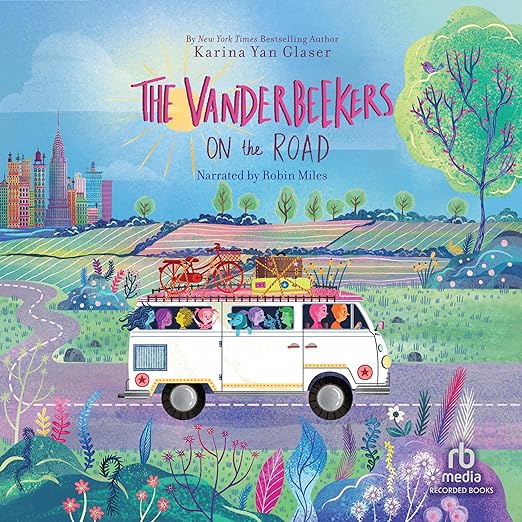
The premise in this installment is a road trip to California, organized as a surprise birthday gift for the family’s father: a recreation of a cross-country journey he never got to take with his own dad. It’s a structurally elegant setup because it layers grief for what was missed against the threat of a new loss, and Karina Yan Glaser keeps both threads live throughout the five hours and twenty-one minutes.
Robin Miles and the Art of Keeping a Large Cast Distinct
Six books in, Robin Miles has become so thoroughly identified with this series that it’s almost impossible to imagine the Vanderbeekers in any other voice. Her performance in this installment is particularly impressive because the road trip format requires her to keep five children audibly separate for extended scenes in which they’re all talking over each other, which, if you’ve spent time around large families in small cars, is precisely what happens.
She handles the emotional range with equal skill. Laney’s distress about change is played younger and more viscerally than the older siblings’ ambivalence about leaving, and Miles calibrates those differences without overdoing either. The father’s sections have a quieter register, a specific kind of adult tiredness under the happiness, that Miles finds without underlining it.
The Change Problem at the Center of the Story
What makes this entry interesting within the series is its subject. Previous Vanderbeekers books have been built around external threats, landlords, neighborhoods, community crises. Here the threat is internal: time passing, kids growing up, the family’s center of gravity shifting. Laney’s campaign to prevent Jessie and Orlando from attending California colleges is the engine of the plot, but Glaser’s real interest is in what it means to love people whose lives are becoming their own.
She handles this without sentimentality, which is harder than it sounds. The book doesn’t pretend the younger kids are wrong to feel scared, and it doesn’t pretend the older kids are wrong to want to leave. The road trip itself functions as a compressed version of that negotiation, everyone stuck together, working through it in real time.
Where the Cross-Country Setting Does and Doesn’t Pay Off
The geography of the trip provides some of the book’s most pleasurable passages. Glaser is good at specific places: the particular texture of a roadside diner, the change in landscape as you head west, the way a breakdown on the highway turns a planned adventure into something more chaotic and real. These sections give Miles room to modulate the pace, and the audiobook benefits from it.
The California destination, though, is underutilized. The college visits happen relatively quickly, and the scenes there feel less developed than the road itself. For a series that has always been rooted in the particular geography of Harlem, the West Coast setting has less emotional specificity than it might. This is a minor complaint in a book that otherwise earns its place in the series.
Who Should Listen and Who Should Skip
Series fans will want this without qualification, Robin Miles alone justifies the listen, and the emotional payoff of watching these characters navigate the transition to adulthood is substantial. Newcomers should start with book one, not because the plot is hard to follow but because the stakes depend on knowing the family. The Booklist comparison to the Penderwicks is apt: this is warm, funny, emotionally generous family fiction at its most accomplished.
Frequently Asked Questions
Is The Vanderbeekers on the Road a good entry point for someone new to the series?
It works as a standalone adventure on the road-trip level, but the emotional weight depends on knowing these characters. The series is strongest when read in order, and book one takes only a few hours, worth starting at the beginning before you get here.
How does Robin Miles handle the large cast of children in a confined road-trip setting?
Exceptionally well. Miles has narrated the entire series, and by book six she has each voice precisely calibrated, Laney’s urgency, Jessie’s older-sibling weariness, Orlando’s specific register. Extended scenes with all five kids speaking are clear and distinct throughout.
Is this appropriate for listeners who find change or family separation emotionally difficult?
The book handles those themes directly and with honesty. Younger listeners who are themselves anxious about family change may find Laney’s storyline resonates intensely, which can be useful, or can be hard, depending on the listener. Worth a conversation before or after.
Does the series maintain its Harlem identity even when the story leaves New York?
The road trip deliberately begins with a departure from Harlem, and there’s some mourning for the familiar geography built into the early chapters. The West Coast setting is handled affectionately but never feels as lived-in as the series’ New York roots. The Harlem identity comes through most strongly in the father’s backstory and the motivation for the trip.