Quick Take
- Narration: P.J. Ochlan brings a kinetic, thriller-paced energy to the story, maintaining suspense through the amnesiac boy’s disoriented perspective without over-dramatizing.
- Themes: Identity and memory, art world crime, high-stakes puzzle-solving
- Mood: Propulsive and intriguing, with a museum-corridor tension throughout
- Verdict: A genuinely clever middle-grade thriller that delivers on its Dan Brown-meets-Jason Bourne premise without condescending to its young audience.
I picked this one up on a Tuesday afternoon with my nephew in mind, someone who is convinced that mysteries are boring unless there are car chases. I was about twenty minutes into the audio when I realized I was no longer thinking about him at all. I was trying to figure out the boy in the National Gallery myself.
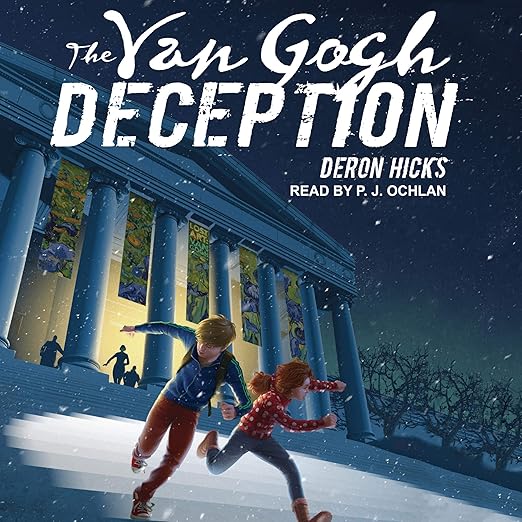
The setup is efficient and immediately strange: a child is found wandering Washington D.C.’s National Gallery of Art with no memory of who he is or how he got there. No name. No past. Just a mind full of seemingly random knowledge and an art fraud already in motion. Deron Hicks wastes no time on preamble. The amnesia premise could easily feel gimmicky, but the boy’s fragmented consciousness becomes the engine of the plot rather than a narrative crutch.
A Narrator Who Runs with the Chase
P.J. Ochlan is a genuinely good fit for this material. He calibrates the boy’s confusion with just enough disorientation to feel authentic, without dragging pace. When the thriller mechanics kick in, Ochlan shifts registers cleanly. His supporting cast voices are distinct without being cartoonish, which matters a great deal in a plot full of art world characters who could have tipped into parody. The chapters are short and propulsive, and Ochlan seems to understand that his job here is to keep a ten-year-old, or their distracted parent in the front seat, leaning forward.
Art History as Plot Device, Not Lecture
What Hicks does shrewdly is weave the actual facts of Van Gogh’s life and the mechanics of art authentication into the chase without stopping the story to explain them. The fraud at the center of the plot is plausible in the way good middle-grade crime usually is: simplified but not falsified. Reviewers have noted that this is the kind of book that made them immediately want the next installment, and that instinct makes sense. The first entry in the Lost Art Mysteries series functions as both a standalone thriller and a series launcher, landing its central mystery while seeding larger questions about the boy’s identity for future volumes.
What the Amnesia Premise Actually Earns
Most children’s thrillers operate with a protagonist who has a fixed identity and a problem to solve. Here, the identity is the problem. That inversion pays off consistently. The reader discovers who the boy is at roughly the same pace the boy does, which creates an unusual reading intimacy for the genre. One reviewer pointed to plot twists that landed with Mission Impossible-level energy, and while that might be generous, the observation tracks. The structural device allows Hicks to distribute information slowly and organically rather than frontloading backstory.
Who Should Listen, Who Should Skip
This is a strong pick for ages ten and up, particularly for kids who have already moved through standard mystery fare and want something that takes them more seriously. It works equally well as a family listen; adults in the room will find themselves engaged rather than merely tolerant. Anyone with an interest in the actual mechanics of art forgery and museum security will find the backdrop rewarding. Listeners who need a protagonist with a stable identity from page one may struggle with the amnesia conceit, though most give it enough time to settle. Those expecting a deep character study will find Hicks is more interested in plot architecture, which is the correct priority for this kind of book.
Frequently Asked Questions
Does the amnesia setup get resolved by the end, or does it continue into the next book?
The core mystery of the boy’s identity is substantially resolved within this audiobook, though the Lost Art Mysteries series continues with new adventures. You will not finish feeling cheated of an answer.
Is this suitable for younger children, say ages seven or eight?
The subject matter and reading level skew toward ages ten and up. The thriller pacing and some of the villain scenes have a genuine intensity that may feel too tense for younger listeners, though the content itself remains age-appropriate.
How does P.J. Ochlan handle the multiple supporting characters without the voices blurring together?
Ochlan keeps the ensemble distinct with register and rhythm rather than exaggerated accents, which suits the thriller tone well. Adult authority figures sound credibly adult, and the boy’s voice remains consistently grounded throughout.
Do I need any background knowledge about Van Gogh or art history to follow the story?
None at all. Hicks integrates the relevant art history organically into the narrative. If anything, listeners who come in knowing nothing about Van Gogh may find the historical details freshly surprising rather than redundant.