Quick Take
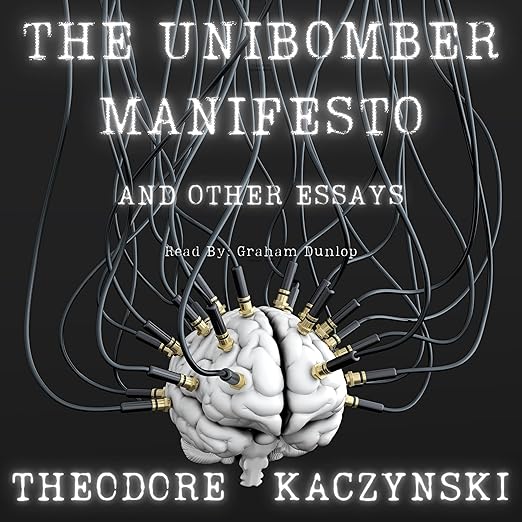
- Narration: Graham Dunlop delivers a clear, unadorned reading that respects the text without editorializing, which is the correct approach for material this historically and ethically fraught.
- Themes: Technology as oppressor of human freedom, industrial civilization’s cost to autonomy, neo-Luddite social criticism
- Mood: Dense and unsettling, with the intellectual coherence of a manifesto and the moral weight of its author’s crimes
- Verdict: A historically significant primary document that deserves to be read critically and in context, not as a guide but as an artifact of a particular strain of anti-modern thought.
There is no neutral way to begin a review of this collection. Theodore Kaczynski killed three people and injured twenty-three more during a seventeen-year mail bombing campaign. He is serving life sentences in a federal prison. The texts compiled here, including the Unabomber Manifesto itself, were produced by a person who believed that violence was a justifiable tool for drawing attention to an argument about technology and human freedom. Understanding that context is not optional background information; it is the frame through which everything that follows should be read.
With that established: the texts themselves are, as multiple reviewers observed, more coherent and organized than popular mythology suggests. Kaczynski earned a mathematics PhD from Michigan and taught at Berkeley before his radicalization. The writing reflects that training. His arguments are structured, footnoted, and internally consistent. Whether they are correct is a separate question from whether they are comprehensible, and they are comprehensible.
Our Take on The Unabomber Manifesto and Other Essays
The collection covers four texts spanning from a 1971 essay on technology and dehumanization written from his Montana cabin to Industrial Society and Its Future, the manifesto published under threat of further bombings in 1995, to later essays written from prison. The central argument of the manifesto is that large-scale technological systems require forms of social organization that are inherently inimical to individual autonomy and psychological wellbeing. Kaczynski argues that this is not a correctable flaw but a structural feature: the technology requires the organization, and the organization requires the constraint. Reviewers who engaged with the argument on its own terms noted that he makes some valid predictions and good points, which is historically accurate, particularly his observations about surveillance, corporate consolidation of information infrastructure, and the psychological costs of alienated labor.
It is also worth placing the manifesto in relation to a broader tradition of technology criticism that preceded and has followed it. Writers like Jacques Ellul, Herbert Marcuse, and more recently Shoshana Zuboff have made structurally similar arguments about the relationship between technological systems and human autonomy without arriving at the same tactical conclusions. Reading Kaczynski’s argument against that intellectual context, rather than in isolation, is the most productive framing for anyone who wants to think seriously about what his texts actually contribute to a long-running debate.
Why Listen to The Unabomber Manifesto and Other Essays
Graham Dunlop’s narration is appropriate for the material. He reads clearly and without inflection that would guide the listener toward a particular emotional response, which is the correct approach for primary-source material this ethically complex. At four and a half hours, the collection is substantive without being exhaustive. The audio format is more accessible than reading the texts cold, particularly for the manifesto’s densely argued middle sections. One reviewer described expecting a rambling, incoherent document and finding instead a highly organized, articulate text. That surprise is an argument for encountering the writing directly rather than through secondary summarization, and the audiobook makes that encounter easier.
What to Watch For in The Unabomber Manifesto and Other Essays
Two things are worth knowing before you listen. First, the editing of the print collection from which this audiobook was drawn contains proofreading errors that reviewers flagged as distracting. Second, and more importantly, the texts argue that technological society is irreversible without revolutionary violence, and the later essays, particularly Hit Where It Hurts, are tactical documents. A reviewer noted that their teenage son had taken some of the ideas too far after reading the manifesto. Engaging with this material as historical and intellectual artifact is appropriate; treating it as a roadmap is where it becomes dangerous. The distinction is not academic.
Who Should Listen to The Unabomber Manifesto and Other Essays
This collection is for readers who want direct access to a historically significant primary document in political and philosophical extremism. Students of American history, technology ethics, environmental radicalism, and the sociology of terrorism have legitimate reasons to engage with these texts in their original form. It is also of interest to anyone who has encountered Kaczynski cited favorably in online spaces and wants to understand the actual argument behind the citations. Those who want a critical engagement with anti-modern thought from a broader historical perspective, rather than Kaczynski’s specific expression of it, will find more nuanced entry points in writers like Ivan Illich or Lewis Mumford.
Frequently Asked Questions
Does listening to this collection in any way endorse Kaczynski’s views or actions?
No. Engaging with primary-source documents is a standard practice in history, political science, and philosophy. Understanding an argument is distinct from endorsing it. The audiobook provides access to historically significant texts that are widely cited in discussions of technology criticism, anti-modernism, and political violence.
How does Kaczynski’s actual writing compare to what popular accounts suggest?
Multiple reviewers note the same surprise: they expected incoherence and found organizational discipline, footnoting, and structured argumentation. This does not make the texts benign, but it does make them more relevant to intellectual history than the criminal-genius narrative sometimes implies.
Is Graham Dunlop’s narration of this material neutral or does it take a stance?
Dunlop reads without editorial inflection, which is the appropriate approach for material this ethically complex. He does not add dramatic weight to passages that might be construed as approving violence, nor does he signal disapproval through tone. The narration functions as transmission rather than interpretation.
Are all four texts in this collection equally substantive, or does quality vary across them?
The manifesto, Industrial Society and Its Future, is the most developed and most cited text. The 1971 essay and the prison-era essays cover related ground but with less systematic development. Reviewers who discuss specific essays by title tend to focus on the manifesto as the central document, which is accurate to its historical weight.