Key Details
- Read by: Travis Baldree has narrated this series from the start, and by book twelve he and Ruwen are practically the same entity - the comic timing, the internal monologue rhythms, the way Baldree differentiates between Ruwen's confidence and his genuine dread have become one of the series' most consistent pleasures.
- At its heart: Magic system mastery under constraint, inherited consequences, knowledge as weapon and trap
- Vibe: Kinetic and cerebral in equal measure - the dungeon-library set piece generates genuine tension without sacrificing the series' humor
- Short version: A. F. Kay continues to find new structural problems for Ruwen to solve, and the Conclave setting is among the more inventive set pieces in the Divine Apostasy series.
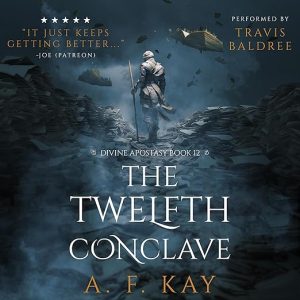
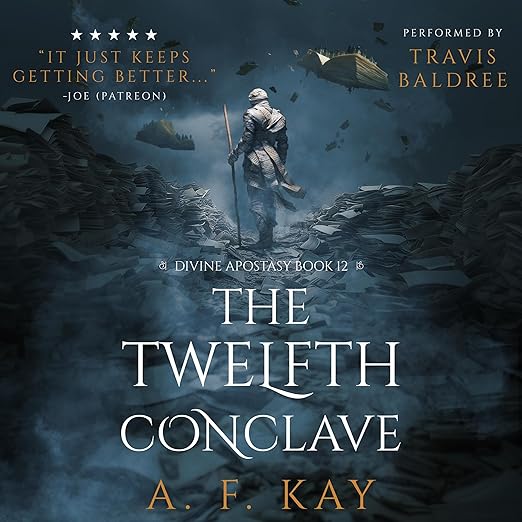
The craft problem A. F. Kay faces in book twelve of the Divine Apostasy series - The Twelfth Conclave, narrated by Travis Baldree - is the same one confronting any long-running LitRPG author: how do you generate genuine tension for a protagonist who has become formidable? Kay's solution here is elegant. The Conclave's library is not simply a setting - it is an environment specifically designed to strip Ruwen of the tools he has spent eleven volumes acquiring. The suppression of his powers inside the shifting dungeon-library creates the most interesting constraint the series has imposed since the early books, because it forces Ruwen to operate on intelligence and improvisation rather than accumulated strength. That is where this audiobook spends most of its eighteen-plus hours.
The synopsis is admirably direct about the stakes: every past Ink Lord who called a Conclave died in it, usually violently, and Ruwen triggered this one a month earlier without observing any of the traditional protocols. That setup positions him as someone walking into a consequence of his own making, which is a more interesting dramatic frame than a simple external threat would provide. The dual pressure of the Conclave itself and the unresolved tension between Ruwen's magic systems - his Soul reaching level four now creates instability with his Chakra work - gives the book two parallel problems to work through simultaneously. Kay handles the interweaving competently: the magic system theorizing doesn't stall the plot, and the plot doesn't overwhelm the system logic. One honest reviewer notes that the title is "shoehorned into the plot" and that there is repetition from earlier volumes, both valid observations. But the same reviewer acknowledges the pace is maintained and the flow is consistent, which at book twelve in an active series is a real achievement. The Realm of Bones, positioned here as the next horizon of power Ruwen can't yet reach, functions as an effective long-range motivator without demanding that this installment resolve what it's set up. The moment when Ruwen discovers a second Ink Lord who may or may not be the Zealot in disguise is the book's sharpest dramatic beat, because it concentrates the series' recurring theme of enemies disguised as allies into a single scene with immediate, life-or-death stakes.
Why Listen to The Twelfth Conclave
Travis Baldree's narration is the primary reason to choose audio for this series, and that remains true here. Baldree has been with Divine Apostasy long enough to have developed instincts for the material that go beyond simple character differentiation. Ruwen's internal voice - the rapid, sometimes chaotic processing of information under pressure - requires a narrator who can make complex system-logic feel immediate rather than academic. Baldree does this with tonal agility that the audiobook format rewards in a way that reading on the page doesn't replicate. Reviewers with eleven books of investment in the series consistently report that the audio versions are more satisfying than the written ones, and the consistency of Baldree's performance across the full twelve-volume run is a significant part of that. Reviewer Grayson Selsor describes the universe as "so in-depth" with "so much passion" put into the story that you can't help but respond to it fully - and Baldree's narration is the delivery mechanism for that passion. The 18-hour runtime is substantial but proportional to the amount of ground the story covers: the Conclave arc, the Chakra development thread, and the introduction of the Realm of Bones as a series horizon all require space to breathe properly.
What to Watch For in The Twelfth Conclave
The Realm of Bones is introduced here as Ruwen's next necessary destination - the only place where he can acquire what he needs to defeat the Zealot - and the book positions it as something genuinely powerful and genuinely dangerous. That setup is satisfying as a narrative promise, but it also means this volume is structurally transitional in ways that earlier, more self-contained entries weren't. The Conclave arc resolves; the larger war against the Zealot does not. Readers who prefer audiobooks that feel complete in themselves should be aware that book twelve is firmly mid-series rather than a natural pause point. The series-only caveat is genuine: arriving at book twelve without the eleven preceding volumes means missing the character relationships, the magic system logic, and the weight of the earned humor that makes Ruwen's predicaments feel consequential. This is not an entry point under any circumstances. For existing listeners, the dungeon-library set piece in the central portion - the shifting aisles, the ancient guardians, the suppression of Ruwen's powers - is the series' most genuinely claustrophobic sequence to date, and hearing Baldree perform Ruwen navigating it with reduced capabilities is a listening highlight.
Who Should Listen to The Twelfth Conclave
Listeners who have followed Divine Apostasy from book one will find this a satisfying continuation with one of the series' stronger structural conceits. The magic-system suppression device gives the book stakes that feel earned rather than manufactured, and the Baldree narration remains a genuine asset that has only improved across twelve volumes of relationship with this material. New listeners should not start here - the book assumes complete familiarity with Ruwen's history, his relationships, and the logic of his multiple power systems. Fans who found some of the more recent volumes less focused than the early ones may find the Conclave setting a welcome return to spatial constraint and immediate consequence. The question the book poses - whether Ruwen can advance his Chakras in a library that suppresses his power - is well-framed, and Kay provides a satisfying answer to it.
Before You Listen
Can this audiobook work as a standalone, or is the full series required?
Full series is required. Book twelve assumes detailed knowledge of Ruwen's power systems, his relationships, and eleven books of accumulated world history. The emotional stakes in particular are only legible to readers who have followed from the beginning.
Has Travis Baldree narrated all twelve audiobooks in the Divine Apostasy series?
Yes. Baldree has been the consistent narrator throughout the series, which is a significant part of why longtime listeners prefer the audio format - the character voices and tonal rhythms have developed over twelve volumes of collaboration between the author's text and Baldree's performance.
Does The Twelfth Conclave resolve its main plot threads, or does it end on a cliffhanger?
The Conclave storyline resolves within this volume. However, the larger conflict with the Zealot and the introduction of the Realm of Bones as the next narrative horizon means the series arc remains open. It functions as a contained arc within an ongoing story.
Is the magic system logic in this audiobook accessible if you're already familiar with LitRPG as a genre but haven't read this series?
The system logic in Divine Apostasy is specific enough to its own worldbuilding that genre familiarity alone won't be sufficient. The Chakra suppression mechanic and the tension between Ruwen's multiple magic systems are built on eleven volumes of established rules. Series newcomers would find the audiobook's system discussions incomplete without that context.