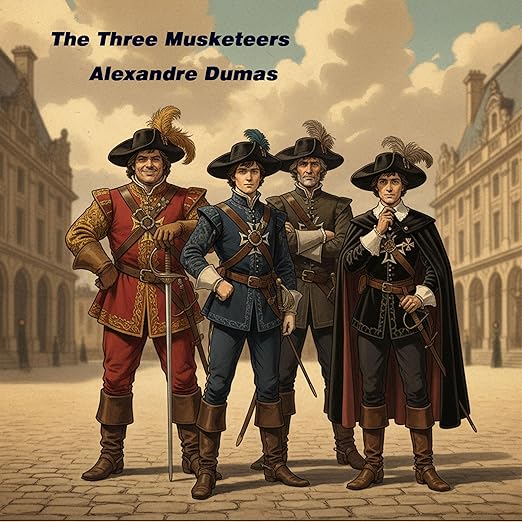
Quick Take
- Narration: Pete Crosad delivers a solid, uncluttered reading of Dumas’s swashbuckling prose; not the most theatrically ambitious performance, but clear and competent throughout.
- Themes: Loyalty and brotherhood, political intrigue, honor versus ambition
- Mood: Spirited and propulsive, with the bonus scaffolding of a scholarly edition
- Verdict: A reliable annotated edition for listeners who want context alongside the adventure, though those seeking pure dramatic performance may prefer other recordings.
I find myself returning to Dumas about once every few years, not because I have anything new to discover in the plot, which I know as well as I know my own bookshelves, but because the energy of The Three Musketeers is one of those reliably restorative things, like a very good cup of coffee at exactly the right time. I listened to this annotated edition on a long train journey, which felt appropriate. There is something about moving through a landscape while d’Artagnan gallops across seventeenth-century France that makes both experiences feel more complete.
This recording, produced by Pete Crosad LLC as part of the Literary Classics Collection series, presents Dumas’s novel with the full scholarly apparatus the series is known for: a new introduction, author biography, historical chronology, footnotes, endnotes, study questions, and a bibliography. At nearly fifteen hours, it is a substantial listen that positions itself between casual entertainment and guided study.
Our Take on The Three Musketeers (Annotated)
For a novel published in 1844 as a serialized adventure story, The Three Musketeers holds up with remarkable vigor. D’Artagnan’s arrival in Paris, his instant entanglements with Athos, Porthos, and Aramis, and the unfolding conspiracy involving Cardinal Richelieu and the enigmatic Milady de Winter, these are not just the building blocks of a genre, they are the genre. Every swashbuckling adventure novel written since carries Dumas’s DNA somewhere in its structure, which means returning to the source has the pleasure of seeing where the template was first assembled.
What this annotated edition adds is the ability to understand that template within its historical context. The footnotes situate the novel’s political maneuvering within the actual tensions of Louis XIII’s court, clarifying the stakes behind events that might otherwise feel like plot mechanics. The chronology helps orient listeners who come to the novel without a deep familiarity with seventeenth-century French history. These additions are genuinely useful rather than decorative, they shift the experience from adventure romp toward something closer to a reading of record.
Why Listen to This Audiobook
The question of which Three Musketeers recording to choose is partly a question of what you want from the experience. This edition’s value proposition is the scholarly apparatus, not the performance. Pete Crosad reads with clarity and a reasonable sense of the material’s energy, though the narration lacks the theatrical flamboyance that some other recordings bring to Dumas’s dialogue-heavy scenes. The famous exchanges between the four musketeers, the banter, the bravado, the loyalty that flows between them so naturally, are served competently rather than brilliantly.
What you gain in trade is structure. The introduction contextualizes Dumas as a writer, including the well-documented collaborations with Auguste Maquet that produced many of his most celebrated novels. The study questions at the end are useful for book clubs or for listeners who want to think critically about what the novel is actually doing beneath the surface-level adventure. One reviewer noted that this edition functions as a gateway to deeper engagement with the text, and that is accurate. It is a listening experience that invites return rather than closure.
What to Watch For in This Edition
A caveat worth noting: reviewers of the print edition have occasionally raised concerns about which version of the text is presented. This audiobook identifies itself as part of the Literary Classics Collection, which is a distinct series from the Oxford World’s Classics edition that many scholars prefer. The translation used matters considerably with Dumas, some translations flatten his prose considerably, while others capture the propulsive, slightly theatrical quality that makes the novel move. Prospective listeners who care about translation fidelity should verify the specific translation used in this recording before committing to nearly fifteen hours.
The novel’s pace is also worth noting for first-time listeners. Dumas was writing for serialization, which means the novel accelerates and slows in patterns tuned for weekly installments rather than sustained listening sessions. The middle section, which involves a significant amount of political maneuvering and travel, is slower than the opening and closing acts. This is true of most recordings, not a flaw specific to this one, but it is worth setting expectations accordingly.
Who Should Listen to The Three Musketeers (Annotated)
This edition is well suited to students, book club participants, and listeners who want to engage with the novel as literary history rather than pure entertainment. If you have not read The Three Musketeers before and want a contextually enriched first encounter, the annotation framework serves that purpose well. If you are returning to the novel and looking for the most dramatically vivid performance available, you might find more theatrically accomplished recordings elsewhere.
For the adventure novel reader who simply wants d’Artagnan and the musketeers at full gallop, this version will deliver. The annotations can be appreciated without slowing the narrative momentum significantly, and Dumas’s plot remains what it always has been: one of the most compulsively paced stories in the European literary tradition.
Frequently Asked Questions
What specific translation is used in this annotated audiobook recording?
The listing does not specify the exact translation, which is a meaningful gap for listeners who care about the quality of the English rendering of Dumas’s French prose. The edition identifies itself as part of the Literary Classics Collection series. Verify the translation before purchasing if this matters to your listening experience.
How are the footnotes and annotations handled in the audio format?
The Literary Classics Collection is structured to include introductory material, chronologies, and study questions as part of the recording. In audio editions of this type, supplementary notes are typically read as separate sections rather than interrupting the main text. The exact format should be confirmed in the product description, but the scholarly apparatus does not appear to disrupt the flow of the novel itself.
Is this a good first introduction to Dumas for listeners unfamiliar with his work?
It is a solid choice. The biographical and historical context provided by the annotation framework is genuinely useful for readers coming to Dumas cold. The novel itself is accessible regardless of background, but understanding the political landscape of Louis XIII’s France enriches the stakes considerably.
At nearly fifteen hours, how does this recording handle the novel’s pacing shifts?
The Three Musketeers was written for serial publication, so the pacing is naturally uneven. The novel opens and closes with high energy, but the middle section moves more slowly through political intrigue and travel. This is inherent to the text rather than a narration issue, and Pete Crosad manages the transitions without adding drag.