Quick Take
- Narration: Philip Ray reads with classical dignity, though the formal register of the Caldwell translation means some passages feel more recited than interpreted.
- Themes: Cosmogony, divine hierarchy and violence, the birth of order from chaos
- Mood: Austere and archaic, demanding attention rather than offering immersion
- Verdict: An essential 69-minute encounter with the foundational text of Greek mythology, best paired with a good companion guide for context.
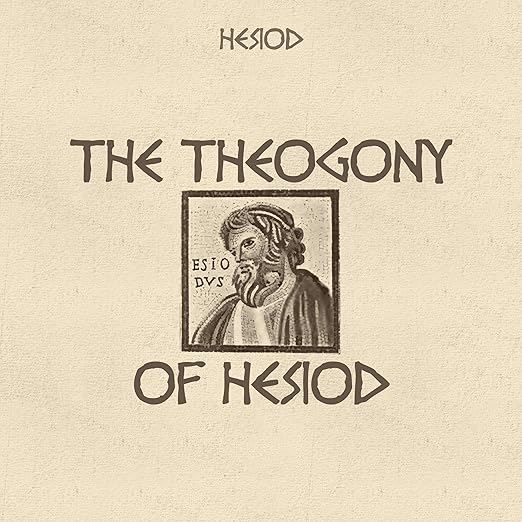
There is a particular pleasure in encountering an ancient text in audio form, especially one as brief and as foundational as Hesiod’s Theogony. I listened to Philip Ray’s recording on a morning walk, and I found myself stopping several times not because I was bored but because I wanted to hold a line in my head before the next one arrived. The Theogony is not comfortable listening. It is the cosmological skeleton of Western mythology, and it moves with the inexorable logic of a world being assembled from nothing, one divine generation at a time.
Written around 700 BCE, the poem traces the emergence of the Greek gods from a primordial dark void through the spontaneous generation of four beings: Chaos, Gaia, Tartarus, and Eros. What follows is a genealogy of divine power, struggle, and the eventual triumph of Zeus. Hesiod did not invent these traditions, but he synthesized them into a coherent hymn that became the framework through which Greek culture understood its own religious inheritance. At sixty-nine minutes, the audiobook is one of the shortest you will ever encounter in the classical literature category, which makes it an unusually low-risk encounter with primary source material.
Our Take on The Theogony of Hesiod
The edition most commonly reviewed appears to be the Richard S. Caldwell annotated translation, which is extensively scholarly. Ian M. Slater’s detailed review makes clear that the Caldwell translation is precise and heavily footnoted, rendering it more useful as a study text than as a pleasurable first encounter with the material. Listeners who want to understand Hesiod’s choices and his relationship to his sources will find this translation invaluable. Listeners who want to experience the poem primarily as poetry may find the formal language creates distance rather than access. Those listeners might consider the Stanley Lombardo translation as an alternative, which is considerably more accessible while remaining faithful to the original.
Why Listen to The Theogony of Hesiod
Because hearing the Theogony rather than reading it activates something different. The verse form, even in translation, carries a rhythmic persistence that prose summaries lose entirely. Philip Ray reads with sober authority, and the poem’s accumulation of divine names and relationships works aurally in a way that can feel numbing on the page. This is how the poem was originally experienced, as a performed hymn before a Greek audience familiar with the names and lineages being invoked. Listening restores some of that quality. At under 70 minutes, the investment is minimal and the cultural return is substantial. The Theogony is one of those texts you can return to many times across a lifetime and always find something different in it.
What to Watch For in The Theogony of Hesiod
One reviewer honestly recommended keeping a summary open in another window to follow the action, and that is not bad advice for newcomers. The Theogony is not a narrative in the modern sense. It does not build toward a climax so much as it accumulates authority through iteration. The divine genealogies are dense, and without some prior familiarity with Greek mythology, certain passages will feel like a catalog rather than a story. Hesiod’s Theogony is also only one account among several circulating in ancient Greece; it should not be treated as the definitive version of Greek cosmology, but as a particularly influential one. The translator’s notes in the Caldwell edition help contextualize these distinctions considerably.
Who Should Listen to The Theogony of Hesiod
Students of classical literature, mythology, and the history of religion will find this essential and appropriately brief. Anyone who has read or listened to Homer and wants to understand the cosmological framework those texts assume will find the Theogony clarifying. The poems are companions, not substitutes, and together they form the foundation of the Western literary tradition. Casual mythology enthusiasts who prefer accessible retellings in the vein of Stephen Fry or Natalie Haynes may find the primary text harder going than expected, but the 69-minute commitment makes it worth attempting. It is not light listening. It is foundational listening, and that is a different category entirely.
Frequently Asked Questions
Which translation does this audiobook use, and how does it compare to other Theogony translations?
The edition appears to use the Richard S. Caldwell translation, which is heavily annotated and scholarly. The Stanley Lombardo translation is considered more accessible for general readers; M.L. West’s is authoritative but dense.
Is prior knowledge of Greek mythology necessary to follow the Theogony?
Helpful but not strictly required. Some familiarity with the major Olympians and the Titan-Olympian war will make the genealogical sections more meaningful. Complete beginners may find a short primer useful before listening.
At 69 minutes, is this really a complete text or an abridgment?
The Theogony is genuinely brief. The poem runs approximately 1,000 lines of Greek verse, and a complete, unabridged reading at a deliberate pace fits comfortably under 90 minutes. This appears to be the full text.
Does Philip Ray’s narration differentiate between different sections of the poem?
The narration is largely undifferentiated in register, which suits the hymnic quality of the text. There are no character voices in the modern sense; the poem is a performed invocation rather than a drama.