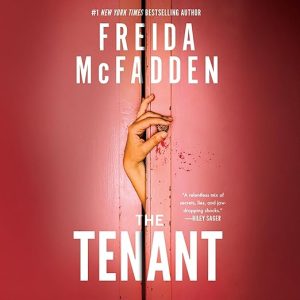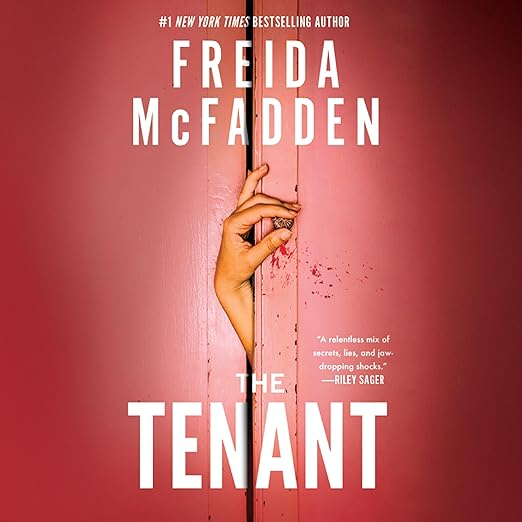
Blake Porter loses his job as a VP of marketing, cannot cover the mortgage on the brownstone he shares with his fiancee, and rents out a room. Whitney answers the ad. That is the whole setup of this audiobook, and Freida McFadden gets to it fast enough that the eight hours and fifty minutes never feel padded. What follows is the part the description handles carefully: neighbors start treating Blake differently, a smell of decay refuses to scrub out, and he begins to suspect someone knows his darkest secrets. The copy is blunt about where this ends up, warning that "The trap is already set" before you have met anybody.
McFadden arrives here off the back of The Boyfriend and The Housemaid, and the publisher leans on that lineage in the first line of the copy. Will Damron holds the narration credit. The listing shows 4.2 across 186 ratings, which turns out to be exactly what the readable reviews would predict.
One Narrator Holds Every Point of View
Structure is the first thing to know, because it changes what you are buying. SatyJenk, writing a month after release, describes "a wild ride of multiple POVs, which I always love for the layered storytelling and added suspense". A single narrator is credited on this recording. That combination is worth thinking about before you commit: one reader has to build and hold apart every point of view the book hands out, without the chapter headers and typographic breaks a printed page uses to do that work for free.
Characterization, not plot, is where the readable pool splits. Nobody here disputes that the twists arrive. Sue calls the book "suspenseful with several turns and twist". The five-star notice signed Me praises "how the story grabs you right away & keeps you hooked until the end". The disagreement sits entirely on whether Blake himself holds up as a person.
He does not, for two of the five. The three-star notice is the sharpest: it observes that the main character is a thirty-something man with a marketing career whose "actual personality read like a college aged woman to me", and adds that "the career wasn't convincing". SatyJenk arrives at something similar from the opposite direction, calling the male lead "Maddening. Dumb. So incredibly annoying that I wanted to scream", though clearly enjoying the sensation. Two readers, one complaint, opposite verdicts.
Short Chapters Turn This Into a Weekend Read
Speed sells this one, and the reviews are honest about it. Marissa Davila reports devouring the book "in what felt like 2 sittings", and at this length that is a plausible weekend. McFadden writes short chapters and ends most of them on a lift, which suits a format you consume while doing something else. A commute-length thriller that keeps its hooks close together is a real and underrated product category.
The domestic premise does a lot of quiet work too. A lodger in your own house is a better engine than a stranger in a remote cabin, because every scene has a reason to keep both people in the same rooms. The description sells "revenge, privilege, and secrets turned sour", and the privilege half is the more interesting one: Blake is a man losing his footing who is convinced he deserves better, and the book is at its best when it lets that curdle. The sensory detail helps as well. A smell of decay that will not scrub out, noises that wake him at night, neighbors whose manner has quietly changed: none of it is supernatural, all of it is deniable, and heard rather than read it accumulates into something closer to dread than to plot.
Multiple viewpoints also pay off in a way that specifically suits listening. Once you know a second perspective is coming, every scene acquires a second reading, and a listener who cannot flip back to check a detail ends up holding more of the book in their head than a print reader would. That is a genuine advantage of the format for this kind of story, provided the voicing keeps the perspectives distinguishable. The alternative failure is worth naming: if two viewpoints blur, a twist that depends on knowing who was speaking simply lands as confusion.
Twist Plausibility and Arithmetic That Lines Up
Plausibility is the recurring complaint, and it comes from a reviewer who otherwise had a good time. Marissa Davila knocks a star off because the twists "are too out there to be real/likely which is what knocks the book down a star for me". The three-star notice puts it more bluntly, filing the whole thing as "a great airport read but nothing to write home about" and asking for character work "a step deeper".
Blake himself is the second thing to test against your own tolerance. If an incompetent, self-deceiving protagonist reads to you as a design choice, the book works. If it reads as a writing problem, you will spend the whole runtime irritated, and audio makes irritation harder to escape than a page you can skim. The pool is genuinely split on this, which is unusual and useful.
Arithmetic rarely lines up this neatly, so the score deserves a plain reading. Five visible grades of 5, 4, 3, 5 and 4 produce an average of exactly 4.20, and the aggregate on this page is 4.2 spread over 186 ratings. Readable notices here are, for once, a faithful miniature of the whole audience rather than a self-selected cheering section. Practically, that means the two complaints above are not outliers you can discount. Roughly the same proportion of the wider readership presumably shares them, which is a more useful thing to know than any single verdict.
Under Nine Hours Is a Small Enough Bet
Anyone who has run through McFadden's better-known titles and wants another in the same key will find it here, and so will anyone shopping for a fast domestic thriller sized to a couple of long drives. It also suits listeners who enjoy multi-perspective suspense and are willing to pay attention, since the pleasure here depends on tracking who knows what and when they learned it.
Look elsewhere if you need your thrillers plausible, since two of five readable reviewers flagged the twists as a step too far. Look elsewhere too if unlikeable protagonists exhaust you rather than amuse you. Come for the structure and the speed, stay if Blake's slow-motion self-sabotage entertains you, and do not expect the book to survive close inspection afterward. Under nine hours is a small enough bet that even the reviewers who complained kept turning pages, which is more than most thrillers of this length manage.
Common Questions
Does this audiobook work if I have not read The Housemaid or The Boyfriend?
Yes. The publisher's copy name-checks both titles as a selling point, not as prerequisites, and nothing in the readable reviews suggests carryover characters or plot. Treat it as a standalone domestic thriller that happens to share an author with two better-known books.
Are the twists in The Tenant audiobook believable?
Two of the five readable reviewers say no. One knocked a star off for twists too out there to be real or likely, and the three-star notice calls the book a solid airport read with unconvincing character work. Nobody disputes that the twists land hard; the argument is about whether they hold up afterward.