The Short Version
- Narration: Leslie Howard handles both Eve and Addie's perspectives with precision, making the dual POV construction immediately legible and sustaining the gap between the two women's versions of events.
- Themes: Power dynamics in institutions of trust, the unreliable insider narrator, female rage and survival strategies
- Mood: Tightly wound and claustrophobic, with a pace that doesn't permit pause for reflection
- Verdict: McFadden's dual-POV construction is the engine driving this audiobook, and Howard's narration makes the competing perspectives compelling enough to hold the tension all the way to the ending.
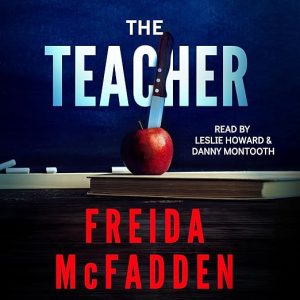
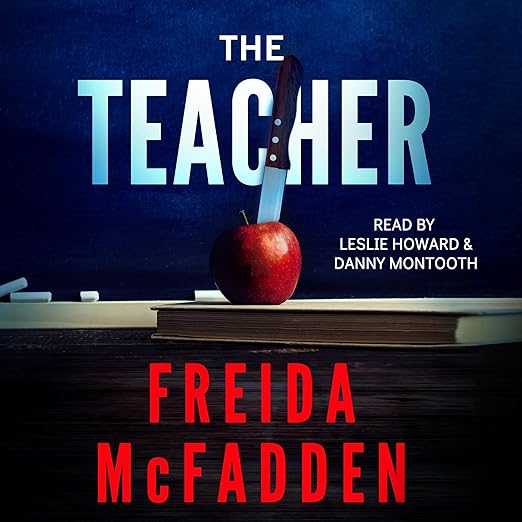
Freida McFadden's The Teacher is the audiobook for listeners who want the plot to turn before they have finished processing the last turn. That is not a criticism. McFadden has built a specific kind of thriller architecture over the course of her bestselling career, and The Teacher is a refined version of it: the dual POV structure that gives each narrator just enough credibility to be believed before removing the ground from under both of them. Leslie Howard's performance makes the audiobook format the optimal way to experience it, because the experience of two voices gradually diverging from each other's account of the same events is physically present in a way that page breaks cannot replicate.
The setup positions Eve, a math teacher at Caseham High School, as the apparent perspective character. Her husband Nate, her orderly life, the student Addie at the center of a teacher-affair scandal the previous year: these elements arrive cleanly and quickly. McFadden opens the mechanism and invites you to inspect it before the mechanism does what mechanisms in her novels do, which is reveal that you were looking at the wrong gear the entire time. One reviewer described being engaged from the first chapter without the typical slow character-introduction period. That responsiveness is earned. McFadden understands that psychological thriller is a genre where trust is the real subject, not crime, and she has structured The Teacher accordingly.
The academic setting is more than window dressing here. McFadden uses the high school environment to concentrate and clarify the power dynamics her novel is examining: the structural authority of teachers over students, the specific vulnerability of young women navigating institutional hierarchies, and the way that institutional trust systems can be weaponized by anyone patient enough to understand them. Addie's character is the novel's real center of gravity despite Eve's apparent primacy in the early chapters. The "Addie can't be trusted. She lies. She hurts people. She destroys lives" framing that the synopsis provides is precisely the kind of surface-level characterization McFadden enjoys constructing and then systematically dismantling.
One reviewer noted that the epilogue "throws you with a right hook," which is consistent with McFadden's approach to endings across her novels. She tends to use the epilogue as a structural device for final revelation rather than for resolution, which is a deliberate choice that some readers find intensely satisfying and others find frustrating. The same reviewer noted that despite giving the book four stars, they felt Addie "should have known better," a moral judgment that itself reveals something about how effectively McFadden has made you care about the characters' choices by the novel's end. Ambivalence about fictional decisions is the mark of a thriller that has successfully made its stakes feel real.
Howard's Two Voices Hide Whose Truth Wins
Leslie Howard is the reason to choose the audiobook over the print edition. Howard navigates the dual POV structure across nine and a half hours with a consistency that makes the experience of tracking two competing narratives genuinely manageable. Eve and Addie do not receive dramatically different vocal treatments, which would risk signaling whose account is "true" before the novel wants to make that signal. Instead, Howard gives each a slightly different register: Eve's narration carries a kind of controlled propriety that frays at specific moments; Addie's is more guarded, with the quality of someone editing in real time. The distinction is subtle enough to sustain ambiguity while remaining legible.
One reviewer described this as their fourth McFadden novel and praised her consistent ability to hook the reader early and hold attention. That pattern holds across McFadden's audiobook catalogue, but The Teacher is notable for how consistently it maintains pressure through its middle section, which is the structural challenge dual-POV thrillers typically fail. Howard's performance is central to that consistency: the two-voice architecture requires a narrator who can hold both threads without either dominating, and Howard does not let either account tip into melodrama.
An Affair Retold by Two Unreliable Witnesses
The student-teacher affair at the novel's backstory center is handled obliquely in the synopsis but examined directly in the text. McFadden uses the affair not as a shock element but as a structural mechanism: the event that has already happened and whose meaning is being retroactively contested by multiple people with competing interests. How you experience the resolution of that backstory depends heavily on which narrator you have been trusting, and McFadden is precise in her management of information across the two perspectives.
Listeners who have read other McFadden novels will arrive with a calibrated skepticism about both narrators. That prior experience with her structural method is both an advantage and a minor limitation: the specific subversions in The Teacher work somewhat differently from those in, say, The Locked Door or Never Never, but readers familiar with her work will be scanning for the technique even while being surprised by the content. First-time McFadden readers may experience the structural revelations with greater force, but there is enough local surprise in the plotting that returning readers are not simply watching a familiar trick performed again.
Trust Issues Matter More Than Action Scenes
Listeners who want psychological thriller built on dual POV with well-managed structural revelation will find this one of McFadden's more tightly constructed novels. The audiobook format is genuinely the optimal version of this particular story, given how much of the effect depends on the experience of two voices occupying the same narrative space with different information.
Those who prefer their thrillers driven by external action over internal psychological maneuvering should approach with tempered expectations: McFadden's action sequences exist but are secondary to the sustained tension of not knowing which narrator to believe. Anyone who found the endings of other McFadden novels unsatisfying will want to know that several reviewers specifically flag the epilogue here as divisive: it provides revelation but not closure in the conventional sense, and the distinction between those two things matters for whether you find the ending satisfying or frustrating.
Is The Teacher audiobook a standalone or do I need to have read other Freida McFadden novels first?
Completely standalone. There are no character or plot connections to McFadden's other novels. The dual-POV structure is a recurring formal choice in her work, but no prior reading is required to follow or enjoy The Teacher.
How does Leslie Howard handle the dual POV structure in this audiobook?
Howard gives Eve and Addie subtly different registers rather than dramatically contrasting voices, which preserves the ambiguity about which narrator is reliable. Eve's narration is slightly more controlled and formal; Addie's carries a quality of careful self-editing. The distinction is calibrated rather than exaggerated.
Does this audiobook require prior knowledge of the student-teacher affair backstory to follow the plot?
No. The affair is established in the audiobook's opening and functions as the event whose meaning is being contested by multiple characters throughout the novel. McFadden constructs the backstory clearly enough through the two narrators that no prior knowledge is needed.
Is the ending of this audiobook satisfying for listeners who want resolution?
The ending provides significant revelation but not conventional closure. The epilogue in particular delivers a final twist that at least one reviewer described as a 'right hook,' and the resolution is deliberately ambivalent rather than neatly conclusive. Listeners who need full narrative resolution may find it frustrating; those who prefer revelation over explanation tend to respond strongly to it.