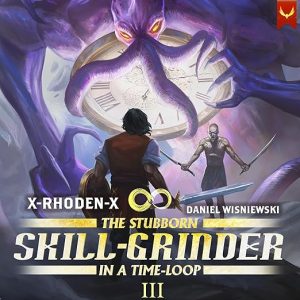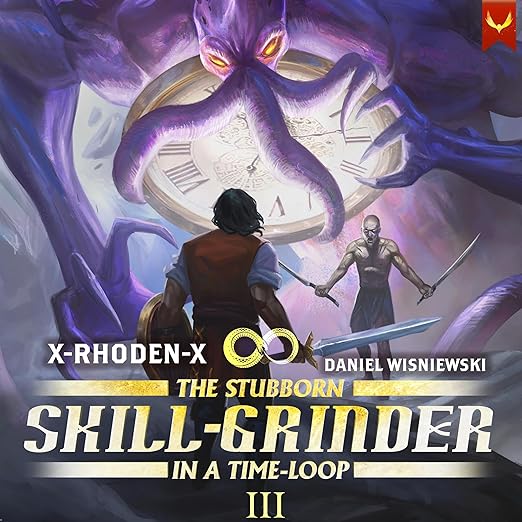
I was somewhere around hour fourteen when I realized the series had done something quietly impressive: Orodan, the protagonist who dies and resets through time loops to grind his way to power, had accumulated enough genuine personality that I was worried about him in a way that had nothing to do with whether he would level up. That is not a given in LitRPG. The genre tends toward protagonists whose emotional lives are thin scaffolding for the actual business of stat screens and skill trees. X-RHODEN-X has been doing something more complicated than that, and Book 3 is where the ambition becomes fully visible.
The setup coming into this volume: Orodan has awakened a Celestial-rarity skill after his fight with the Eldritch Avatar, and the consequences are cosmically loud. Champions from multiple worlds are now hunting him. Worse, his characteristic bluntness, he has been telling people directly about the time loops, which is not something most loop protagonists do, has attracted the attention of entities who specifically know how to deal with people like him, including the possibility of a true death that the loops cannot undo. The series has expanded from a local grind to an extra-planar chase, and Book 3 commits to that scale fully.
The central appeal of this series has always been Orodan's specific brand of stubbornness. He is not clever in the traditional LitRPG sense, he does not exploit systems or find elegant shortcuts. He hits the wall, dies, resets, and hits the wall again slightly differently. That approach is played for both comedy and genuine pathos, and the cleaning skill that readers mention as a recurring highlight is a perfect example of how the author uses apparent absurdity to reveal character. Orodan's relationship to unglamorous, useful competence says something real about him.
Book 3 complicates that dynamic by introducing a time-limit element that some readers have found jarring. The loop count is no longer unlimited, which changes the calculus of Orodan's approach significantly. One reviewer with a four-star rating raised a legitimate concern about this shift, it was not established in the earlier volumes and is introduced somewhat obliquely here. Whether that reads as a narrative evolution or a rule change depends on how attached you are to the original mechanics. I found it justified by the story's escalation, but it is a genuine adjustment to make.
Wisniewski Sustains Twenty-Nine Hours of System Notifications
Daniel Wisniewski has been this series' narrator throughout and has built a real fluency with Orodan's voice, the particular combination of directness and bewildered resilience that defines the character. At nearly 29 hours, this is a long listen even by LitRPG boxset standards, and the pacing requires a narrator who can sustain energy through action sequences without losing the quieter character moments. Wisniewski manages it. The series features what the synopsis describes as a detailed system, loads of skills, varied progression paths, and cultivation aspects, all of which require a narrator who can deliver stat information and system notifications without making them feel like interruptions. He has that calibration dialed in by this point.
The worldbuilding depth continues to reward investment. The inter-planar expansion that Book 3 undertakes could have felt like generic fantasy inflation, but the author keeps the cosmology grounded in specific, consequential details. When new factions and champions appear, they feel like they belong to a coherent universe rather than being imported from a convenient generator.
Checkpoints Orodan Cannot Control or Exploit
This is emphatically not a good entry point. The series has a cumulative emotional investment that makes Book 3 land significantly harder for readers who have been with Orodan since the beginning. Starting here would mean missing the character development that makes the cosmic-stakes moments feel earned. Begin with Book 1 and commit to the progression.
The checkpoint mechanic introduced in this volume, Orodan cannot control when checkpoints are set and cannot use them strategically, is a point of genuine debate among fans. Some find it enriches the tension. Others, as noted in reviews, feel it disrupts the internal logic the series established. It is worth being aware of going in rather than encountering it mid-listen and feeling blindsided.
Existential Stakes Reward Readers Through Book Two
Readers who have completed Books 1 and 2 and are looking for the series to expand its scope and raise the existential stakes will find this volume delivers exactly that. If you have been charmed by Orodan's combination of bluntness, perseverance, and oddly affecting humanity, Book 3 tests and deepens those qualities under significantly more pressure. LitRPG listeners who appreciate character-driven progression over pure power fantasy will find the series worth the investment.
If you have not read the earlier volumes, or if LitRPG's combination of fantasy worldbuilding and game-system mechanics does not appeal to you, this is not the place to start or to experiment. The series rewards commitment and background knowledge. It does not soften its learning curve for newcomers.