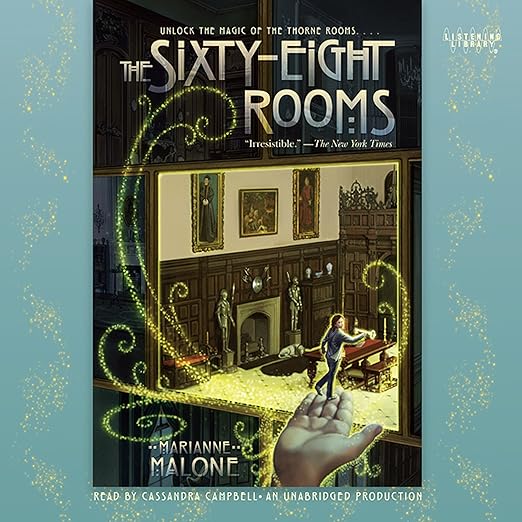
Quick Take
- Narration: Cassandra Campbell handles the Chicago Art Institute setting and the miniature world sequences with a quiet sense of wonder that suits the book’s atmosphere exactly.
- Themes: Miniature worlds and hidden histories, Chicago art history, the magic of curiosity
- Mood: Quietly enchanting, with the particular pleasure of a real place turned into adventure
- Verdict: A charming art-world adventure grounded in the actual Thorne Rooms at the Art Institute of Chicago, best appreciated by listeners who love the idea of a real place holding a real secret.
My introduction to the Thorne Rooms came through this book, which is probably not the sequence Marianne Malone intended, but it worked. I spent an afternoon after finishing the audio researching the sixty-eight miniature rooms that Mrs. James Ward Thorne had actually built in the 1930s and currently inhabit the Children’s Galleries of the Art Institute of Chicago. They are extraordinary. And the fact that Malone built a middle-grade adventure directly on top of that real history is a genuinely good idea, executed with care.
The premise is elegant: what if a magic key allowed you to shrink small enough to walk through the Thorne Rooms and discover what others had left behind inside them? Ruthie and Jack, the protagonists, find exactly such a key, and the story follows what they discover across the sixty-eight exquisitely detailed miniature spaces, each designed in the style of a different historical period.
Real History as Magical Infrastructure
What Malone does shrewdly is use the actual historical details of the Thorne Rooms as the substance of the magic rather than mere backdrop. The specificity matters: the knobs on the doors, the candles in the candlesticks, the particular historical periods represented. The story functions as an introduction to decorative arts history without ever feeling like an introduction to anything. Ruthie and Jack discover fragments of other people’s stories inside the rooms, left there by previous tiny visitors, and tracing those fragments requires engaging with the history embedded in the architecture around them. It is a genuinely elegant structure.
Cassandra Campbell and the Scale of Wonder
Cassandra Campbell is one of the more reliable narrators in middle-grade audio, and she serves this material well. The miniature world sequences require a narrator who can convey both the wonder of the scale change and the credible danger of being very small in a building full of unsuspecting people. Campbell manages both registers. Her Chicago setting feels grounded rather than touristic, and her handling of the secondary characters who inhabit the art institute world is appropriately varied without becoming showy.
For Readers of Chasing Vermeer and The Doll People
The publisher’s comparisons are honest ones. Fans of Blue Balliett’s Chasing Vermeer will recognize a similar investment in art as mystery, and readers who loved Ann M. Martin and Laura Godwin’s The Doll People series will find the miniature-world mechanics familiar and satisfying. The Sixty-Eight Rooms sits at an interesting intersection of art history adventure and portal fantasy, drawing on the pleasure of secret passages and hidden spaces that appears throughout children’s literature from Narnia onward. What distinguishes it is the specificity of the real place at its center.
Who Should Listen, Who Should Skip
This is a strong recommendation for ages eight to twelve, particularly for children who enjoy discovering that real places hold extraordinary histories. It works well for families who live in or visit Chicago and might actually visit the Thorne Rooms afterward. Listeners looking for a fast-paced thriller will find the pace more contemplative than kinetic; this is a book that rewards close attention to its world-building rather than propulsive momentum. It is the first in the Sixty-Eight Rooms Adventures series, and it sets up the larger mystery with a satisfying first-entry resolution.
Frequently Asked Questions
Are the Thorne Rooms a real place, and does knowing that change the listening experience?
Yes. The sixty-eight miniature rooms built by Mrs. James Ward Thorne in the 1930s are real and currently housed in the Art Institute of Chicago. Knowing this adds a significant dimension to the listening experience; many readers have reported visiting the actual rooms after finishing the book.
How does Cassandra Campbell handle the transitions between the regular-sized Chicago world and the miniature room sequences?
Campbell uses a slight shift in pacing and vocal register to mark the transitions, which helps listeners feel the scale change without requiring elaborate audio effects. The shifts are handled smoothly and contribute to the sense of entering a different kind of space.
Does the story require familiarity with art history or decorative arts to be enjoyable?
No prior knowledge is needed. The historical detail about the rooms’ different periods is introduced through Ruthie and Jack’s discovery, so the information arrives as part of the adventure rather than as background study.
Is this the first book in a series, and how does it leave things at the end?
This is the first book in the Sixty-Eight Rooms Adventures series, which continues with Stealing Magic. The first book resolves its central mystery satisfyingly while establishing the larger world and the mechanics of the magic key for future volumes.