Quick Take
- Narration: David Gilmore keeps the pacing tight and the action sequences clear, which is exactly what this kind of adventure serial demands.
- Themes: Lost history, archaeological mystery, loyalty under pressure
- Mood: Propulsive and warmly plotted
- Verdict: Entry 36 in the Sam Reilly series delivers exactly what longtime fans expect: sharply assembled adventure fiction built around a genuine historical mystery.
I came to this book as someone who has not read all 35 previous Sam Reilly novels, which is, I should admit, not the ideal entry point. Christopher Cartwright has been building this character and this world across a substantial body of work, and there are moments in The Shield of Hercules where you feel the history of those prior relationships without having access to it. But the novel is constructed to function for readers who know the series well, and at seven hours it moves quickly enough that the gaps in my familiarity never became an obstacle.
David Gilmore narrates with the kind of efficiency that adventure fiction requires. This is not a narration that calls attention to itself; it is one that serves the story’s momentum. When the action sequences accelerate, Gilmore’s pacing follows. When the historical context requires a steadier hand, he provides it. Over 36 installments, a Sam Reilly narrator needs to feel like a reliable companion, and Gilmore earns that.
Our Take on The Shield of Hercules
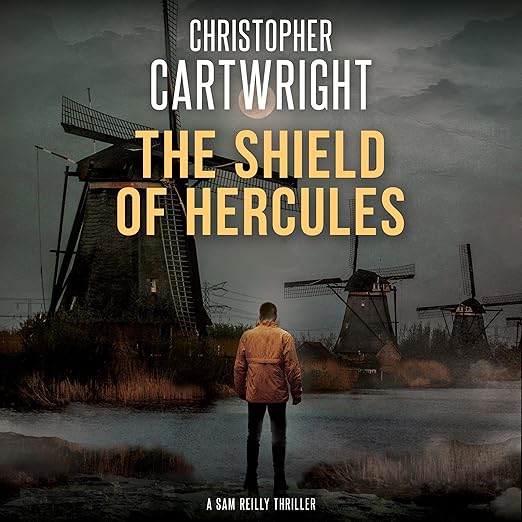
Cartwright anchors this installment in a real historical event: the catastrophic Dutch flood of 1953, known as the Watersnoodramp, which killed more than 1,800 people and reshaped the Netherlands’ relationship to sea defenses. Against this documented disaster, Cartwright embeds a fictional murder hidden by the chaos of the flood, a skeleton with a severed hand and a mysterious artifact discovered seven decades later. The Shield of Hercules of the title is a mythological relic of antiquity, and Sam Reilly’s mission is to determine what the artifact unlocks and why someone is willing to kill to keep that secret buried. What makes this premise work is the specificity of the historical grounding. The 1953 flood is not decorative context; it is a reason for things to have been hidden and for that hiding to have held for seventy years.
Why Listen to The Shield of Hercules
Adventure fiction with archaeological and historical underpinnings depends on two things working in tandem: the mystery needs to feel genuinely mysterious, and the physical danger needs to feel genuinely dangerous. Cartwright manages both here, with reviewers noting that the tension stays active throughout and that the ensemble around Sam, including Genevieve, Almira, and a secondary cast that has developed across the series, provides emotional texture beyond the central mystery. One reviewer noted appreciation for the pet references and the sense that Sam now operates with something like a real family, which is a detail that distinguishes this kind of long-running series from adventure fiction where the protagonist exists in permanent isolation. That relational depth is harder to access for a new reader, but it adds warmth even from the outside.
What to Watch For in The Shield of Hercules
Veteran readers of the series flagged that this installment uses an ending type that Cartwright has not deployed before. One reviewer described it as slightly disturbing and explicitly expressed hope that the next book would be out soon. Without providing specifics, it is worth knowing that the conclusion here is not entirely closed-loop in the way some standalone adventure fiction is. Series readers will likely read this as a deliberate setup; new readers may find it more disorienting. The book’s humor is also worth mentioning: several reviewers call attention to funny moments that do not undermine the suspense, which is a harder balance to strike than it sounds and which Cartwright handles consistently.
Who Should Listen to The Shield of Hercules
Fans of the Sam Reilly series will find this a strong entry. Adventure fiction listeners who enjoy mysteries rooted in actual historical events and who don’t mind ensemble casts with substantial backstory will also do well here. This is not an ideal starting point for new readers given the relational depth baked into the later installments, but Cartwright writes clearly enough that it functions as a standalone mystery even without that context. Listeners who prefer clean conclusions over serial cliffhangers should note the ending before committing.
Frequently Asked Questions
Is The Shield of Hercules a good entry point for the Sam Reilly series, or should I start from book one?
The mystery functions as a standalone, but the emotional weight of the ensemble relationships is built over 35 previous books. New readers will enjoy the adventure but miss context around secondary characters. Starting from the beginning is ideal if you want to invest in the series fully.
How accurately does the book incorporate the 1953 Dutch flood disaster?
The Watersnoodramp is a real historical event in which over 1,800 people died. Cartwright uses the disaster as the foundation for a fictional mystery hidden within it, so the historical framing is genuine even as the plot built around it is invented.
Does David Gilmore’s narration work for the action-heavy sequences in this installment?
Yes. Gilmore keeps the pacing tight through action scenes and provides appropriate steadiness during the historical and expository sections. The narration serves the story efficiently without drawing attention to itself.
Several reviews mention a surprising ending, what should I know going in?
Reviewers indicate Cartwright uses a narrative choice at the end of this installment that he hasn’t employed before in the series. Without spoiling it, it is worth knowing the ending does not fully resolve and has generated strong reader reaction in both directions.