Quick Take
- Narration: Fred Berman handles the ensemble of absurd characters with dexterity and comic timing, giving each a distinct enough voice that the 14 stories maintain individual identity.
- Themes: Found-family comedy, bureaucracy vs. chaos, irreverent fantasy world-building
- Mood: Gleefully chaotic and warm-hearted, with genuine laugh-out-loud moments
- Verdict: A companion collection that rewards existing fans of the Unconventional Heroes series and offers an unusually entertaining entry point for newcomers willing to start mid-universe.
I put this on during what I expected to be a fairly tedious Saturday errand run and ended up sitting in a parking lot for an extra forty minutes because I was not willing to stop listening to what was happening with a pyromaniacal elf and a flock of magical sheep. L. G. Estrella is doing something genuinely funny, which is harder to achieve in fantasy than the genre’s long tradition of comedy might suggest. Most fantasy humor leans on archetype-subversion without earning the individual jokes. The Sheep Dragon earns most of its jokes.
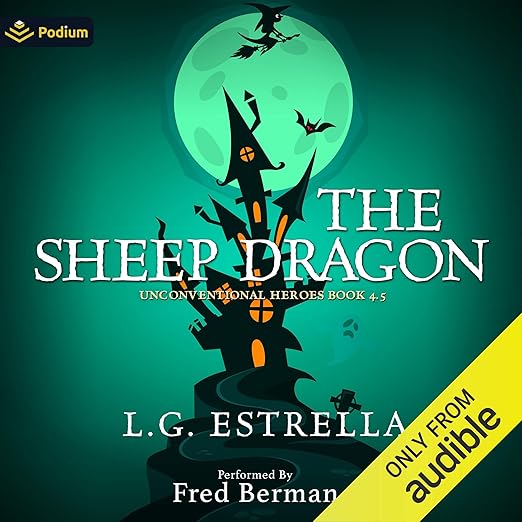
To understand what you are getting: The Sheep Dragon is not a novel. It is a collection of fourteen short stories set before, during, and after the first four books in the Unconventional Heroes series. Timmy, the Grand Necromancer who is more practical than menacing, is at the center, but the collection systematically expands into every member of his improbable ensemble. The pint-sized apprentice who dreams of necromantic supremacy but is mostly adorable. The vampire whose wardrobe has been drastically reduced by her habit of getting stabbed. The legendary swordsman who faces the indignity of potentially dying of old age. The timid bureaucrat whose gift for almost being eaten is matched only by his gift for paperwork.
Our Take on The Sheep Dragon
At twenty-six hours and thirty-four minutes, this is a substantial listen for a short story collection. The individual stories vary in length, and one reviewer noted accurately that calling them short stories understates their scale, many read as novellas. That distinction matters: Estrella is not doing quick sketches. She is doing sustained character studies in an absurdist register, and the longer runtime per story means the comic setups have room to pay off fully rather than rushing to the punchline.
The ensemble structure is the collection’s greatest strength and its occasional weakness. Stories that focus on the more developed characters, Timmy, Katy the pyromaniacal elf, the ancient vampire, land consistently. The stories that expand into secondary figures are more uneven, as one reviewer observed. There is also a certain amount of repeated foundational information across stories that becomes redundant if you are reading the whole collection sequentially rather than dipping into individual stories. Estrella writes each story to function as a standalone, which means the set-up work gets duplicated when you move through the collection end to end.
Why Listen to The Sheep Dragon
The humor earns consistent respect in the reviews for a specific reason: Estrella seems genuinely amused by her own characters rather than merely deploying them. The question the synopsis poses about whether a young dragon can watch over a flock of sheep without eating them is funnier in practice than in description because the dragon’s hunger is treated as a character trait that conflicts with his actual desire to succeed rather than as a running gag. Nobody is safe, not pineapples, not bandits, not giant mutant cows. The specificity of the targets of chaos is part of what makes the comedy work.
Fred Berman’s narration holds this together across twenty-six hours in a way that deserves specific recognition. Comedy is harder to narrate than drama because timing matters more. Berman has both the range to differentiate among the ensemble and the comedic instinct to land the absurd moments without telegraphing them. The review about laughing aloud at Katy’s encounter with a panther in the jungle is an accurate gauge: moments like that require a narrator who commits to the bit without winking at the audience, and Berman consistently commits.
What to Watch For in The Sheep Dragon
This is companion fiction rather than standalone fiction. The collection is enriched by familiarity with the main Unconventional Heroes series, particularly because the backstory revealed in some of the stories functions partly as supplementary material to events in the novels. Newcomers can enter here, and several readers clearly did so successfully, but they will occasionally sense they are getting partial context. The uneven quality across fourteen stories is also worth flagging: the collection is mostly excellent, but there are stories where the central joke does not quite sustain its length. One reviewer called these sections slightly tedious, which is accurate for specific entries rather than the collection as a whole.
Who Should Listen to The Sheep Dragon
Existing fans of the Unconventional Heroes series should consider this essential. The backstory development and character expansion are worth the runtime, and the humor is consistent with what made the main series work. Newcomers to Estrella’s work who enjoy character-driven absurdist fantasy and are willing to dive into an established universe mid-stream will find enough here to orient themselves and likely come out wanting to start from book one of the main series. Listeners who need strong narrative throughline in their fiction will struggle with the collection format, since the connective tissue between stories is character rather than plot.
Frequently Asked Questions
Can I start with The Sheep Dragon if I have not read the main Unconventional Heroes series?
Yes, with the understanding that some story context draws on events from the first four novels. Estrella writes each story to function as a standalone, so you will not be lost, but familiarity with the main series adds a layer of appreciation to the backstory revelations. Many reviewers came to the collection as newcomers and used it as an entry point to the universe.
At over 26 hours, is the length justified for a short story collection?
The stories function more as novellas than short stories, so the runtime is appropriate to the actual scale of the content. Individual stories have room to develop their comic setups fully rather than rushing. The main caveat is that repeated foundational information across stories can feel redundant when listening end to end.
How does Fred Berman handle narrating a comedy ensemble with multiple distinct characters?
Very well. Berman differentiates the ensemble characters clearly and has the comedic timing to land the absurdist moments without telegraphing them in advance. Comedy narration is technically more demanding than drama, and Berman commits to the material throughout the full runtime.
Are all fourteen stories of equal quality, or are some significantly weaker than others?
Uneven but mostly strong. Stories centered on the main ensemble, particularly Timmy, Katy, and the vampire, land most consistently. Stories that expand into secondary characters are more variable. One reviewer noted some sections felt slightly tedious, which is accurate for specific entries. The overall collection is well above average even accounting for its weakest stories.