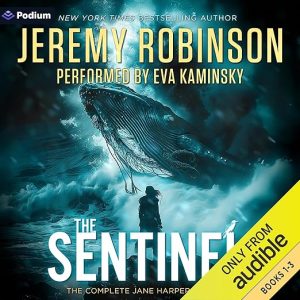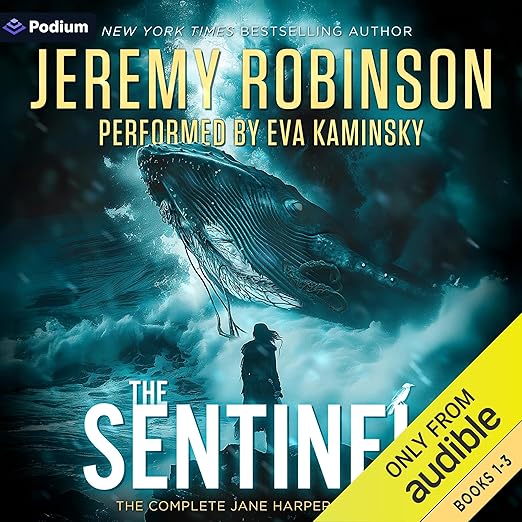
Someone in a reading group I follow asked what to listen to after finishing James Rollins' Sigma Force series, and the recommendation that came back most often was Jeremy Robinson's Jane Harper books. I filed that away and came back to it months later when the complete trilogy appeared as a single production, twenty-seven hours with Eva Kaminsky narrating. I put it on during a week of evening walks and found myself extending the walks to keep listening, which is the most honest endorsement I can give.
Robinson is a number one Audible and New York Times bestselling author with a reputation for high-concept, high-velocity action fiction, and the Jane Harper trilogy is his most formally daring work: a genre hybrid that moves from environmentalist thriller to survival horror to cosmic body horror over the course of three books without losing its tonal footing. That is harder than it sounds.
First, the Big Picture
The premise begins with whale hunters and environmentalists locked in a violent confrontation in the Arctic Ocean. Both ships sink. Survivors from both sides of the conflict are stranded on a desolate island. Enter Jane Harper, introduced as an undercover agent who is razor-sharp and unflinching, wielding her wit as deftly as her fists. The central conflict then turns strange: ancient Viking ruins. Something beneath the frozen ground. The Draugar. Undying Vikings controlled by hive-mind parasites connected by three sinister queens, capable of spreading to any mammalian host, including bears, whales, and people.
This is the moment where Robinson either loses his audience or locks them in for all twenty-seven hours. Reviewers describe him as unlocking his demented mind and plucking out a tale of horror, humor, science fiction, and heart. One listener compared the experience to a trashy TV show, which they explicitly clarified was not a criticism. The comparison holds: Robinson is working in a register that values momentum and entertainment over literary ambition, and within those terms he is genuinely accomplished.
The Best Parts of The Sentinel: The Complete Jane Harper Trilogy
Eva Kaminsky's narration is a major part of why this works in audio. Jane Harper's character, described by one reviewer as a badass chaos gremlin who is smart, savage, and always ten steps ahead or faking it very well, requires a narrator who can handle the self-deprecating humor alongside the action without letting either undercut the other. Kaminsky manages it. The comedy lands. The physical sequences have weight and pacing. The emotional gut punches, and there are a few, arrive without being telegraphed into melodrama.
The single-volume format also allows the arc of Jane's development to work properly. Reviewers who read the books individually had to wait between installments; the complete trilogy in audio gives listeners the full character arc in a single continuous experience, which is how Robinson intended it to land. One reviewer who went in skeptical described such change in Jane that they could not put it down. That developmental arc is the heart of what makes the trilogy worth its runtime.
What Might Not Land
The quality is not entirely consistent across all twenty-seven hours. One reviewer noted that the writing is generally tighter at the beginning and gets fast and loose as the story progresses. This is a common issue in long action series, and it is worth setting expectations accordingly: the first book is the most carefully constructed, and the subsequent volumes trade some of that tightness for escalation and resolution. For listeners who prioritize sustained prose quality, this is a meaningful caveat. For listeners who are primarily there for the ride, it matters much less.
The book is also extremely comfortable with its own absurdity. Hive-mind Viking parasites that can infect bears and whales require a listener who can set aside plausibility and engage with the logic of the world on its own terms. Robinson expects this, and he prepares you for it, but first-time Robinson readers should know that this is the contract he is offering.
Who Should Listen to The Sentinel: The Complete Jane Harper Trilogy
James Rollins readers, as the original recommendation suggested, are the most obvious audience. Listeners who enjoy action-driven horror hybrids with a protagonist who provides genuine comedic relief without sacrificing competence will find Jane Harper one of the more entertaining characters in recent genre audio. Those looking for character-driven literary horror, pristine prose throughout, or a coherent scientific framework for the supernatural elements will find the trilogy unsatisfying. Listeners who can commit to twenty-seven hours and enjoy the feeling of a long-form adventure playing out in full will get the best version of what Robinson is offering here.
A Few Questions About The Sentinel: The Complete Jane Harper Trilogy
Do I need to have listened to the individual Jane Harper books before this trilogy collection?
No. The Sentinel: The Complete Jane Harper Trilogy contains all three books sequentially and is fully self-contained. Listeners new to Robinson's Jane Harper series can start here without prior familiarity.
How does Eva Kaminsky handle the shift between action sequences, horror, and the book's frequent humor?
Reviewers consistently highlight the humor as landing well in audio, which is harder to sustain than tension or horror. Kaminsky handles the tonal range between Jane's self-deprecating internal voice and the escalating external chaos with enough consistency that the shifts feel intentional rather than jarring.
Is the Draugar horror element derived from actual Norse mythology, or is it Robinson's invention?
The Draugar, undead figures from Norse mythology, are a real element of that tradition. Robinson uses them as the basis for a science fiction framework involving hive-mind parasites and extraterrestrial origins, which is his own invention. The blend of genuine mythological source material and genre SF is part of what gives the premise its texture.
Does the trilogy have a satisfying conclusion, or does it end on a cliffhanger?
Multiple reviewers describe the conclusion as worth waiting for and note that having all three books in one collection makes the resolution feel earned. This is a complete arc, not a setup for additional volumes.