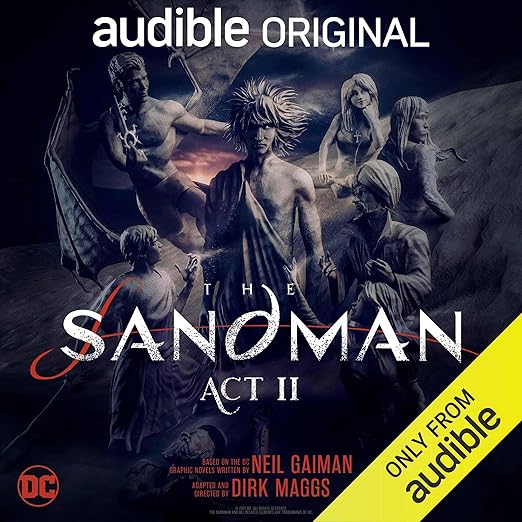
I had been putting off The Sandman: Act II for months, not because I doubted it, but because Act I had set such a specific standard that I wasn't sure I was ready to commit to another extended visit to the Dreaming. I finally started it on a long weekend with nowhere I had to be, which turned out to be exactly right. This is not background listening. It rewards the kind of attention you give to something you're watching rather than something running alongside other tasks.
Act II adapts volumes four through six of Neil Gaiman's original comics run: Season of Mists, A Game of You, and most of Fables and Reflections. That means the audio drama ranges across the French Revolution, ancient Rome, eighth-century Baghdad, nineteenth-century San Francisco, and the contemporary world, often within the span of a single episode. The scope is genuinely enormous, and Dirk Maggs's adaptation and direction hold it together with a structural intelligence that earns the comparisons to prestige theater.
How The Sandman: Act II Holds Up
Gaiman as narrator is the right anchor for a story this diffuse. His voice has a quality that is difficult to describe precisely: it's intimate without being confessional, authoritative without being distant. He created these characters and this world, and you feel that in the performance even when the material is at its most abstract. James McAvoy's Morpheus is the brooding, inhuman presence the character requires, and McAvoy resists the temptation to make him sympathetic in conventional ways. The Lord of Dreams is not a comfortable character to spend time with, and McAvoy keeps that true.
The supporting cast is where Act II expands most visibly from its predecessor. Kat Dennings's Death has been praised across both acts for capturing the character's paradoxical optimism. Emma Corrin as Thessaly brings a particular worldly precision. Brian Cox, John Lithgow, Jeffrey Wright, Regé-Jean Page, Michael Sheen, Kristen Schaal, and many others contribute to what feels less like a cast list and more like a gathering of performers who each wanted to be in this specific project. Ray Porter and Simon Vance appear as well, in roles that complement rather than compete with their more familiar solo narration work.
The production design is what separates this from conventional audiobooks and even from most audio dramas. The immersive quality reviewers describe is the result of layered sound design and music that don't merely accompany the voices but create the environments those voices inhabit. Season of Mists, which involves Morpheus reopening Hell and inviting its former inmates to parley, benefits enormously from production that can render the scale of what's happening.
Listeners who've engaged with the original graphic novels will find the adaptation faithful to the emotional architecture of the source even where specific sequences are condensed or restructured for audio. Listeners coming to Sandman through audio without prior comics exposure may occasionally feel the density of the mythology, but the production's care with context means that Act II is followable as long as you've heard Act I.
Weak Spots in The Sandman: Act II
One reviewer noted that the enclosed physical materials for Act II (if you have the boxed set) repeated the sticker art from Act I and lacked the episode guide booklet that made the first set useful. This is a packaging note rather than a content criticism, but listeners who purchased the physical edition expecting different bonus materials should be aware.
The content warning in the synopsis is real. This is Gaiman's mature-audience Sandman, with explicit language, graphic violence, and sexual content appropriate to the source material. The publisher flags this clearly, but it bears repeating for listeners who might be giving this as a gift or listening without having heard Act I's tonal register.
The Right Listener for The Sandman: Act II
Anyone who finished Act I should continue directly here. Listeners who didn't start with Act I can begin anywhere in Gaiman's mythology if they're already comics-familiar, but the audio adaptation is best experienced in sequence. This is not appropriate for young listeners despite the fantasy framing. Sandman is adult fiction about dream, death, loss, and obligation, and Act II handles all of those in ways that require a mature audience to fully receive.