Quick Take
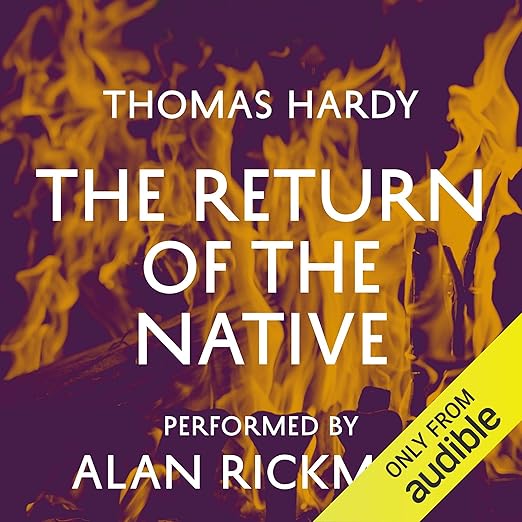
- Narration: Alan Rickman’s velvet baritone is extraordinary here, he differentiates every dialect and character with theatrical precision, and gives Egdon Heath itself a living presence on audio.
- Themes: Thwarted ambition, the tyranny of place, desire vs. self-deception
- Mood: Brooding and atmospheric, slow-burning Victorian melancholy
- Verdict: If you want Hardy at his most landscape-obsessed and psychologically relentless, this Audible exclusive is the edition to choose, Rickman’s narration makes the case for audio over print.
I came to this one after a long week and did not plan to start anything ambitious. I wanted something substantial to carry me through a Saturday afternoon walk, and figured Hardy was reliable company. Within the first twenty minutes I had slowed my pace considerably, because Egdon Heath, as rendered by Alan Rickman’s voice, had taken on a presence I was not quite prepared for. That is the specific and strange power of this audiobook: the landscape ceases to be backdrop and becomes a character, exerting its own gravitational logic over everyone who moves across it. The heath listens and waits and outlasts. You feel that in a way that reading quietly to yourself does not quite produce.
Thomas Hardy published The Return of the Native in 1878, and it remains one of his most structurally ambitious novels. I had read it in print years ago for a Victorian literature seminar, and returning to it via audio revealed textures I had missed entirely on the page. The dialogue rhythms, the regional dialect, the long descriptive passages Hardy gives to the heath itself, all of it lands differently when spoken aloud by someone who understands that Hardy was writing tragedy in something close to the Greek mode. Structure and fate, character and landscape, operating in that particular locked combination Hardy favored above all other arrangements.
Egdon Heath as the Novel’s Sixth Character
Hardy opens this novel with an extended meditation on Egdon Heath before a single human being appears on the page, and that choice is entirely deliberate and structurally significant. The heath is ancient, indifferent, and permanent. It outlasts every ambition and every desire the characters carry onto it. Eustacia Vye, stranded at her grandfather’s lonely cottage, reads the heath as her jailor, a beautiful prison without walls that nonetheless holds her completely. Clym Yeobright, returning from Paris with plans to become a schoolmaster, reads it as home and source of meaning. Diggory Venn, the reddleman wandering its paths through reddened hands and reddened cart, seems almost native to it in a way the others never quite manage. What Hardy constructs, and what reviewers of this audiobook consistently note, is a world where the symbolic setting and the modernity of the characters exist in genuine, sustained tension with each other. The question the novel poses is whether we are ever truly free to shape our lives, or whether geography, class, and temperament conspire against us from the start. On audio, with Rickman reading the heath descriptions in an unhurried register that resists sentimentality, that question accumulates real weight across fifteen hours of listening. You begin to feel what the characters feel: that the heath is watching, that leaving is harder than it should be, that returning is perhaps the most dangerous act of all.
What Rickman Does That the Printed Page Cannot
One reviewer noted that Rickman’s performance makes the experience feel like listening to a play being acted out, and that is not hyperbole. He differentiates the rustic characters through accent and rhythm without tipping into caricature, gives Clym Yeobright a certain earnest gravity that makes his eventual failures feel tragic rather than deserved, and finds something genuinely troubling in Wildeve’s calculated charm. The real challenge, and the point where the audiobook does not fully resolve its structural problem, is Eustacia. An early reviewer put it plainly: Eustacia on the page is dangerously alluring, but certain qualities of her interiority are harder to convey through a male narrator, however accomplished. Rickman tries, and there are passages where he succeeds in suggesting her restlessness and her aristocratic scorn. But the electric volatility that Hardy gives her in close prose narration is occasionally flattened by the need to externalize what is primarily an internal register. This is not a failure of Rickman’s considerable talent; it is a structural limitation of single-narrator casting for a novel whose power depends so heavily on one woman’s inner experience of being trapped in the wrong life.
Hardy’s Pessimism and the Tragedy It Builds
It is worth saying plainly that The Return of the Native is not a comfortable listen. Hardy does not offer consolation or ironic distance. The escalating misunderstandings that drive the tragedy feel neither contrived nor melodramatic, because Hardy has spent the first half of the novel establishing precisely why each character is incapable of seeing past their own desires. Eustacia’s destructive restlessness draws others into a web of deceit and unhappiness not out of malice but out of a desperate conviction that she deserves more than the heath can offer. Hardy makes her sympathetic and infuriating in equal measure, and that combination is his signature achievement as a novelist. Compared to Far from the Madding Crowd or The Woodlanders, this novel is arguably less structurally elegant in its handling of the peripheral characters, but the psychological intensity of its central relationships more than compensates. The novel’s famous ending, with Venn domesticated and the heath unchanged, carries a particular weight when heard aloud, as if the landscape itself is the only entity that got what it wanted.
Who Should Listen and Who Should Come Back Later
This audiobook is ideal for listeners who already have some appetite for Victorian realism and are genuinely prepared for a slow build toward tragedy. Hardy’s prose demands patience; the first hour or two are devoted almost entirely to establishing Egdon Heath and its population before anything resembling a conventional plot emerges. If you are coming to Hardy for the first time, Far from the Madding Crowd might be a gentler entry point, the stakes are comparable but the protagonist is defined by a different set of qualities. For those who want Hardy at his most uncompromising, and want to hear what happens when a genuinely great actor engages with genuinely great prose, this Audible exclusive delivers something rare. Rickman earned his AudioFile Earphones Award here, and for fans of both Hardy and Rickman, the recording carries an extra layer of meaning that only deepens with time and familiarity.
Frequently Asked Questions
Is Alan Rickman’s narration suitable for someone unfamiliar with Hardy’s Victorian prose style?
Rickman’s pacing and clarity actually help new readers navigate Hardy’s longer descriptive passages. His theatrical instincts break up what can feel dense on the page, making the heath descriptions more immersive than intimidating. That said, the novel itself is structurally slow in its opening hours, so patience is still required regardless of narrator.
Does the single-narrator format work for a novel with multiple distinct regional dialects and accents?
Yes, impressively well. Rickman distinguishes the rustic characters through accent and rhythm without exaggeration, and the Wessex dialect feels grounded rather than theatrical. The main limitation is Eustacia, whose interiority is harder to convey through a male voice, but Rickman handles her scenes with careful attention.
How does The Return of the Native compare to other Hardy audiobooks in terms of the overall listening experience?
This stands out as an unusually premium production for a Hardy title. Many Hardy audiobooks use adequate but unremarkable narrators. Having Rickman on this particular text elevates the experience significantly, particularly for the atmospheric heath passages that define the novel’s distinctive tone.
Is this a free audiobook on Audible, and is it an Audible-exclusive recording?
Yes, this is available as a free audiobook through Audible membership and was produced as an Audible-exclusive recording. The Earphones Award from AudioFile Magazine confirms it as one of the stronger productions in the classic literature catalog.