Quick Take
- Narration: Jaime Green reads her own work with the measured curiosity of someone who has genuinely lived with these questions; the intimacy it creates is unusual and effective.
- Themes: Astrobiology and the search for extraterrestrial life, science fiction as scientific imagination, the meaning of human exceptionalism
- Mood: Expansive and contemplative, occasionally slow but consistently rewarding
- Verdict: A genuinely original piece of science writing that uses the alien-life question as a mirror for examining what we actually believe about ourselves.
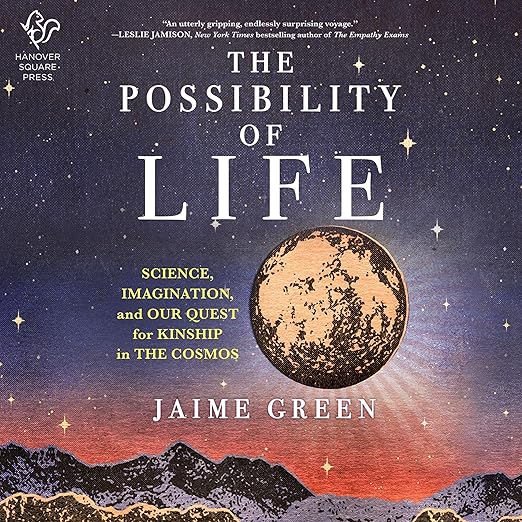
There is a particular kind of science book that I find myself returning to: the kind where the ostensible subject turns out to be a vehicle for something more philosophically interesting. The Possibility of Life is one of those books. Jaime Green is asking whether life exists on other planets, but what she is really asking, and what she makes explicit fairly early on, is what the answer to that question would mean. What does it reveal about our values, our assumptions, and our almost involuntary need to believe we are not alone?
I listened to this on several long walks in autumn, the kind of light that makes everything feel slightly provisional, which turned out to be exactly the right atmosphere. Green narrates her own book, and there is something about hearing a writer's own voice on material this personal and intellectually vulnerable that changes the listening experience in ways that are hard to articulate but easy to feel.
Our Take on The Possibility of Life
Green's approach is distinctive. She moves through the history of human thinking about extraterrestrial life, from Galileo and Copernicus through the contemporary search for exoplanets, but she weaves science fiction throughout as a parallel track rather than a footnote. The inclusion is deliberate and argued rather than decorative: Green's case is that science fiction writers, precisely because they are not constrained by empirical possibility, have done some of the most imaginative conceptual work on what alien life might actually mean. She draws on A Wrinkle in Time, Star Trek, Arrival, and others not as cultural reference points but as philosophical sources. A reviewer with a science background called this "a breakthrough in the style of science books," noting that Green's MFA in writing allows her to handle complex scientific subjects with an accessibility that technical writers often miss. That assessment is accurate.
Why Listen to The Possibility of Life
Green's self-narration is a genuine asset. Her reading style is unhurried and reflective, which suits material that invites pause. One reviewer compared the experience to reading a long poem, and that quality translates to audio in a way that surprised me: Green does not perform the text, she inhabits it, and you can hear the difference. The book rewards patient listening. A reviewer who described it as sometimes bogging down in longer sections is not wrong, but the density is usually earned rather than gratuitous. The sections on vent life, on the specific chemistry of how life might have begun, and on the philosophical implications of the Fermi paradox are the ones that slow down the most and also the ones that generate the most genuine intellectual discomfort in the best sense of that phrase.
What to Watch For in The Possibility of Life
Listeners seeking a propulsive narrative will find this book a slower listen than the cover might suggest. Green is an essayist at heart, and the book has an essayistic rather than investigative structure. There is no central mystery being solved; there is a question being turned over and examined from multiple angles. Some reviewers found this frustrating, particularly in the middle sections where the science becomes more technical. The audiobook does not provide the visual formatting of the printed book, so chapters with denser scientific content require more active listening than others. That said, the book's intellectual ambition is exactly what distinguishes it from the more straightforward popular science competition.
Who Should Listen to The Possibility of Life
This audiobook is for readers who are drawn to science writing that takes ideas seriously at a philosophical level, not just an empirical one. It works for people who have read popular astronomy or astrobiology and found themselves wanting a book that connected those questions to something larger. It also works for readers whose primary interest is literary nonfiction and who are willing to follow Green into scientific territory they may not know well. Skip it if you want fast, fact-dense popular science without the philosophical detours. But if the question of what it means to be human, asked through the lens of whether we might not be alone, sounds like the kind of thing that could keep you walking past your front door without noticing, this is worth your time.
Frequently Asked Questions
Is a science background necessary to follow The Possibility of Life?
No. Green has an MFA in writing and approaches the science as an informed generalist. The more technical sections are accessible to non-specialists, though they require attentive listening in audio format.
How does Green incorporate science fiction into what is otherwise a nonfiction science book?
Science fiction is treated as a serious intellectual source rather than as decoration. Green argues that writers like Ursula K. Le Guin and filmmakers behind works like Arrival have done conceptual work on alien life that complements and in some cases anticipates scientific thinking.
Does Green narrating her own book affect the listening experience noticeably?
Yes, in a positive way for most listeners. Her reading is reflective and personal, which suits material that is explicitly about what these scientific questions mean to her as a human being. The intimacy is earned by the content.
Is this book primarily about the science of searching for extraterrestrial life, or about the cultural and philosophical dimensions?
Both are present, but the cultural and philosophical dimensions are the organizing framework. The science provides the substance; Green's question is what that science reveals about human values and assumptions.