Quick Take
- Narration: Ruffin Prentiss matches Kwame Alexander’s spoken-word energy precisely, the verse passages land with rhythmic punch, and the motivational sections never tip into sermon territory.
- Themes: Self-determination, learning from athletes, basketball as life metaphor
- Mood: Urgent and warm, with a spoken-word pulse underneath everything
- Verdict: At just over an hour, this companion to The Crossover works as a standalone motivational listen for kids 10 and up, the format is inventive, the advice is genuine, and the athlete voices are well chosen.
I finished The Playbook on a Sunday morning when I was procrastinating on something I did not want to do. I put it on half-attentively, expecting light fare from a companion volume. Somewhere around the Nelson Mandela section I realized I had stopped procrastinating and started listening. That is the specific achievement of Kwame Alexander’s approach: he makes you forget you are receiving a lesson.
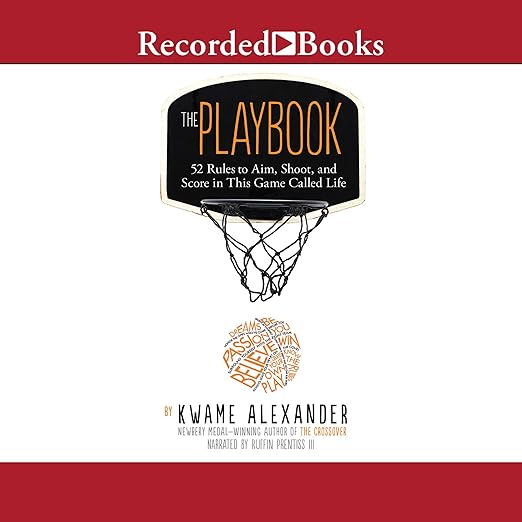
The Playbook is described as a companion to The Crossover, Alexander’s Newbery Medal-winning verse novel about basketball and family. You do not need to have read The Crossover to engage with this audiobook, it stands entirely on its own. What it shares with the novel is Alexander’s belief that basketball and life operate on the same principles, and that the rules of one illuminate the rules of the other. The book is organized as a series of rules, each containing wisdom from athletes and public figures, running just over an hour, the kind of audiobook that delivers a complete experience in a single commute.
Rules That Do Not Sound Like Rules
The rule-based format could easily become a motivational poster collection, bland maxims strung together with celebrity names attached. Alexander avoids this because he writes the connective tissue himself, in verse and in prose, and because he shares personal stories of failure and recovery rather than simply relaying other people’s victories. Reviewer Evangeline noted that the book combines personal narratives, athlete stories, and quotations into something that functions as a self-help book for kids without being reductive about it. Alexander is not peddling easy comfort. He is talking about the gap between wanting and having, and what goes in that gap.
The choice of voices cited is deliberate and wide. Serena Williams, LeBron James, Steph Curry, Carli Lloyd, Michelle Obama, and Nelson Mandela represent a range of sports, genders, eras, and types of achievement. No single figure dominates. The effect is a sense that the lessons offered are not the exclusive property of basketball culture but are principles that migrate across domains. For a child athlete in any sport, that breadth matters considerably.
Ruffin Prentiss and the Verse Sections
Alexander’s prose has a spoken-word quality even in paragraph form, and Ruffin Prentiss handles both registers with skill. The verse sections need a narrator who can respect the line breaks without becoming declamatory, and Prentiss achieves this. He reads the Alexander-authored passages with a forward lean that suggests momentum, which is tonally right for a book about aspiring. The longer quotation passages receive slightly more formal delivery, creating a helpful textural contrast that keeps 66 minutes from feeling uniform.
Reviewer Practical Picks pointed out that the short chapters deliver motivational lessons through basketball metaphors, which is accurate. The brevity is a feature rather than a limitation. This is a book designed to be returned to, individual chapters listened to on game-day mornings, or before a difficult practice, or after a hard loss. The chapters function as discrete units rather than requiring linear progression.
Who Should Listen, Who Should Skip
Listen if your child is 10 to 16 and responds to athletes as role models. The sports framing is consistent throughout, so children who do not connect with basketball or athletics generally may find the metaphors thin. Listen also if you have a reluctant reader who loved The Crossover, this is Alexander at his most accessible and energizing. Skip if you are looking for deep biographical content about any of the athletes mentioned; each figure appears briefly. The book is about principles, not profiles.
Frequently Asked Questions
Does The Playbook work as a standalone listen, or is reading The Crossover first necessary?
It functions completely as a standalone. The motivational content does not depend on knowledge of The Crossover’s story or characters. Listeners who have read the novel will find additional resonance, but it is not a prerequisite.
Is this more of a sports book or a self-help book?
Both, deliberately. Alexander uses basketball as the central metaphor and draws on athlete examples, but the underlying lessons about goal-setting, resilience, and self-determination apply to any domain. Reviewer Practical Picks correctly described it as aimed at kids who enjoy sports and self-growth simultaneously.
At 66 minutes, is this too short to feel like a complete audiobook?
The length is intentional. The book is designed to be listened to in full once and then returned to in sections, individual chapters run a few minutes each and work as standalone motivational pieces. Think of it as a playlist as much as a linear album.
How does Ruffin Prentiss handle the verse sections compared to the prose sections?
Prentiss handles both well. The verse sections are delivered with rhythm but without over-performance, he lets the line structure guide the pacing rather than imposing theatrical emphasis. The result is that Alexander’s own voice feels present throughout.