Quick Take
- Narration: David Baker reads the sprawling Harold Robbins saga with the controlled energy the material demands; he handles the novel’s shifting registers from desert drama to Middle East oil intrigue without losing coherence.
- Themes: Secret identity and inherited loyalty, the collision of Jewish and Arab heritage, political corruption as personal fate
- Mood: Propulsive and melodramatic in the tradition of the big popular novel, with genuine geopolitical texture beneath the soap-opera surface
- Verdict: Harold Robbins at his most structurally ambitious, built around a secret that takes a lifetime to confront and a hero who is more than he believes himself to be.
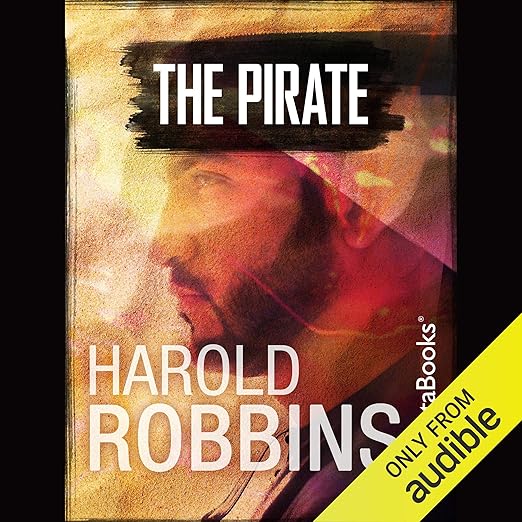
There is a specific pleasure in listening to Harold Robbins that criticism has never quite managed to account for honestly. He was dismissed for decades as a guilty-pleasure novelist, too commercial for serious consideration, too lurid for polite recommendation. And yet his best books, The Carpetbaggers, The Betsy, and arguably this one, The Pirate, have a structural ambition and a willingness to engage with the political and economic forces of their moment that much more critically approved fiction was too cautious to attempt. I listened to The Pirate over four evenings last winter, and while I was not surprised by its pleasures, I was surprised by its weight.
The setup is a sandstorm in the desert, which is the right kind of opening for a Harold Robbins novel: operatic and improbable and immediately involving. Two men, Samir Al Fay and Isaiah Ben Ezra, meet with their pregnant wives in extremis. Samir’s wife delivers a stillborn girl. Ben Ezra’s wife dies in childbirth delivering a healthy boy. Ben Ezra, transcending what any reasonable account of 1940s Jewish-Arab relations would suggest was possible, gives his son to Samir. Only these two men know. Samir names the boy Badyr, raises him as his own, and the son grows up to become the Pirate, one of the most powerful and wealthy Arabic entrepreneurs in the Middle East, educated in the West, more Western than Arabic in sensibility, and deeply distrustful of Jews.
The Secret That Drives Everything
The biblical architecture of this premise is not accidental. Robbins was working explicitly in the tradition of the Moses story, as one reviewer notes, and the structural parallel informs the book’s central tension: Badyr is a man who builds his identity on a foundation that is not what he thinks it is. His contempt for Jews, his deep investment in his perceived Arabic heritage, his relationships with women and with business rivals all orbit a center he cannot see. That kind of dramatic irony, where the reader knows something the protagonist does not, is a classical device, and Robbins uses it with genuine skill.
The political context is not decoration. Robbins wrote The Pirate against the backdrop of the 1970s oil crisis, the escalating Arab-Israeli conflict, and the rise of international terrorism as a geopolitical force. Badyr’s business empire sits at the intersection of Middle East oil money, Western financial interests, and the shadowy world of political violence that his resources make him a target for. That web of intrigue, the corruption and terrorism that threaten his empire, is handled with enough specificity to feel researched rather than invented, which is more than you might expect from a writer typically described as pulp.
The Women Who Hold His Fate
Robbins describes two women as having power over Badyr’s fate, which is the kind of framing that makes contemporary readers reasonably cautious. And it is true that the female characters in this novel, including the long-lost love and the woman obsessed with finding her missing father, are organized around their relationships to the male protagonist in ways that reflect the novel’s 1970s context. One reviewer found the novel’s frequent and gratuitous sex a drawback, and that observation is accurate: Robbins did not write subtle sexuality, and the erotic content in The Pirate is from an era when editors allowed considerably more of it to pass unexamined.
Within those limitations, however, the female characters have more agency than the framing suggests. The woman searching for her missing father is pursuing her own investigation with her own purposes, and her relationship to Badyr’s fate is structural rather than simply romantic. The long-lost love carries a history that shapes the ending’s emotional logic. Neither is a passive figure, even if both are organized by the novel’s primary interest in its male protagonist.
David Baker and the Eleven-Hour Listen
The Pirate runs eleven hours and twenty-two minutes, which is a substantial commitment, and Baker is the right reader for it. Harold Robbins’ prose moves quickly: long sentences that pile detail on detail, scenes that cut between settings in ways that require a narrator to maintain spatial clarity across considerable geographic range. Baker’s reading has the controlled energy that this kind of big popular novel needs. He does not slow down for the landscape passages or speed up unnecessarily for the action. The consistent pace is what allows the novel’s episodic structure, jumping decades and continents as Badyr’s life develops, to feel coherent rather than fragmented.
The novel was adapted as a CBS miniseries with a cast that included Anne Archer, Christopher Lee, Ian McShane, and Armand Assante, which tells you something about the scale of the material. That production is long unavailable in most markets, which makes the audiobook the most accessible form of the story for current listeners. Baker does not attempt to replicate a full-cast production, and does not need to: Robbins’ dialogue is written to carry character voice in prose, and Baker respects that rather than performing against it.
What Kind of Reader This Book Rewards
The Pirate is unambiguously a popular novel of its period, not a literary one. It traffics in melodrama, in outsized characters, in geopolitical scenarios that have the texture of research but the proportions of opera. If you come to it expecting something like contemporary literary fiction, you will find the wrong thing. If you come to it understanding the tradition it works in, the big mid-century American commercial novel that Robbins essentially invented, you will find something that has held up better than the genre’s reputation suggests.
The secret-identity structure is the book’s most durable element, because it is not merely a thriller device but a genuine meditation on the question of what it means to be something other than what you believe you are. That question was pressing in the 1970s Middle East and remains pressing now, which is why one reviewer called it as relevant today as the day it was written. The geopolitics have shifted. The human architecture has not.
Frequently Asked Questions
Is The Pirate a standalone novel or part of a series?
It is a standalone novel, not a sequel or continuation. Robbins’ other books, including The Carpetbaggers, share no characters with The Pirate, though they occupy the same universe of outsized mid-century ambition and commercial drama.
How does the book handle the Jewish-Arab identity conflict at its center?
With more nuance than you might expect from a 1970s commercial novel. The secret at the book’s heart, a Jewish man’s son raised as an Arab leader, forces Badyr to eventually confront a self-image built on a false premise. One reviewer describes it as a story about loving one another across lines of perceived enmity, which is a reasonable summary of the book’s moral architecture.
Is the sexual content in The Pirate likely to be a problem for most listeners?
It is present and sometimes described as gratuitous by reviewers. The book is a Harold Robbins novel, and Robbins wrote with the erotic license that publishers accepted in the 1970s without the restraint current mainstream fiction typically applies. Listeners who prefer no explicit content should be aware of this.
Does the CBS miniseries adaptation match the novel, and should I seek it out?
The miniseries is largely unavailable in current markets, making the audiobook the most accessible form of the story. The novel is the source material, and those who have seen the miniseries describe it as a reasonable adaptation, though condensed. The novel’s internal monologue and the full sweep of Badyr’s business dealings translate better in the book than they could in a television format.