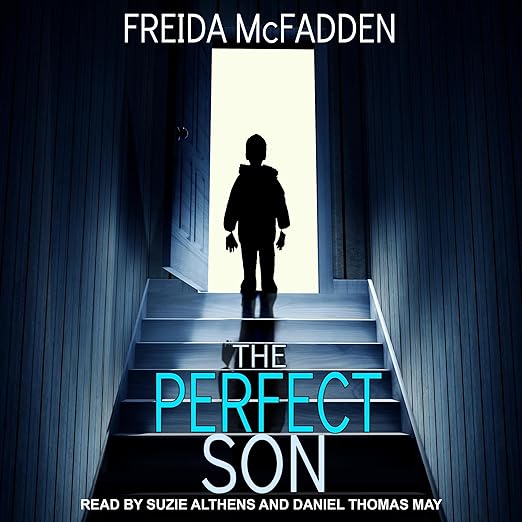
Quick Take
- Narration: Suzie Althens delivers a controlled, unsettled performance that matches the novel’s anxious maternal perspective without tipping into hysteria.
- Themes: Maternal blind spots, the horror of suburban normalcy, complicity and protection
- Mood: Tight and paranoid, moving at the brisk pace McFadden fans expect
- Verdict: A compact, efficiently constructed thriller with a twist that genuinely surprises, though devoted McFadden readers may find some beats familiar.
There is a particular reading experience that Freida McFadden has made her signature, an efficiently constructed psychological thriller that runs fast, keeps you turning pages, and delivers at least one twist that recontextualizes everything before it. The Perfect Son delivers all of that within under eight hours, which is roughly how long it took me to listen to it across a single long drive and the subsequent evening on my couch. By the time I reached the ending, I had been wrong about who the killer was twice, which is exactly the kind of experience this kind of book exists to provide.
The premise is cleanly suburban and immediately unsettling. Erika Cass presents herself as a woman with a perfect family, and the opening chapters give us enough glimpses of her inner life to understand that she has always sensed something wrong with her teenage son Liam. When two detectives arrive to ask questions about a disappeared neighbor girl, and Liam is named as the last person to see her alive, those premonitions crystallize into something much more specific and much more terrible.
Our Take on The Perfect Son
McFadden’s greatest skill is managing the reader’s suspicion across a small cast. The Perfect Son is not a sprawling thriller with dozens of suspects. It is a contained family drama where the horror comes from proximity, the discomfort of watching Erika rationalize, protect, and eventually confront what she has known at some level for years. One reviewer noted this was the first McFadden they were able to predict, and that is a fair warning. The broad shape of the story is not as obscured as it might be in some of her other novels. But the specific mechanics of the twist, and a second reveal that lands in the novel’s final pages, are less predictable than the setup might suggest.
The characterization of Erika is worth noting specifically. McFadden gives her a disturbing quality of preferential treatment toward Liam that borders on willful blindness, a partiality that readers may find infuriating before they find it explicable. That friction is intentional and structurally necessary, though it can make the early chapters uncomfortable in a way that is different from conventional thriller suspense.
Why Listen to The Perfect Son
Suzie Althens keeps the anxiety calibrated. Erika’s narration is written in a state of constant low-level dread punctuated by denial and rationalization, and Althens finds the right register for that psychological state, controlled enough to be believable as a functioning person, frayed enough that the listener never stops feeling the wrongness underneath. McFadden’s novels depend on readers staying inside their protagonists’ heads even when those protagonists are making terrible choices, and Althens makes that intimacy work in audio.
The runtime is also a genuine asset here. At just under eight hours, the audiobook does not have room for padding. McFadden uses every chapter purposefully, and in audio that compactness creates a sustained sense of unease that would be harder to achieve across a longer listen.
What to Watch For in The Perfect Son
This is not among McFadden’s most celebrated novels, and it is worth being honest about why. The domestic thriller framework is familiar territory for her, and The Perfect Son does not push at the boundaries of what she has done before. Reviewers who compared it to The Housemaid will find a book that operates on similar principles with somewhat less concentrated impact. It is a McFadden novel with McFadden’s strengths, but it is not the title that demonstrates her at maximum force.
The treatment of Erika’s younger daughter also feels underdeveloped. The daughter is present in the novel but does not receive the attention that would make her a fully realized character, which means the family dynamics read as slightly asymmetrical.
Who Should Listen to The Perfect Son
McFadden readers who want more of what she does well, at a compact and manageable runtime, will find this satisfying. Listeners new to psychological thrillers looking for a controlled, accessible entry point will also do well here. If you have read McFadden’s most popular titles and found them predictable, this one carries the same disclaimer. Skip this if you are looking for maximum complexity or an unconventional structure. This is McFadden doing what she does, efficiently and with a legitimately surprising central twist.
Frequently Asked Questions
How does The Perfect Son compare to Freida McFadden’s more celebrated titles like The Housemaid?
The Perfect Son operates on similar principles but with a smaller cast and a more contained setting. It lacks some of the escalating institutional horror of The Housemaid but compensates with a tighter domestic focus. Most McFadden readers find it satisfying rather than essential.
Does Suzie Althens capture the unreliable narrator quality that McFadden’s first-person thrillers require?
Yes. Althens plays Erika’s denial and rationalization with enough control that the listener stays inside her perspective even when her reasoning is obviously compromised. The performance keeps you from rejecting the narrator while never letting you fully trust her.
Is the twist in The Perfect Son genuinely surprising, or is it telegraphed for experienced thriller readers?
Mixed results among reviewers. Some found it predictable; others were genuinely blindsided. The primary reveal has a certain genre logic that attentive readers may anticipate, but a secondary revelation in the final pages catches most listeners off guard.
Does the novel resolve its central mystery completely, or does it leave questions open?
The mystery of what happened to the disappeared girl is fully resolved, as is the question of Liam’s guilt or innocence. McFadden provides definitive answers rather than ambiguity, which distinguishes the novel from more literary thrillers that prefer unresolved tension.