At a Glance
- Narration: J.S. Arquin has narrated this series long enough to know exactly how it breathes, his performance is most impressive in the battle sequences, where the LitRPG system details and action choreography converge.
- Themes: Escalating war and military strategy, progression system theory, the costs of prolonged conflict on individuals and institutions
- Mood: Dense, high-stakes, and action-forward, built for listeners already committed to the series
- Verdict: Exactly what eleven books of series investment earns you, C. Mantis delivers a volume that raises the stakes meaningfully while rewarding long-term readers without condescending to them.
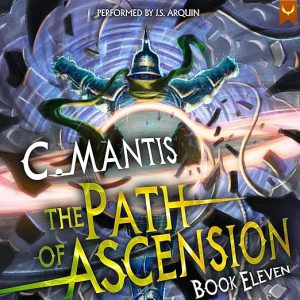
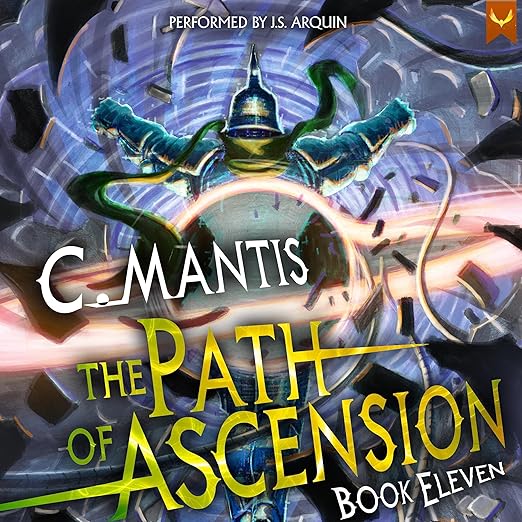
Book eleven of anything is a commitment. By the time you reach it, you have invested hundreds of hours with the same characters, the same magic system, the same internal logic of a world someone else built. The Path of Ascension 11 arrives at a point in the series where the children Matt, Liz, and Aster once were have become Ascenders carrying real weight in a war that has now lasted a century. I started this one on a Tuesday afternoon and came up for air somewhere around Thursday. That is a different kind of reading experience than a standalone novel, and C. Mantis earns it.
The premise for this entry is a war scenario pushed to a tipping point. Three Ascenders are fighting a three-against-two holding action against an Empire that has resources and systematic advantages, and even with the addition of allies Light and Shadow, they are barely keeping pace. Then their enemies make a decisive move of their own. The book is structurally about what happens when stalemate breaks, and about what the people inside a long conflict look like after a century of it.
Ten Volumes of Rules Avoid Power Creep
One of the consistent strengths of The Path of Ascension across its run is what C. Mantis describes as a logically and internally consistent magic and progression system. By book eleven, that system has had ten volumes to establish its rules, and Mantis uses that accumulated architecture to generate genuine tension in battles. When characters' abilities interact, the outcomes feel derivable from established principles rather than contrived for dramatic effect. One reviewer noted with appreciation that Mantis depicts the full range of power profiles across the cast, not just the main characters, and that the enemy and distant-tier powers feel believably distinct from those of Matt's team.
This is harder to execute than it sounds at book eleven. Many long-running progression fantasy series encounter what might be called power creep incoherence, where the escalating scale of abilities eventually detaches from the internal logic that made the early books satisfying. Mantis has avoided this by keeping the system's underlying rules stable even as the scale expands, and the result is that the stakes in book eleven feel higher without feeling arbitrary.
Hundred-Year War Adds Geopolitical Weight
The decision to set this volume explicitly in the context of a hundred-year conflict has thematic weight that reviewers who have followed the series from the beginning will feel most acutely. The characters who started as children navigating relatively small-scale challenges are now functioning within an institution of conflict that predates them and will likely outlast many of their choices. That institutional dimension gives book eleven a slightly different texture than earlier volumes, more strategic and geopolitically aware, while still delivering the action and character development readers are there for.
One reviewer expressed a specific frustration with the series' time scale, which is, as they put it, one hundred times greater than reasonable. This is a recurring structural tension in long-form Xianxia-influenced progression fantasy: the genre's internal logic tends toward vast timescales that can create emotional distance from individual events. Mantis manages this better than most, but the critique is legitimate and worth knowing going in.
Arquin Tracks Matt's Growth Across Eleven Books
The relationship between a narrator and a long-running series is one of the audiobook world's underappreciated collaborations. By book eleven, Arquin knows these characters' rhythms as well as any human being outside the author's head. His performance here is most assured in the battle sequences, where he has to track multiple simultaneous combatants with distinct ability sets and render the LitRPG system information at the same time as the physical choreography. That is genuinely difficult, and he does it without reducing either element.
His characterization of Matt across eleven books has tracked the character's growth from an uncertain beginner to a military-caliber Ascender, and that accumulated arc is audible in how Arquin reads him now. The voice carries a weight of experience that was not there in the early volumes, and that continuity of characterization is one of the genuine pleasures of staying with a series narrated by the same performer across its full run.
Not an Entry Point for New Listeners
This review is unlikely to be the entry point for new listeners, and Mantis does not write book eleven as if it might be. The narrative assumes you know the characters, the world's rules, and the political history of the conflict. Dropping in here without prior context would be like starting a chess match in the endgame: the positions make sense internally, but you have no idea how anyone got there.
For readers who are already in the series, book eleven delivers exactly what the investment earns: meaningful escalation, coherent system mechanics, and characters who have grown in ways that feel organic rather than forced. The decisive enemy move that drives the plot generates real uncertainty about outcomes, which is difficult to sustain at book eleven of anything. The fact that it works here says something about the quality of the foundation Mantis has built across the series.
How does book 11 handle the balance between LitRPG system content and actual narrative storytelling?
The series has always leaned toward the Xianxia interior-of-a-LitRPG structure Mantis describes, where the system information is integrated into character decision-making rather than delivered as stat-block exposition. By book eleven, that integration is mature, and the power profiles serve the story rather than interrupting it.
Does J.S. Arquin's narration handle the large cast and multiple ability systems clearly?
Yes. By this point in the series, Arquin's familiarity with the cast is evident in how cleanly he differentiates characters and renders the battle sequences. The LitRPG system details and physical action run concurrently without becoming confusing, which is a genuine technical accomplishment across twenty-three hours of material.