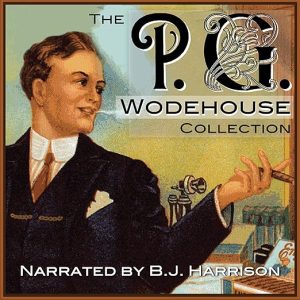
I came to Wodehouse embarrassingly late for someone with a literature degree, sometime in my early thirties, when a colleague handed me a battered copy of Right Ho, Jeeves with the instruction to read it immediately. I read it immediately. I have read it several times since. There is a particular quality to Wodehouse's comedy that resists explanation without demonstration: it is not the situations that are funny, exactly, though the situations are often absurd. It is the sentences. The way Bertie Wooster's narration describes a world in which everyone around him has far more sense than he does, while remaining genuinely fond of his own company. The way Jeeves solves problems in the background and delivers his solutions with a diffidence that functions as the most aristocratic possible form of condescension.
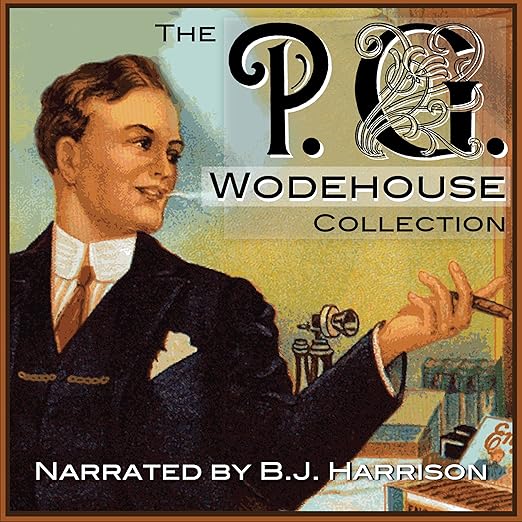
The P.G. Wodehouse Collection assembled by B.J. Harrison includes the complete Right Ho, Jeeves, seven hours of the full novel, plus thirteen shorter works: Leave It to Jeeves, Jeeves and the Unbidden Guest, The Aunt and the Sluggard, Death at the Excelsior, Jeeves and the Hard-Boiled Egg, Jeeves in the Springtime, The Man Upstairs, Jeeves and the Chump Cyril, Jeeves Takes Charge, Deep Waters, The Man Who Disliked Cats, Extricating Young Gussie (exclusive to this collection), and the pre-series story that planted the seeds for one of English literature's most beloved comic partnerships. The total runtime is fifteen hours and forty-two minutes, published in 2014 by B.J. Harrison's Classic Tales label.
How The P.G. Wodehouse Collection Holds Up
A reviewer described Wodehouse as the greatest humorist in the English language with the conviction of someone who had considered other candidates and dismissed them. That is perhaps generous to Wodehouse and unfair to other claimants, but it captures something real about the density and precision of the prose. Wodehouse invented phrases that have survived their originator, one reviewer cited the example of someone who was not disgruntled but was most certainly not gruntled, which is the kind of construction that embeds itself in memory on first encounter. The short story format, which dominates this collection by volume, suits his particular gifts. Each piece sets up a social predicament and resolves it through a combination of Jeeves's offscreen genius and Bertie's accidental contribution, with a consistency that would be formulaic in a lesser writer's hands and is instead deeply satisfying in Wodehouse's.
A reviewer recommended treating the collection like a box of chocolates: each piece terrifically entertaining, but too many at once can seem repetitive. That is honest and accurate advice. The Jeeves stories operate through a recognizable template, and bingeing them at pace dulls the pleasure that spacing them out preserves. The short story format actually makes this collection better suited to a commute listen than a novel might be, each piece is complete in itself, and the natural breaks prevent the formula from wearing before the next story begins.
Why The P.G. Wodehouse Collection Works as an Audiobook
Narrating Wodehouse requires understanding where the comedy lives. It is not in dramatic pauses or in the narrator winking at the listener. It is in the prose itself, and the narrator's job is to deliver that prose cleanly and trust it. Harrison understands this. His approach is restrained and well-paced, he reads with the quiet enjoyment of someone who finds Wodehouse genuinely funny but does not feel the need to explain the joke. The stories may be dated in their social setting, as one reviewer noted, but the humor still delivers, which Harrison's reading confirms rather than having to compensate for. Wodehouse's descriptions remain as funny on audio as they do in print, possibly more so, since the timing of the delivery is controlled rather than depending on the reader's internal pacing.
Right Ho, Jeeves is the correct centerpiece for a collection like this. It is the most developed single Wodehouse comedy in audio form, long enough to build real momentum through its accumulating catastrophes, with enough ensemble weight to show what Wodehouse could do when given extended runway. Bertie's increasingly desperate attempts to orchestrate the romantic affairs of his friends, each intervention making everything measurably worse, reaches a pitch of comic escalation in the final third that only a full novel can sustain. The shorter stories around it provide the variety the collection needs.
Weak Spots in The P.G. Wodehouse Collection
The collection's exclusive story, Extricating Young Gussie, deserves attention separately. It is one of Jeeves's earliest appearances, from a period when the character's role had not yet fully crystallized into the definitive manservant-genius we know from the later novels. Reading it alongside the more developed Jeeves stories gives a sense of how Wodehouse found his way toward the character's full form, the seeds are clearly present, but the dynamic is slightly more tentative than in his mature work. A reviewer who loved the Bertie and Jeeves stories described the collection as showing the seeds of that series, which is an accurate characterization: this is not just a greatest hits compilation but a portrait of a literary character in the process of becoming himself.
Who Should Listen to The P.G. Wodehouse Collection
Readers unfamiliar with British social comedy of the Edwardian and interwar periods will find some references opaque, though nothing essential to the humor depends on deep historical knowledge, the class comedy translates well enough across context. Listeners who require plot driven by external stakes will find Wodehouse's cheerful stakes-free world a mismatch. But for anyone who has ever enjoyed British comedy, class satire, or simply extremely well-crafted prose that makes you laugh in public without warning, this collection is a reliable pleasure. It is available as a free audiobook on Audible. One reviewer said Wodehouse has now become my favorite author. The fifteen hours here make a persuasive case for that outcome.
Good to Know
What is the Extricating Young Gussie story included in this collection?
It is a Jeeves short story exclusive to this B.J. Harrison collection, one of the early Jeeves appearances that predates the full novels. It is useful context for understanding where the character originated before Wodehouse fully developed the manservant-genius dynamic.
Is the P.G. Wodehouse Collection available as a free audiobook?
Yes, it is currently listed at $0.00 on Audible. At over 15 hours including the complete Right Ho, Jeeves and 13 additional stories, this free audiobook represents exceptional listening value for fans of British comedy.
Is B.J. Harrison's narration suited to Wodehouse's particular comic style?
Yes. Harrison reads with measured restraint and lets Wodehouse's prose generate the comedy rather than performing the humor for the listener. Multiple reviewers describe the collection as laugh-out-loud funny in audio form, which confirms that the narration serves rather than subverts the material.