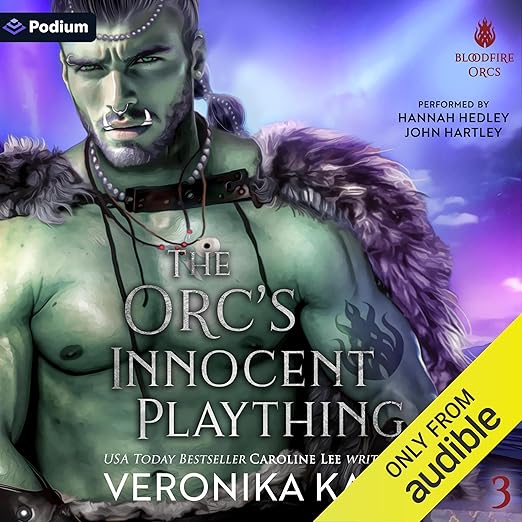
Quick Take
- Narration: Hannah Hedley gives Myra an appealing mix of Highland-inflected hesitancy and dry wit, making the fish-out-of-water dynamic land without tipping into parody.
- Themes: Intimacy bargains and reluctant attraction, cross-species world-building, found family in a transplanted community
- Mood: Steamy and playful, with genuine warmth underneath the spice
- Verdict: The third Bloodfire Orcs book delivers on its romantic promise without the third-act breakup that plagues so many entries in this subgenre, a genuine relief.
I will be honest about my relationship with romantasy audiobooks: I approach them with one calibrated expectation, which is that the genre promises heat and frequently delivers misunderstanding-driven frustration instead. So when I sat down with The Orc’s Innocent Plaything, the third book in Veronika Kane’s Bloodfire Orcs series, I was braced for the usual third-act collapse. It never came. That alone distinguishes this book from a significant portion of its competition.
The setup is exactly what the title promises: Myra, a midwife who crossed through magical stones to reach the orc village where her sister now lives, decides one ale-fueled evening to proposition Vartok, the clan’s acting chief and the most infuriating man she has encountered since arriving. He drives her absolutely mad, charming to everyone else, demanding and teasing with her specifically, and she has had enough of her inexperience being the subject of jokes. The bargain that results is the hinge on which the entire book turns, and Kane handles it with considerably more character work than the premise might suggest.
Our Take on The Orc’s Innocent Plaything
What makes this installment work, particularly compared to similar romantasy titles flooding the market, is that Kane respects both protagonists enough to give them genuine interior lives. Vartok is not simply a dominant green fantasy, he is shouldering real responsibility for a clan he loves, grieving a brother’s absence, and using his reputation for flirtatiousness as armor. Myra’s inexperience is treated as a character trait that generates real vulnerability rather than merely a plot mechanism for spicy scenes. The result is that when the relationship develops, it feels earned. One reader specifically noted that the misunderstanding tropes never became annoying, and I think that is because Kane moves through them decisively rather than dragging them out as padding.
The broader Bloodfire Orcs world also benefits from Kane’s restraint with exposition. The mechanics of how the stones work, what brought Myra’s sister to the orc village in the first book, and the political situation with Vartok’s missing elder brother are all present but never suffocate the central romance. Kane trusts the reader to fill in enough gaps to stay oriented, which is the mark of a writer who understands that over-explaining is the enemy of atmosphere.
Why Listen to The Orc’s Innocent Plaything
Hannah Hedley’s narration is a meaningful asset here. She manages the slightly formal, Highland-adjacent speech patterns of the orc world, the narrator’s internal monologue is peppered with phrases like “’twas” and “aye”, without making it feel like a Renaissance Faire affectation. Her vocal differentiation between Myra’s flustered hesitancy and Vartok’s assured, measured cadence gives the intimacy bargain scenes real tension. The audio format benefits this kind of material particularly well: pacing is everything in steamy romantasy, and Hedley understands that the space between words matters as much as the words themselves.
What to Watch For in The Orc’s Innocent Plaything
This is book three of a series, and while one reader confirmed it can be read as a standalone, the village dynamics and the relationship between Myra’s sister and her mate carry weight that is better understood with series context. New listeners should expect a moderate learning curve with character relationships in the first act. Some reviewers flagged the locations of certain steamy scenes as more public than they expected, apparently a feature of orc cultural norms in this world, which Kane addresses within the fiction rather than ignoring, but which may strike some listeners as incongruous. The romantic subplot involving Vartok’s family tensions adds texture but is not fully resolved in this volume.
Who Should Listen to The Orc’s Innocent Plaything
Listeners who love romantasy with genuine heat and actual character work, readers who have grown frustrated with the genre’s tendency to substitute sexual tension for emotional development, will find this a satisfying listen. If you have enjoyed Katee Robert’s Dark Olympus series or Grace Draven’s Radiance for combining romance with genuine world-building investment, Kane’s Bloodfire Orcs occupies a similar space. Skip it if explicit content is not your preference, or if monster romance as a premise does not appeal regardless of execution quality.
Frequently Asked Questions
Can The Orc’s Innocent Plaything be listened to without reading the first two Bloodfire Orcs books?
Yes, with caveats. One reader confirmed it works as a standalone, and the central romance is complete within this volume. However, the village community, Myra’s sister’s relationship, and some family dynamics with Vartok will carry more weight with series context. New listeners should expect some assumed familiarity.
How explicit is this audiobook, and does Hannah Hedley’s narration handle those scenes well?
It is explicitly adult content, multiple reviewers use words like steamy and spicy. Hedley handles intimate scenes with the same vocal confidence she brings to the rest of the narration, making them feel integrated rather than jarring. This is not a fade-to-black romance.
Does this book actually avoid the third-act breakup that frustrates so many romance audiobook listeners?
Yes. A reader review specifically flagged this as a highlight: no third-act breakup. The conflict and tension are maintained through other mechanisms, which makes the resolution feel earned rather than manufactured.
What makes the orc world-building in this series feel different from standard fantasy romance settings?
Kane uses a portal-fantasy structure, humans crossing stones into the orc world, that lets her explore cultural collision rather than just putting fantasy creatures in human social situations. The orc community has its own social codes, which the intimacy bargain plot exploits productively, and which Hedley conveys through the characters’ speech patterns and behavioral assumptions.